

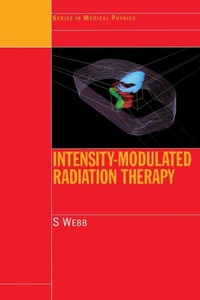
Intensity-Modulated Radiation Therapy
1st Edition
Published on 1. January 2001
Book
Paperback/Softback
454 pages
978-0-7503-0699-7 (ISBN)
Description
Clinical conformal radiotherapy is the holy grail of radiation treatment and is now becoming a reality through the combined efforts of physical scientists and engineers, who have improved the physical basis of radiotherapy, and the interest and concern of imaginative radiotherapists and radiographers.
Intensity-Modulated Radiation Therapy describes in detail the physics germane to the development of a particular form of clinical conformal radiotherapy called intensity modulated radiation therapy (IMRT). IMRT has become a topic of tremendous importance in recent years and is now being seriously investigated for its potential to improve the outcome of radiation therapy. The book collates the state-of-the-art literature together with the author's personal research experience and that of colleagues in the field to produce a text suitable for new research workers, Ph.D. students, and practicing radiation physicists that require a thorough introduction to IMRT. Fully illustrated, indexed, and referenced, the book has been prepared in a form suitable for supporting a teaching course.
Intensity-Modulated Radiation Therapy describes in detail the physics germane to the development of a particular form of clinical conformal radiotherapy called intensity modulated radiation therapy (IMRT). IMRT has become a topic of tremendous importance in recent years and is now being seriously investigated for its potential to improve the outcome of radiation therapy. The book collates the state-of-the-art literature together with the author's personal research experience and that of colleagues in the field to produce a text suitable for new research workers, Ph.D. students, and practicing radiation physicists that require a thorough introduction to IMRT. Fully illustrated, indexed, and referenced, the book has been prepared in a form suitable for supporting a teaching course.
Reviews / Votes
"It would be a very useful book for graduate students and researchers in many disciplines including medical physics, biomedical engineering, radiology, radiotherapy and clinical research. Intensity-Modulated Radiation Therapy is recommended for all health science libraries as well as science libraries."-E-STREAMS, Vol. 5, No. 12
More details
Series
Language
English
Place of publication
London
United Kingdom
Publishing group
Taylor & Francis Ltd
Target group
Professional and scholarly
Professional
Dimensions
Height: 234 mm
Width: 156 mm
Thickness: 24 mm
Weight
685 gr
ISBN-13
978-0-7503-0699-7 (9780750306997)
Copyright in bibliographic data and cover images is held by Nielsen Book Services Limited or by the publishers or by their respective licensors: all rights reserved.
Schweitzer Classification
Other editions
Additional editions
Person
Steve Webb, Professor of Radiological Physics, Head, Joint Department of Physics, Institute of Cancer Research and Royal Marsden NHS Trust, Sutton, Surrey, UK
Content
PREFACE 1 IMRT: GENERAL CONSIDERATIONS 1.1 Background to the development of IMRT 1.2 How many IMBs are needed and where should they be placed?-the use of compensators 2 ROTATION IMRT: TOMOTHERAPY 2.1 NOMOS MIMiC delivery 2.2 Developments in IMRT using the NOMOS equipment reported 2.3 The tomotherapy machine at the University of Wisconsin 2.4 Verification of IMRT by the NOMOS MIMiC and the Wisconsin machine 3 IMRT USING A MULTILEAF COLLIMATOR 3.1 IMB delivery using a multileaf collimator 3.2 Issues in delivering IMBs via the DMLC technique 3.3 Delivery of IMRT by the multiple-static-field technique 3.4 IMRT by scanned beams 3.5 Combined electron and photon IMRT 3.6 Summary 4 IMRT: CLINICAL IMPLEMENTATION AND ASSOCIATED ISSUES 4.1 Clinical applications of IMRT 4.2 IMRT and movement 4.3 Induced cancers from IMRT? 4.4 Verification of IMRT 4.5 Potential limitations for CFRT with IMRT 4.6 A look to the future-robotic IMRT? 4.7 Summary 5 3D PLANNING FOR CFRT INCLUDING IMRT 5.1 A philosophical note on the optimization (customization?) of treatments 5.2 PTV determination, fuzzy logic and adaptive radiation therapy 5.3 Multimodality imaging and therapy planning 5.4 Plan improvement-'conventional' CFRT, neural nets 5.5 Optimization of IMRT 5.6 Choice of optimization technique 5.7 Beam-orientation optimization 5.8 Organ motion and treatment outcome 5.9 Analysis of treatment plans 5.10 Automatic importance factors 5.11 Summary and a look to the future