

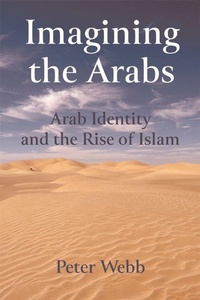
Imagining the Arabs
Arab Identity and the Rise of Islam
Published on 1. August 2017
Book
Paperback/Softback
416 pages
978-1-4744-2643-5 (ISBN)
Description
Who are the Arabs? When did people begin calling themselves Arabs? And what was the Arabs' role in the rise of Islam? Investigating these core questions about Arab identity and history by marshalling the widest array of Arabic sources employed hitherto, and by closely interpreting the evidence with theories of identity and ethnicity, Imagining the Arabs proposes new answers to the riddle of Arab origins and fundamental reinterpretations of early Islamic history.
This book reveals that the time-honoured stereotypes which depict Arabs as ancient Arabian Bedouin are entirely misleading because the essence of Arab identity was in fact devised by Muslims during the first centuries of Islam. Arab identity emerged and evolved as groups imagined new notions of community to suit the radically changing circumstances of life in the early Caliphate. The idea of 'the Arab' was a device which Muslims utilised to articulate their communal identity, to negotiate post-Conquest power relations, and to explain the rise of Islam. Over Islam's first four centuries, political elites, genealogists, poetry collectors, historians and grammarians all participated in a vibrant process of imagining and re-imagining Arab identity and history, and the sum of their works established a powerful tradition that influences Middle Eastern communities to the present day.
This book reveals that the time-honoured stereotypes which depict Arabs as ancient Arabian Bedouin are entirely misleading because the essence of Arab identity was in fact devised by Muslims during the first centuries of Islam. Arab identity emerged and evolved as groups imagined new notions of community to suit the radically changing circumstances of life in the early Caliphate. The idea of 'the Arab' was a device which Muslims utilised to articulate their communal identity, to negotiate post-Conquest power relations, and to explain the rise of Islam. Over Islam's first four centuries, political elites, genealogists, poetry collectors, historians and grammarians all participated in a vibrant process of imagining and re-imagining Arab identity and history, and the sum of their works established a powerful tradition that influences Middle Eastern communities to the present day.
Reviews / Votes
A wide-ranging and ambitious book. -- Philip Wood, Aga Khan University, Institute for the Study of Muslim Civilisations * Al-?U?ur al-Wus?a * A paradigm-shifting study...a rich and fascinating work, one that is destined to become a classic in the field.' -- Aaron W. Hughes, University of Rochester * American Journal of Islamic Social Sciences *More details
Language
English
Place of publication
Edinburgh
United Kingdom
Target group
College/higher education
Product notice
Paperback (trade)
Unsewn / adhesive bound
Dimensions
Height: 231 mm
Width: 154 mm
Thickness: 25 mm
Weight
623 gr
ISBN-13
978-1-4744-2643-5 (9781474426435)
Copyright in bibliographic data and cover images is held by Nielsen Book Services Limited or by the publishers or by their respective licensors: all rights reserved.
Schweitzer Classification
Other editions
Additional editions
E-Book
05/2016
1st Edition
Edinburgh University Press
€31.49
Available for download
E-Book
05/2016
1st Edition
Edinburgh University Press
€31.49
Available for download
Person
Peter Webb is University Lecturer in Arabic literature and culture at Leiden University.
Content
Acknowledgements; Note on the Text; Introduction; Part 1: The Rise of Arab Communities; 1. The Rise of Arab Communities; I. Arabs and pre-Islamic Textual Traditions; II. Arabs in Arabia: ethnogenesis, interpretations and problems; III. An Arabness pretence: pre-Islamic 'Arab'-cognates reconsidered; 2. Pre-Islamic 'Arabless-ness': Arabian Identities; I. The Arabic Language: a signpost to Arabness?; II. The search for Arabs in pre-Islamic poetry; III. Contextualising the 'Arabless' Poetry: ethnic boundaries in pre-Islamic Arabia; IV. The rise of 'Arab' poetry; V. Transition from 'Ma?add' to 'Arab': case study of Dhu Qar; VI. Pre-Islamic Arabian identity: conclusions; 3. Arabness from the Qur'an to an ethnos; I. 'Arab': an ethnonym resurrected?; II. The Qur'an and Arabness; III. Early Islam and the genesis of Arab identity; Part Two: The Changing Faces of Arabness in Early Islam; 4. Interpreting Arabs: defining their name and constructing their family; I. 'Arab' defined; II. Arabness and contested lineage; III. Arab genealogy reconsidered: kinship, gender and identity; IV. The creation of 'traditional' Arab genealogy; V. Defining Arabs: conclusions; 5. Arabs as a people and Arabness as an idea: 750-900 CE; I. Arabs in the early Abbasid Caliphate (132-193/750-809); II. Forging an Iraqi 'Arab Past'; III. al-Jahiliyya and imagining pre-Islamic Arabs; IV. Arabs and Arabia: changing relationships in the third/ninth century; 6. Philologists, 'Bedouinisation' and the 'Archetypal Arab' after the mid-third/ninth century; I. Philologists and Arabness: changing conceptions of Arabic between the late second/eighth and fourth/tenth centuries; II. The transformation of Arabness into Bedouin-ness; III. Bedouin Arabness and the emergence of a Jahiliyya archetype; IV. Conclusions; Imagining and Reimagining the Arabs: Conclusions; Bibliography.