


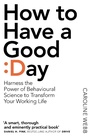
How To Have A Good Day
The Essential Toolkit for a Productive Day at Work and Beyond
Will be published approx. on 14. January 2027
Book
Paperback/Softback
368 pages
978-1-0374-2236-2 (ISBN)
Description
In How to Have a Good Day, economist and former McKinsey partner Caroline Webb shows readers how to use recent findings from behavioral economics, psychology, and neuroscience to transform our approach to everyday working life.
Advances in these behavioral sciences are giving us ever better understanding of how our brains work, why we make the choices we do, and what it takes for us to be smart and savvy. But it's not always been easy to see how to apply these insights in the workplace - until now.
In How to Have a Good Day, Webb explains how three big scientific ideas can help us be at our best every day. She shows us exactly how to apply this science to our plans, tasks and conversations, in step-by-step guidance that allows us to:
- Set better priorities
- Make the hours go further
- Turn every interaction into a success
- Strengthen our personal impact
- Be resilient in the face of setbacks
- Sustain our energy over the course of the day
Webb teaches us how to be at our best under pressure, and gives us specific tools to tackle common work challenges - from conflict with colleagues, to dull meetings and packed inboxes.
Filled with stories of people who have used Webb's insights to boost their job satisfaction and performance at work, How to Have a Good Day is the book so many people wanted when they finished Nudge, Blink and Thinking Fast and Slow, and were looking for practical ways to apply this fascinating science to their own lives and careers.
A remarkable and much needed book, How to Have a Good Day firmly delivers on its promise, showing us all how to have a lifetime of good days.
'Wise, fun and humane. The best behavioural self-help book by far. Everyone should read it.' - Cass R. Sunstein, co-author of Nudge
Advances in these behavioral sciences are giving us ever better understanding of how our brains work, why we make the choices we do, and what it takes for us to be smart and savvy. But it's not always been easy to see how to apply these insights in the workplace - until now.
In How to Have a Good Day, Webb explains how three big scientific ideas can help us be at our best every day. She shows us exactly how to apply this science to our plans, tasks and conversations, in step-by-step guidance that allows us to:
- Set better priorities
- Make the hours go further
- Turn every interaction into a success
- Strengthen our personal impact
- Be resilient in the face of setbacks
- Sustain our energy over the course of the day
Webb teaches us how to be at our best under pressure, and gives us specific tools to tackle common work challenges - from conflict with colleagues, to dull meetings and packed inboxes.
Filled with stories of people who have used Webb's insights to boost their job satisfaction and performance at work, How to Have a Good Day is the book so many people wanted when they finished Nudge, Blink and Thinking Fast and Slow, and were looking for practical ways to apply this fascinating science to their own lives and careers.
A remarkable and much needed book, How to Have a Good Day firmly delivers on its promise, showing us all how to have a lifetime of good days.
'Wise, fun and humane. The best behavioural self-help book by far. Everyone should read it.' - Cass R. Sunstein, co-author of Nudge
Reviews / Votes
How to Have a Good Day is an extraordinary book - a wonderful mix of science, practical advice, and stories based on Caroline Webb's years of experience helping a huge range of people transform their professional lives for the better. Every chapter is studded with engaging real-world examples that ring true and illustrate how to make the most of the book's suggestions. Whatever your personal definition of a good day, you'll have more of them after reading this book. -- Susan Cain, author of <i>QUIET: The Power of Introverts in a World That Can't Stop Talking </i> How to Have a Good Day is a smart, thorough, and eminently practical book. Just about every page offers a science-based tip to help you become better off - or, in many cases, just plain better. -- Daniel H. Pink, author of <i>To Sell is Human</i> and <i>Drive</i> Finally, a practical book based on evidence. How to Have a Good Day is grounded in state-of-the-art research on behavior and neuroscience, and animated with vivid examples from professionals who have successfully applied Webb's advice. It might even leave you looking forward to your next tricky conversation or challenging task as an opportunity to try out her tips. -- Adam Grant, Wharton professor and <i>New York Times</i> bestselling author of <i>Give and Take</i> and <i>Originals</i> Webb has given us a great gift: she has synthesized all the advice coming out of labs around the world, filtered it for quality, and illustrated it with well-chosen examples. The appendices alone will save you dozens of hours per year - particularly on email - and help you create more great days for yourself. This is the only self-improvement book you will need in the next five years. -- Jonathan Haidt, NYU-Stern School of Business, Author of <i>The Happiness Hypothesis</i>, and <i>The Righteous Mind</i>More details
Language
English
Place of publication
London
United Kingdom
Publishing group
Pan Macmillan
Target group
Interest Age: From 18 years
Product notice
Paperback (UK-B)
Dimensions
Height: 197 mm
Width: 130 mm
ISBN-13
978-1-0374-2236-2 (9781037422362)
Copyright in bibliographic data is held by Nielsen Book Services Limited or its licensors: all rights reserved.
Schweitzer Classification
Other editions
Additional editions
E-Book
01/2016
Macmillan
€18.49
Available for download
Person
Caroline Webb is a management consultant and executive coach who has spent fifteen years at McKinsey and at her own firm, Sevenshift, showing clients how to use behavioral science to boost their professional effectiveness. An Oxford and Cambridge trained economist, Webb and her work has been featured in the Financial Times, New York Times, Washington Post, The Economist, Forbes, and the BBC.
Content
Introduction - i: INTRODUCTION Section - ii: THE SCIENCE ESSENTIALS Section - iii: THE TWO-SYSTEM BRAIN Section - iv: THE DISCOVER-DEFEND AXIS Section - v: THE MIND-BODY LOOP Unit - 1: PART I: PRIORITIES Setting Intentional Direction for Your Day Chapter - 1: ONE: Choosing Your Filters Chapter - 2: TWO: Setting Great Goals Chapter - 3: THREE: Reinforcing Your Intentions Unit - 2: PART II: PRODUCTIVITY Making the Hours in the Day Go Further Chapter - 4: FOUR: Singletasking Chapter - 5: FIVE: Planning Deliberate Downtime Chapter - 6: SIX: Overcoming Overload Chapter - 7: SEVEN: Beating Procrastination Unit - 3: PART III: RELATIONSHIPS Making the Most of Every Interaction Chapter - 8: EIGHT: Building Real Rapport Chapter - 9: NINE: Resolving Tensions Chapter - 10: TEN: Bringing the Best Out of Others Unit - 4: PART IV: THINKING Being Your Smartest, Wisest, Most Creative Self Chapter - 11: ELEVEN: Reaching Insight Chapter - 12: TWELVE: Making Wise Decisions Chapter - 13: THIRTEEN: Boosting Your Brainpower Unit - 5: PART V: INFLUENCE Maximizing the Impact of All You Say and Do Chapter - 14: FOURTEEN: Getting Through Their Filters Chapter - 15: FIFTEEN: Making Things Happen Chapter - 16: SIXTEEN: Conveying Confidence Unit - 6: PART VI: RESILIENCE Sailing Through Setbacks and Annoyances Chapter - 17: SEVENTEEN: Keeping a Cool Head Chapter - 18: EIGHTEEN: Moving On Chapter - 19: NINETEEN: Staying Strong Unit - 7: PART VII: ENERGY Boosting Your Enthusiasm and Enjoyment Chapter - 20: TWENTY: Topping Up the Tank Chapter - 21: TWENTY-ONE: Playing to Your Strengths Section - vi: POSTSCRIPT: MAKING IT STICK Section - vii: APPENDIX A: How to Be Good at Meetings Section - viii: APPENDIX B: How to Be Good at Email Section - ix: APPENDIX C: How to Reinvigorate Your Routine Section - x: SUGGESTED FURTHER READING Section - xi: GLOSSARY Acknowledgements - xii: ACKNOWLEDGMENTS Section - xiii: NOTES Index - xiv: INDEX