

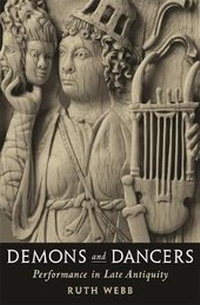
Demons and Dancers
Performance in Late Antiquity
Published on 1. January 2009
Book
Hardback
318 pages
978-0-674-03192-0 (ISBN)
Description
Compared to the wealth of information available to us about classical tragedy and comedy, not much is known about the culture of pantomime, mime, and dance in late antiquity. Charges of obscenity and polemical anti-theater discourse have, at times, erased these popular performance traditions from the modern imagination. Demons and Dancers returns us to the times and places where those great ancient theaters were more than picturesque ruins dotting the Mediterranean landscape.
Ruth Webb fills this gap in our knowledge of the ancient world and provides us with a richly detailed look at social life in the late antique period through an investigation of its performance culture. The book focuses on the eastern empire, from Greece proper to modern-day Turkey and Egypt, between the second and sixth centuries CE. Using some of the tools provided by modern performance theory, this book explains how audiences interpreted the actions on stage, how the status of male and female performers shifted across time and place, how skilled the actors actually were (it was commonplace to dismiss these performers for their lack of skill), and what role spectacles involving spoken and sung words, as well as stylized gestures, had in Greco-Roman civic life.
Ruth Webb fills this gap in our knowledge of the ancient world and provides us with a richly detailed look at social life in the late antique period through an investigation of its performance culture. The book focuses on the eastern empire, from Greece proper to modern-day Turkey and Egypt, between the second and sixth centuries CE. Using some of the tools provided by modern performance theory, this book explains how audiences interpreted the actions on stage, how the status of male and female performers shifted across time and place, how skilled the actors actually were (it was commonplace to dismiss these performers for their lack of skill), and what role spectacles involving spoken and sung words, as well as stylized gestures, had in Greco-Roman civic life.
Reviews / Votes
Outstanding. -- Denis Feeney * Times Literary Supplement * One of the most visible remains a tourist finds in the ruined cities of the Roman Empire is a stone-built theater with a huge seating capacity, and he may wonder what productions were staged there that attracted such great audiences; gladiatorial combats, sometimes, and even wild beast fights in the eastern empire, where cities generally lacked amphitheaters, But the specialty of the theater was mime and pantomime, with music and dancing, Much of the evidence belongs to late antiquity, the general neglect of which makes this book all the more important. Mimes were skits with both male and female entertainers, and pantomimes were generally men, whose dancing interpreted a story that might be recited or sung by a performer accompanied by musicians, Webb describes the production companies, the place of theater in society, and the art of the pantomime, a dancer who could impersonate a man or a woman as the story required. Dancers could be enormously popular, but society ranked them low on the social scale, and the church considered the theater a haunt of the devil. Webb fills a gap in theater history with this fine book. -- J. A. S. Evans * Choice * Pantomime-dances which told stories-fired the imagination of the ancient world. In the Roman Empire, dancers were superstar entertainers who wildly excited the audience with their brilliantly expressive and worryingly sexy performances. And as the Roman Empire moved into the Christian Empire, the full force of moral disapproval was brought to bear on the physical display of the dancing body. Demons and Dancers is a superb introduction to this extraordinary story. -- Simon Goldhill, author of <i>Jerusalem: City of Longing</i>More details
Language
English
Place of publication
Cambridge, Mass
United States
Target group
College/higher education
Illustrations
11 halftones on 10 p. mock insert
Dimensions
Height: 235 mm
Width: 156 mm
ISBN-13
978-0-674-03192-0 (9780674031920)
Copyright in bibliographic data and cover images is held by Nielsen Book Services Limited or by the publishers or by their respective licensors: all rights reserved.
Schweitzer Classification
Person
Ruth Webb is Honorary Research Fellow, Birkbeck College London, and Professeur Associee, Universite Paris 10.
Content
* Preface * Introduction * Theater and Society * Performers * Pantomime: The Dancing Body * The Pantomime as Drama: Dancers, Audiences, and the Communicative Body * Mime: The Drama of Everyday Life * Mime, Humor, and Society * Images of Actors: Identification and Estrangement * Ideas of the Audience: Possession and the Eye * Christians and the Theater * Conclusion * Epilogue * Abbreviations * Biographical and Bibliographical Notes on the Principal Ancient Sources * Notes * Index