

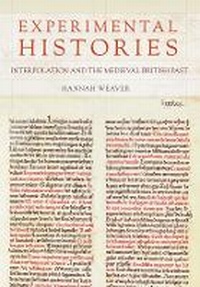
Experimental Histories
Interpolation and the Medieval British Past
Published on 15. August 2024
Book
Hardback
246 pages
978-1-5017-7620-5 (ISBN)
Description
In Experimental Histories, Hannah Weaver examines the medieval practice of interpolation-inserting material from one text into another-which is often categorized as being a problematic, inauthentic phenomenon akin to forgery and pseudepigraphy. Instead, Weaver promotes interpolation as the signature form of medieval British historiography and a vehicle of historical theory, arguing that some of the most novel concepts of time in medieval historiography can be found in these altered narratives of the past.
For Weaver, historiographical interpolation constitutes the traces of active experimentation with how best to write history, particularly the history of Britain. Historians in twelfth- and thirteenth-century Britain recognized the difficulty of enfolding complex events into a linear chronology and embraced innovative textual methods of creating history. Focusing on the Brut tradition but also analyzing the long history of interpolated historiography, including the Bayeux Embroidery, Experimental Histories offers a new interpretation of generic remixing in medieval writing about the past. Drawing on both manuscript studies and the new formalism, it shows that the practice of inserting materials from romance and hagiography allowed creative revisers to explore how lived events relate to passing time. By embracing interpolation, Weaver provides lively insights into the ways that time becomes history and human actors experience time.
For Weaver, historiographical interpolation constitutes the traces of active experimentation with how best to write history, particularly the history of Britain. Historians in twelfth- and thirteenth-century Britain recognized the difficulty of enfolding complex events into a linear chronology and embraced innovative textual methods of creating history. Focusing on the Brut tradition but also analyzing the long history of interpolated historiography, including the Bayeux Embroidery, Experimental Histories offers a new interpretation of generic remixing in medieval writing about the past. Drawing on both manuscript studies and the new formalism, it shows that the practice of inserting materials from romance and hagiography allowed creative revisers to explore how lived events relate to passing time. By embracing interpolation, Weaver provides lively insights into the ways that time becomes history and human actors experience time.
Reviews / Votes
Despite interpolation's uneven fortunes in our modern world, Weaver's own interpolation into existing scholarship on the Brut tradition will certainly be cited frequently in future literary studies of medieval chronicles. * Modern Philology *More details
Language
English
Place of publication
Ithaca
United States
Target group
College/higher education
Product notice
Paper over boards
Illustrations
21 color halftones - 21 Halftones, color
Dimensions
Height: 229 mm
Width: 152 mm
Weight
907 gr
ISBN-13
978-1-5017-7620-5 (9781501776205)
Copyright in bibliographic data and cover images is held by Nielsen Book Services Limited or by the publishers or by their respective licensors: all rights reserved.
Schweitzer Classification
Other editions
Additional editions
E-Book
08/2024
Cornell University Press
€34.99
Available for download
Person
Hannah Weaver is Assistant Professor of English and Comparative Literature at Columbia University. She is the coeditor of a special issue of the Medieval Globe titled Medieval Re-Creation.
Content
Introduction: Interpolation and the Patchwork of History
1. The Rise of Historical Interpolation from Antiquity to Geoffrey of Monmouth
2. Prophecy and the Prudent Reader
4. Finding Fulfillment in the Roman de Brut
5. Images and Collapse in the Bayeux Embroidery and the Egerton Brut
The Afterlives of Interpolation and Timefulness
1. The Rise of Historical Interpolation from Antiquity to Geoffrey of Monmouth
2. Prophecy and the Prudent Reader
4. Finding Fulfillment in the Roman de Brut
5. Images and Collapse in the Bayeux Embroidery and the Egerton Brut
The Afterlives of Interpolation and Timefulness