

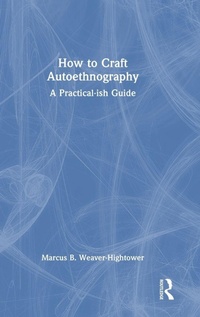
How to Craft Autoethnography
A Practical-ish Guide
1st Edition
Published on 10. October 2025
Book
Hardback
334 pages
978-1-032-59980-9 (ISBN)
Description
How to Craft Autoethnography is a comprehensive and engaging guide to the art and science of autoethnography, a qualitative research method that blends personal narrative with cultural analysis. Designed to be both practical and theoretically grounded, the book offers a structured yet flexible approach to developing "good" autoethnographic research.
Throughout the book, Weaver-Hightower addresses the essential components of autoethnographic research, including when to use (or not use) the method, how to generate and analyze data, and how to assess quality and ethics in an autoethnography. The book carefully explores different forms of autoethnography-evocative, analytic, critical, and arts-based-providing readers with concrete examples and exemplars. Practical chapters detail strategies for planning studies, generating data through self-reflection and memory work, engaging with social theory, and writing in ways that resonate with readers both inside and outside academia.
This book provides an indispensable resource for students, scholars, and practitioners seeking to deepen their understanding of autoethnography and to use it effectively in their research. The book also includes a range of pedagogical features, such as learning objectives, exercises, and exemplars, to support readers in developing their own autoethnographic projects.
Throughout the book, Weaver-Hightower addresses the essential components of autoethnographic research, including when to use (or not use) the method, how to generate and analyze data, and how to assess quality and ethics in an autoethnography. The book carefully explores different forms of autoethnography-evocative, analytic, critical, and arts-based-providing readers with concrete examples and exemplars. Practical chapters detail strategies for planning studies, generating data through self-reflection and memory work, engaging with social theory, and writing in ways that resonate with readers both inside and outside academia.
This book provides an indispensable resource for students, scholars, and practitioners seeking to deepen their understanding of autoethnography and to use it effectively in their research. The book also includes a range of pedagogical features, such as learning objectives, exercises, and exemplars, to support readers in developing their own autoethnographic projects.
More details
Language
English
Place of publication
London
United Kingdom
Publishing group
Taylor & Francis Ltd
Target group
College/higher education
Postgraduate and Undergraduate Advanced
Illustrations
10 s/w Abbildungen, 2 s/w Photographien bzw. Rasterbilder, 8 s/w Zeichnungen, 8 s/w Tabellen
8 Tables, black and white; 8 Line drawings, black and white; 2 Halftones, black and white; 10 Illustrations, black and white
Dimensions
Height: 240 mm
Width: 161 mm
Thickness: 23 mm
Weight
675 gr
ISBN-13
978-1-032-59980-9 (9781032599809)
Copyright in bibliographic data and cover images is held by Nielsen Book Services Limited or by the publishers or by their respective licensors: all rights reserved.
Schweitzer Classification
Other editions
Additional editions
E-Book
10/2025
1st Edition
Routledge
€60.49
Available for download

Book
10/2025
1st Edition
Routledge
€68.40
Shipment within 10-20 days
E-Book
10/2025
1st Edition
Routledge
€60.49
Available for download
Person
Marcus B. Weaver-Hightower is Professor and leader of the Foundations of Education program at Virginia Tech (Blacksburg, Virginia, USA). He has written award-winning qualitative research on gender, education, food policy, and qualitative methods, and he has guided scores of students through successful qualitative dissertations.
Content
List of Figures and Tables
Acknowledgments
A Note on Pedagogical Features
Preface: My Relationship With Autoethnography
Chapter 1: Introducing Autoethnography
Chapter 2: When to Use or Not Use Autoethnography
Chapter 3: What Makes for "Good" Autoethnography? Ethics and Quality
Chapter 4: Planning, Proposing, and Preparing for Your Autoethnography
Chapter 5: Generating "Data" for Your Autoethnography
Chapter 6: Transforming Your Autoethnographic Data
Chapter 7: Writing and Representing Your Autoethnography
Appendices: Autoethnographic Examples
A. "Waltzing Matilda: An Autoethnography of a Father's Stillbirth" by Marcus B. Weaver-Hightower
B. "A Dating App Autoethnography: Presenting Myself as a Researcher and User" by Janelle Ward
C. "Invisible Borders: On Being a Ghanaian Immigrant in the United States" by Abigail Amoako Kayser
Acknowledgments
A Note on Pedagogical Features
Preface: My Relationship With Autoethnography
Chapter 1: Introducing Autoethnography
Chapter 2: When to Use or Not Use Autoethnography
Chapter 3: What Makes for "Good" Autoethnography? Ethics and Quality
Chapter 4: Planning, Proposing, and Preparing for Your Autoethnography
Chapter 5: Generating "Data" for Your Autoethnography
Chapter 6: Transforming Your Autoethnographic Data
Chapter 7: Writing and Representing Your Autoethnography
Appendices: Autoethnographic Examples
A. "Waltzing Matilda: An Autoethnography of a Father's Stillbirth" by Marcus B. Weaver-Hightower
B. "A Dating App Autoethnography: Presenting Myself as a Researcher and User" by Janelle Ward
C. "Invisible Borders: On Being a Ghanaian Immigrant in the United States" by Abigail Amoako Kayser