

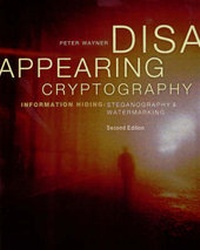
Disappearing Cryptography
Information Hiding: Steganography Watermarking
2nd Edition
Published on 29. April 2002
Book
Paperback/Softback
413 pages
978-1-55860-769-9 (ISBN)
Description
"Disappearing Cryptography, Second Edition" describes how to take words, sounds, or images and hide them in digital data so they look like other words, sounds, or images. When used properly, this powerful technique makes it almost impossible to trace the author and the recipient of a message. Conversations can be submerged in the flow of information through the Internet so that no one can know if a conversation exists at all. This full revision of the best-selling first edition describes a number of different techniques to hide information. These include encryption, making data incomprehensible; steganography, embedding information into video, audio, or graphics files; watermarking, hiding data in the noise of image or sound files; mimicry, "dressing up" data and making it appear to be other data, and more. The second edition also includes an expanded discussion on hiding information with spread-spectrum algorithms, shuffling tricks, and synthetic worlds.Each chapter is divided into sections, first providing an introduction and high-level summary for those who want to understand the concepts without wading through technical explanations, and then presenting greater detail for those who want to write their own programs.
To encourage exploration, the author's Web site contains implementations for hiding information in lists, sentences, and images. Each chapter is divided into sections, providing first an introduction and high-level summary for those who want to understand the concepts without wading through technical details, and then an introductory set of details, for those who want to write their own programs. Fully revised and expanded, this book covers key concepts for non-technical readers. It goes into technical details for those wanting to create their own programs and implement algorithms. It features an up-to-date website containing the code samples from the book.
To encourage exploration, the author's Web site contains implementations for hiding information in lists, sentences, and images. Each chapter is divided into sections, providing first an introduction and high-level summary for those who want to understand the concepts without wading through technical details, and then an introductory set of details, for those who want to write their own programs. Fully revised and expanded, this book covers key concepts for non-technical readers. It goes into technical details for those wanting to create their own programs and implement algorithms. It features an up-to-date website containing the code samples from the book.
Reviews / Votes
"Disappearing Cryptography is a witty and entertaining look at the world of information hiding. Peter Wayner provides an intuitive perspective of the many techniques, applications, and research directions in the area of steganography. The sheer breadth of topics is outstanding and makes this book truly unique. A must read for those who would like to begin learning about information hiding." -Deepa Kundur, University of TorontoMore details
Series
Edition
2nd Revised edition
Language
English
Place of publication
San Francisco
United States
Publishing group
Elsevier Science & Technology
Target group
Professional and scholarly
Edition type
Revised edition
Dimensions
Height: 235 mm
Width: 187 mm
Weight
747 gr
ISBN-13
978-1-55860-769-9 (9781558607699)
Copyright in bibliographic data and cover images is held by Nielsen Book Services Limited or by the publishers or by their respective licensors: all rights reserved.
Schweitzer Classification
Other editions
Additional editions
E-Book
05/2002
2nd Edition
Morgan Kaufmann
€50.95
Available for download
Previous edition

Book
01/1996
Academic Press
€30.89
Article exhausted; check for reprint
Person
Peter Wayner is a writer living in Baltimore and is the author of Digital Cash and Agents at Large (both Academic Press). His writings appear in numerous academic journals as well as the pages of more popular forums such as MacWorld and the New York Times. He has taught various computer science courses at Cornell University and Georgetown University.
Content
Preface. Framing Information. Encryption. Error Correction. Secret Sharing. Compression. Basic Mimicry. Grammars and Mimicry. Turing and Reverse. Life in the Noise. Anonymous Remailers. Secret Broadcasts. Keys. Ordering and Reordering. Spreading. Synthetic Worlds. Watermarks. Steganalysis. Afterword. Appendix A Java Mimic Code. Appendix B Baseball CFG. Appendix C Reversible Grammar Generator. Appendix D Software. Further Readings. Bibliography. Index