

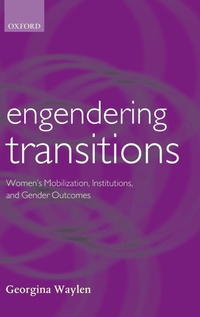
Engendering Transitions
Women's Mobilization, Institutions and Gender Outcomes
Published on 24. May 2007
Book
Hardback
256 pages
978-0-19-924803-2 (ISBN)
Description
What has been the impact of transitions to democracy on gender relations? What roles have women's mobilizations played in processes of democratization? In a new and over-arching thematic analysis, Engendering Transitions answers these questions by comparing the transitions from state socialism and authoritarianism that took place as part of the 'third wave' of democratization that swept the world from the mid 1970s onwards.
Using empirical material drawn from eight case study countries in East Central Europe and Latin America as well as South Africa, Georgina Waylen explores the gendered constraints and opportunities provided by processes of democratization and economic restructuring. This book uses a sophisticated analytical framework that brings together the analysis of key actors and institutions and shows that, under certain conditions, transitions to democracy can result in some positive gender outcomes such as improvements in women's political representation and more 'gender sensitive' policy in areas such as domestic violence.
Georgina Waylen argues that women's mobilization during transitions is no guarantee of success and change is easier to achieve in some areas than others. Understanding the roles that can be played by organized women's movements, key actors and the wider political environment is crucial in helping us to explain why these gender outcomes vary in different contexts. This book addresses important debates within the study of both comparative politics and gender and politics and substantially improves our understanding of the ways in which transitions to democracy are gendered.
Using empirical material drawn from eight case study countries in East Central Europe and Latin America as well as South Africa, Georgina Waylen explores the gendered constraints and opportunities provided by processes of democratization and economic restructuring. This book uses a sophisticated analytical framework that brings together the analysis of key actors and institutions and shows that, under certain conditions, transitions to democracy can result in some positive gender outcomes such as improvements in women's political representation and more 'gender sensitive' policy in areas such as domestic violence.
Georgina Waylen argues that women's mobilization during transitions is no guarantee of success and change is easier to achieve in some areas than others. Understanding the roles that can be played by organized women's movements, key actors and the wider political environment is crucial in helping us to explain why these gender outcomes vary in different contexts. This book addresses important debates within the study of both comparative politics and gender and politics and substantially improves our understanding of the ways in which transitions to democracy are gendered.
More details
Series
Language
English
Place of publication
Oxford
United Kingdom
Target group
Professional and scholarly
Dimensions
Height: 240 mm
Width: 161 mm
Thickness: 18 mm
Weight
552 gr
ISBN-13
978-0-19-924803-2 (9780199248032)
Copyright in bibliographic data and cover images is held by Nielsen Book Services Limited or by the publishers or by their respective licensors: all rights reserved.
Schweitzer Classification
Other editions
Additional editions
Book
05/2007
Oxford University Press
€60.00
Shipment within 15-20 days
Person
Georgina Waylen is Reader in Politics at the University of Sheffield, UK. She has researched and written extensively on gender and transitions to democracy for over fifteen years. Her articles on this theme have been published in a range of journals including World Politics, Journal of Latin American Studies, Democratization, Third World Quarterly and Comparative Political Studies. She is also the author of Gender in Third Politics (1996) and the co-editor of Gender, Politics and the State (1998) and Towards a Gendered Political Economy (2000).
Content
PART ONE: ANALYSING GENDER AND TRANSITIONS ; PART TWO: WOMEN'S ORGANIZING ; PART THREE: THE ELECTORAL ARENA ; PART FOUR: THE STATE AND POLICY OUTCOMES