

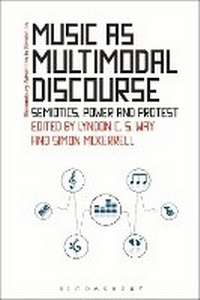
Music as Multimodal Discourse
Semiotics, Power and Protest
Published on 26. July 2018
Book
Paperback/Softback
256 pages
978-1-350-07986-1 (ISBN)
Description
We communicate multimodally. Everyday communication involves not only words, but gestures, images, videos, sounds and of course, music. Music has traditionally been viewed as a separate object that we can isolate, discuss, perform and listen to. However, much of music's power lies in its use as multimodal communication. It is not just lyrics which lend songs their meaning, but images and musical sounds as well. The music industry, governments and artists have always relied on posters, films and album covers to enhance music's semiotic meaning.
Music as Multimodal Discourse: Semiotics, Power and Protest considers musical sound as multimodal communication, examining the interacting meaning potential of sonic aspects such as rhythm, instrumentation, pitch, tonality, melody and their interrelationships with text, image and other modes, drawing upon, and extending the conceptual territory of social semiotics. In so doing, this book brings together research from scholars to explore questions around how we communicate through musical discourse, and in the discourses of music. Methods in this collection are drawn from Critical Discourse Analysis, Social Semiotics and Music Studies to expose both the function and semiotic potential of the various modes used in songs and other musical texts. These analyses reveal how each mode works in various contexts from around the world often articulating counter-hegemonic and subversive discourses of identity and belonging.
Music as Multimodal Discourse: Semiotics, Power and Protest considers musical sound as multimodal communication, examining the interacting meaning potential of sonic aspects such as rhythm, instrumentation, pitch, tonality, melody and their interrelationships with text, image and other modes, drawing upon, and extending the conceptual territory of social semiotics. In so doing, this book brings together research from scholars to explore questions around how we communicate through musical discourse, and in the discourses of music. Methods in this collection are drawn from Critical Discourse Analysis, Social Semiotics and Music Studies to expose both the function and semiotic potential of the various modes used in songs and other musical texts. These analyses reveal how each mode works in various contexts from around the world often articulating counter-hegemonic and subversive discourses of identity and belonging.
Reviews / Votes
This volume offers a useful collection of studies ... Individual case studies are skilfully drawn and very thought-provoking. * IASPM@Journal * Music As Multimodal Discourse takes the reader through a fascinating journey in the multimodal dimension of music as discourse, through its material and ideological purport and through its incredible power of integration with other models of discourse. It is a reading that addresses academic boundaries that have no more reason to exist. * CADAAD * A very thought-provoking collection of essays. * Punctum: International Journal of Semiotics * Music as Multimodal Discourse is an essential volume for scholars seeking to understand and analyse the role of music in ways that uncover its critical potential for social change. All too often music is analysed as a "merely" aesthetic, emotive, or abstractly cultural phenomenon. This valuable collection understands music as a primary motivating element in political and historical struggles for power, and as forms of discourse that are often opaque precisely because they are so elemental and ubiquitous. * Philip Graham, Professor of Music, Queensland University of Technology, Australia *More details
Series
Language
English
Place of publication
London
United Kingdom
Publishing group
Bloomsbury Publishing PLC
Target group
College/higher education
Dimensions
Height: 234 mm
Width: 156 mm
Weight
358 gr
ISBN-13
978-1-350-07986-1 (9781350079861)
Copyright in bibliographic data and cover images is held by Nielsen Book Services Limited or by the publishers or by their respective licensors: all rights reserved.
Schweitzer Classification
Other editions
Additional editions
E-Book
01/2017
1st Edition
Bloomsbury Academic
€39.99
Available for download
E-Book
01/2017
1st Edition
Bloomsbury Academic
€39.99
Available for download
Persons
Lyndon C. S. Way is Associate Professor of media and communications at Izmir University of Economics, Turkey
Simon McKerrell is Senior Lecturer & Head of Music at Newcastle University, UK
Simon McKerrell is Senior Lecturer & Head of Music at Newcastle University, UK
Content
List of Figures
List of Tables
List of Contributors
Preface
Acknowledgements
1. Understanding Music as Multimodal Discourse, Simon McKerrell (Newcastle University, UK) and Lyndon C. S. Way (Izmir University of Economics, Turkey)
2. The Role of Music in Ridiculing the Working Classes in Reality Television, Goeran Eriksson and David Machin (OErebro University, Sweden)
3. 'Shame Makes the World Go Around': Performed and Embodied (Gendered) Class Disgust in Morrissey's 'Slum Mums', Aileen Dillane, Martin J. Power and Eoin Devereux (University of Limerick, Ireland)
4. Recontextualization and Fascist Music, John E. Richardson (Loughborough University, UK)
5. Authenticity and Subversion: Protest Music Videos' Struggle with countercultural Politics and Authenticity, Lyndon C. S. Way (Izmir University of Economics, Turkey)
6. Sonic Logos, Theo van Leeuwen (University of Technology Sydney, Australia)
7. 'If You Have Nothing To Say - Sing It!': On the Interplay of Music, Voice and Lyrics in the Advertising Jingle, Johnny Wingstedt (Dalarna University, Sweden)
8. When the Fairy Tale Is Over: An Analysis of Songs and Institutional Discourse against Domestic Violence in Spain, Laura Filardo-Llamas (University of Valladolid, Spain)
9. Indigenous Hip Hop as Anti-colonial Discourse in Guatemala, Rusty Barrett (University of Kentucky, USA)
10. Song, Sonic Metaphor, and Countercultural Discourse in British Folk-rock Recordings, Matthew Ord (Newcastle University, UK)
Index
List of Tables
List of Contributors
Preface
Acknowledgements
1. Understanding Music as Multimodal Discourse, Simon McKerrell (Newcastle University, UK) and Lyndon C. S. Way (Izmir University of Economics, Turkey)
2. The Role of Music in Ridiculing the Working Classes in Reality Television, Goeran Eriksson and David Machin (OErebro University, Sweden)
3. 'Shame Makes the World Go Around': Performed and Embodied (Gendered) Class Disgust in Morrissey's 'Slum Mums', Aileen Dillane, Martin J. Power and Eoin Devereux (University of Limerick, Ireland)
4. Recontextualization and Fascist Music, John E. Richardson (Loughborough University, UK)
5. Authenticity and Subversion: Protest Music Videos' Struggle with countercultural Politics and Authenticity, Lyndon C. S. Way (Izmir University of Economics, Turkey)
6. Sonic Logos, Theo van Leeuwen (University of Technology Sydney, Australia)
7. 'If You Have Nothing To Say - Sing It!': On the Interplay of Music, Voice and Lyrics in the Advertising Jingle, Johnny Wingstedt (Dalarna University, Sweden)
8. When the Fairy Tale Is Over: An Analysis of Songs and Institutional Discourse against Domestic Violence in Spain, Laura Filardo-Llamas (University of Valladolid, Spain)
9. Indigenous Hip Hop as Anti-colonial Discourse in Guatemala, Rusty Barrett (University of Kentucky, USA)
10. Song, Sonic Metaphor, and Countercultural Discourse in British Folk-rock Recordings, Matthew Ord (Newcastle University, UK)
Index