

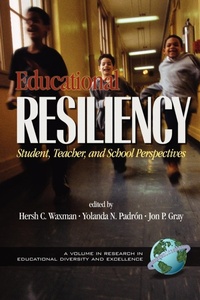
Educational Resiliency
Student, Teacher, and School Perspectives
Will be published approx. on 5. September 2000
Book
Paperback/Softback
288 pages
978-1-931576-08-6 (ISBN)
Description
This book is the first volume in the series Research in Educational Diversity and Excellence. The purpose of the present book is to summarize and discuss recent perspectives, research, and practices related to educational resilience.
There are three distinct parts of the book. The first part, "Conceptual Issues and Reviews of Research," focuses on issues related to defining resiliency as well as reviewing classical and recent studies in the area of educational resiliency. Part II, "Studies of Students' Resiliency," focuses on recent resiliency findings including methodological issues and implications of individual and school-level resilience. The final part, "Schools, Programs, and Communities that Enhance Resiliency," concentrates primarily on interventions and instructional programs that foster resiliency in youth and the schools they attend.
There are three distinct parts of the book. The first part, "Conceptual Issues and Reviews of Research," focuses on issues related to defining resiliency as well as reviewing classical and recent studies in the area of educational resiliency. Part II, "Studies of Students' Resiliency," focuses on recent resiliency findings including methodological issues and implications of individual and school-level resilience. The final part, "Schools, Programs, and Communities that Enhance Resiliency," concentrates primarily on interventions and instructional programs that foster resiliency in youth and the schools they attend.
More details
Series
Language
English
Place of publication
Charlotte
United States
Publishing group
Emerald Publishing Inc
Target group
College/higher education
Professional and scholarly
Dimensions
Height: 229 mm
Width: 152 mm
Thickness: 17 mm
Weight
471 gr
ISBN-13
978-1-931576-08-6 (9781931576086)
Copyright in bibliographic data and cover images is held by Nielsen Book Services Limited or by the publishers or by their respective licensors: all rights reserved.
Schweitzer Classification
Other editions
Additional editions
Hersch C. Waxman | Yolanda N. Padron
Educational Resiliency
Student, Teacher, and School Perspectives
E-Book
04/2006
1st Edition
Information Age Publishing
from
€62.33
Available for download
Content
Part I. Issues and Reviews of Research.
Chapter 1. Introduction and Overview; Hersh C. Waxman, Jon Gray, and Yolanda N. Padron.
Chapter 2. Resilience: Emerging Social Constructions in Educational Policy, Research, and Practice; Joel H. Brown.
Chapter 3. Promoting Educational Resilience for Students At-Risk of Failure; Hersh C. Waxman, Jon P. Gray, and Yolanda N. Padron.
Chapter 4. Resilience Research and Practice: National Resilience Resource Center Bridging the Gap; Kathy M. Marshall.
Part II. Studies of Students' Resiliency.
Chapter 5. A Longitudinal Look at the Literacy Development of Children Prenatally Exposed to Crack/Cocaine; Diane Barone.
Chapter 6. Achieving Success: An Agentic Model of Resiliency; Ruth Silva and Judy Radigan.
Chapter 7. Mathematics Learning Environment Differences between Resilient, Average, and Nonresilient Elementary Students; Hui-Li Chang.
Chapter 8. The Student-Teacher Axis: Idiosyncratic Credit and Cutting the Slack; Sue McGinty.
Chapter 9. The Relations of Teacher Education Students' Resiliency, Work Motivation, and School-Level Resilience; Jon P. Gray.
Part III. Schools, Programs, and Communities That Enhance Resiliency.
Chapter 10. Presenting a Resilience Paradigm for Teachers; Sybil Wolin.
Chapter 11. Developing Resilient Learning Communities to Close the Achievement Gap; Robert Stephen Topf, Virginia Frazier-Maiwald, and Martin L. Krovetz.
Chapter 12. Resilient Communities: The Interplay between Community Development and Child Development Through Effective School Reform; Hector H. Rivera.
Chapter 13. Promoting Resiliency in Youth, Educators, and Communities; Doris Annie Henry and Mike M. Milstein.
Chapter 14. Future Directions for Educational Resiliency Research; Hersh C. Waxman, Ann Brown, and Hui-Li Chang.
Contributing Authors.
Chapter 1. Introduction and Overview; Hersh C. Waxman, Jon Gray, and Yolanda N. Padron.
Chapter 2. Resilience: Emerging Social Constructions in Educational Policy, Research, and Practice; Joel H. Brown.
Chapter 3. Promoting Educational Resilience for Students At-Risk of Failure; Hersh C. Waxman, Jon P. Gray, and Yolanda N. Padron.
Chapter 4. Resilience Research and Practice: National Resilience Resource Center Bridging the Gap; Kathy M. Marshall.
Part II. Studies of Students' Resiliency.
Chapter 5. A Longitudinal Look at the Literacy Development of Children Prenatally Exposed to Crack/Cocaine; Diane Barone.
Chapter 6. Achieving Success: An Agentic Model of Resiliency; Ruth Silva and Judy Radigan.
Chapter 7. Mathematics Learning Environment Differences between Resilient, Average, and Nonresilient Elementary Students; Hui-Li Chang.
Chapter 8. The Student-Teacher Axis: Idiosyncratic Credit and Cutting the Slack; Sue McGinty.
Chapter 9. The Relations of Teacher Education Students' Resiliency, Work Motivation, and School-Level Resilience; Jon P. Gray.
Part III. Schools, Programs, and Communities That Enhance Resiliency.
Chapter 10. Presenting a Resilience Paradigm for Teachers; Sybil Wolin.
Chapter 11. Developing Resilient Learning Communities to Close the Achievement Gap; Robert Stephen Topf, Virginia Frazier-Maiwald, and Martin L. Krovetz.
Chapter 12. Resilient Communities: The Interplay between Community Development and Child Development Through Effective School Reform; Hector H. Rivera.
Chapter 13. Promoting Resiliency in Youth, Educators, and Communities; Doris Annie Henry and Mike M. Milstein.
Chapter 14. Future Directions for Educational Resiliency Research; Hersh C. Waxman, Ann Brown, and Hui-Li Chang.
Contributing Authors.