

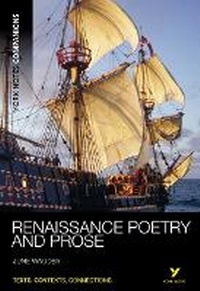
York Notes Companions: Renaissance Poetry and Prose
Published on 15. June 2010
Book
Paperback/Softback
368 pages
978-1-4082-0478-8 (ISBN)
Description
A fresh and exciting approach to the poetry and prose of the Renaissance which discusses the best-known writers and poets of the age - Shakespeare, Milton, Spenser and Donne - alongside writers much newer to the canon, such as Mary Sidney, Anne Locke and Aemilia Lanyer. The cultural context of the period is covered extensively in chapters focusing on religion, exploration and gender, and relevant modern critical theory is integrated throughout.
More details
Series
Language
English
Place of publication
Harlow
United Kingdom
Publishing group
Pearson Education Limited
Target group
College/higher education
ISBN-13
978-1-4082-0478-8 (9781408204788)
Copyright in bibliographic data and cover images is held by Nielsen Book Services Limited or by the publishers or by their respective licensors: all rights reserved.
Schweitzer Classification
Person
Dr June Waudby has taught for ten years on the BA English Literature and BA Arts and Humanities programmes at the University of Hull. Her area of specialism is Renaissance literature, but she also teaches Restoration Drama, Children's Literature and within the field of Women's Writing, through from the seventeenth century to the twentieth. Her personal research interests mainly focus on and early modern women writers and the Reformation, in particular its impact on individual sense of identity and literary production. June is currently preparing the manuscript of a monograph on the early work of Anne Vaughan Locke for Brepols and co-editing a collection of essays entitled She's Leaving Home in the series 'European Intertexts: A Study of Women's Writing in English As Part of a European Fabric' for Peter Lang (forthcoming 2011). Published work includes essays on the Anne Locke's poetry and prose, given as papers in Naples and Hungary, as part of the 'European Intertexts' series of conferences (2003, 2004), an article on Mary Sidney and Protestant concepts of literary pride (Dundee, 2009). Papers in progress include a defence of the central female character in Webster's White Devil (New York 2010) and a study of Tudor London as a dystopia as represented in contemporary literary production (London 2010). She belongs to the Fellowship of the Higher Education Academy and is a member of the Renaissance Society of America.
Content
Part One - Introduction
Part Two - A Cultural Overview
Part Three - Texts, Writers and Contexts
Sonnets and Love Poetry: William Shakespeare, Thomas Wyatt and Philip Sidney
Extended commentary: Shakespeare, Sonnets
Renaissance Epyllion: Thomas Lodge, William Shakespeare and Christopher Marlowe
Extended Commentary: Marlowe, Hero and Leander (c. 1593)
Pastoral to Epic: Andrew Marvell, Edmund Spenser and John Milton
Extended Commentary: Spenser, The Faerie Queene (1590-6), Book Three
Religious Verse: Anne Locke, Mary Sidney and John Donne
Extended Commentary: Locke, A Meditation (1560)
Humanist Prose and Rhetoric: Thomas More, Philip Sidney and Thomas Wilson
Extended Commentary: More, Utopia (1516)
Conduct Books: Castiglione, Thomas Hoby and Whately
Extended Commentary: Castiglione, The Book of the Courtier (1528)
Part Four: Critical theories and Debates
The Country and City
The Woman Debate
Exploration and New Worlds
Religion and Controversy
Part Five - References and resources
Timeline
Further reading
Index
Part Two - A Cultural Overview
Part Three - Texts, Writers and Contexts
Sonnets and Love Poetry: William Shakespeare, Thomas Wyatt and Philip Sidney
Extended commentary: Shakespeare, Sonnets
Renaissance Epyllion: Thomas Lodge, William Shakespeare and Christopher Marlowe
Extended Commentary: Marlowe, Hero and Leander (c. 1593)
Pastoral to Epic: Andrew Marvell, Edmund Spenser and John Milton
Extended Commentary: Spenser, The Faerie Queene (1590-6), Book Three
Religious Verse: Anne Locke, Mary Sidney and John Donne
Extended Commentary: Locke, A Meditation (1560)
Humanist Prose and Rhetoric: Thomas More, Philip Sidney and Thomas Wilson
Extended Commentary: More, Utopia (1516)
Conduct Books: Castiglione, Thomas Hoby and Whately
Extended Commentary: Castiglione, The Book of the Courtier (1528)
Part Four: Critical theories and Debates
The Country and City
The Woman Debate
Exploration and New Worlds
Religion and Controversy
Part Five - References and resources
Timeline
Further reading
Index