

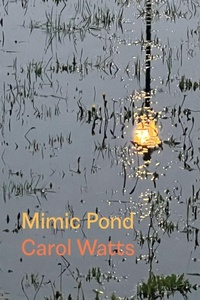
Mimic Pond
Published on 14. June 2024
Book
Paperback/Softback
136 pages
978-1-84861-917-3 (ISBN)
Description
Mounts Pond is a small urban pond on Blackheath, in south-east London, named for its dark earth. It is one of four ponds on the heath and the only one which comes and goes with seasonal weather. Records suggest it has been there for centuries. The pond is named after the small mound which rises like a tumulus beside it, the only rising on this levelled ground. It is a place famous for rebellions, political speeches, assemblies and sermons, with War Tyler and Michael An Gof of the Cornish rebellion both part of its history.
The pond swells and wanes with the season, is a barometer of the climate, and also a neighbourhood shared with the rhythms of crows and starlings, humans and plants. The pond is fragile and sometimes vandalised, occasionally rubbish strewn, a quilting point on the heath that speaks to depletion and survival, yet open to endlessly attuning, shifting, sometimes spectacular light, and mimic proposals.
Mimic Pond is part of a practice of ongoing documenting, which is my living here in this neighbourhood. 'Born otherwise' in Ponge's words, the pond wells up and vanishes in these poems, and elsewhere in notebooks, photographs and a wider making.
The pond swells and wanes with the season, is a barometer of the climate, and also a neighbourhood shared with the rhythms of crows and starlings, humans and plants. The pond is fragile and sometimes vandalised, occasionally rubbish strewn, a quilting point on the heath that speaks to depletion and survival, yet open to endlessly attuning, shifting, sometimes spectacular light, and mimic proposals.
Mimic Pond is part of a practice of ongoing documenting, which is my living here in this neighbourhood. 'Born otherwise' in Ponge's words, the pond wells up and vanishes in these poems, and elsewhere in notebooks, photographs and a wider making.
Reviews / Votes
Q: When is a pond not a pond? A: When it's a mimic pond. In this remarkable book, on her walks to and from a tiny urban water hole in South East London, Carol Watts discovers hidden in plain sight an unlikely place that is paradoxically both itself and not itself as well as being everything else. Combining local and natural history, close observation and some wonderfully rich imaginative and speculative writing, Watts fathoms the pond's impossible shallows, finding them 'irreducible to/words Yet words come'." -Jeff Hilson"What survives extinction is a roaring question for an apex predator loping toward uncertain futures. Or does the possibility of ongoing life itself sound 'brutal vanishments'? Watts's almanac of walks around the reverberating margins of an urban seasonal pond pursues such questions, feeling for the 'shock of future time' if not 'living repair'. As 'a hole to see the sky through' the pond mimics, through its 'swellings & disappearances', all that the lockdown of landlocked life forecloses, drawing us close to those 'who inhabit the edge of sight' and resounding 'expanses/ on different scales', from the climate violence of 'capital contagions' to 'all the small resistances'. As exquisite and profound as it is down to earth, with the humour of its 'mudlark/ affordances', this poetry offers acts of attention we can survive by." -Jonathan Skinner
"'When to speak of ponds, is/ barely a marginal good'. In close embodied attention to what is at hand, what others may not even perceive, a scratty pond on London's Blackheath, Carol Watts finds another body there, a life which morphs from ear to eye to roaring mouth. A kindred mimic pond. Distressed and stressed by our 'predatory searching,' exhausted by our extractions and climate distortions, yet enduring through centuries, the pond speaks back and forth with ancestral ghosts of possible pasts and futures, human and wolfish wild. The poems address the diversity and scarcity of what is there and what is absent in terms of plant and insect life, but also translate the poet's interior world of dreams, imaginings and heavy hopes. Daily walking is written into the rhythm here, so that we understand when something happens, in the weather, bird, or animal world, it is significant and calls for our response. This is quiet and beautiful work, ultimately looking out for what can be found that is good, like the crows who inhabit it." -Harriet Tarlo
More details
Language
English
Place of publication
Exeter
United Kingdom
Dimensions
Height: 229 mm
Width: 152 mm
Thickness: 8 mm
Weight
209 gr
ISBN-13
978-1-84861-917-3 (9781848619173)
Copyright in bibliographic data and cover images is held by Nielsen Book Services Limited or by the publishers or by their respective licensors: all rights reserved.
Schweitzer Classification
Person
Carol Watts was until recently Professor at the University of Sussex. Her writing attends to lived and often hidden and entangled histories of extraction, migration and community, from weedy marginal land (Dockfield, Equipage 2017) to the planetary (Sundog, Veer 2013 and Where Blue Light Falls, Shearsman, 2018). Her most recent poetry collection Kelptown (Shearsman, 2020) explored the UK south coast as a hallucinatory and adaptive zone of inundation. Her latest, Mimic Pond, documents the life of a seasonal pond on London's Blackheath, a place associated over centuries with protest and gatherings.