

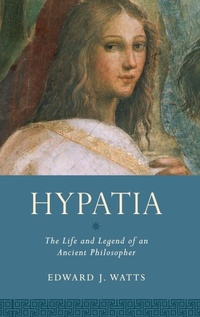
Hypatia
The Life and Legend of an Ancient Philosopher
Published on 27. April 2017
Book
Hardback
224 pages
978-0-19-021003-8 (ISBN)
Description
A philosopher, mathematician, and martyr, Hypatia is one of antiquity's best-known female intellectuals. For the sixteen centuries following her murder by a mob of Christians Hypatia has been remembered in books, poems, plays, paintings, and films as a victim of religious intolerance whose death symbolized the end of the Classical world. But Hypatia was a person before she was a symbol. Her great skill in mathematics and philosophy redefined the intellectual life of her home city of Alexandria. Her talent as a teacher enabled her to assemble a circle of dedicated male students. Her devotion to public service made her a force for peace and good government in a city that struggled to maintain trust and cooperation between pagans and Christians. Despite these successes, Hypatia fought countless small battles to live the public and intellectual life that she wanted. This book rediscovers the life Hypatia led, the unique challenges she faced as a woman who succeeded spectacularly in a man's world, and the tragic story of the events that led to her murder.
Reviews / Votes
The book is written in a readable style, without sacrificing rigor or intellectual transparency. The research is thorough. References and details are put in end notes ordered by chapter, easily accessible to the interested reader without disturbing the text ow. I can recommend this book to university students as well as to the general reader interested in late Roman philosophy or in the life of one of the few known female philosophers from before modern times. * Christian Bennet, Mathematical Reviews * Anyone interested in Hypatia will want to read this book [...] they will end up with a much deeper understanding of the culture of Late Antiquity. * Fernando Q. Gouvea, Colby College * Watts is most compelling in the summations of his findings and narratives ... A careful historical portrait of one of antiquity's most accomplished women. * Steve Young, Library Journal * To shine as a mathematician; to alter decisively the teaching curriculum of an ancient university; to work for the peace of an explosive city: Hypatia of Alexandria had done all this before her senseless murder by a Christian mob in 415 CE. With zest and exemplary scholarship, Ed Watts has brought alive the vivid world of Alexandria that both made Hypatia's achievements possible and also led to her unexpected, shocking death. It is a book that shows that truth is stranger (and a lot more interesting) than the rose-tinted fiction which has usually enveloped the life and death of this remarkable woman. * Peter Brown, Princeton University * Hypatia of Alexandria led an exceptional life as a celibate teacher of philosophy and political adviser. Edward Watts uses his expert knowledge of her city, and of late antique education, to explain the content and context of her teaching, and to show how Alexandria made possible both her career and her appalling death. Hypatia's death made her a symbol of repression, but for her, philosophy was a way of life, and that is the focus of this excellent book. * Gillian Clark, University of Bristol * Immersing Hypatia into her world of competing philosophers, jockeying bishops and local potentates, loyal students and rival monks, Watts restores the brilliant mathematician and philosophical leader, a woman all but submerged under the mask her violent death created. In the process, he also evokes the fabric of cosmopolitan late Roman Alexandria, a city in which Christians and others coexisted despite tensions that could and did erupt into moments of spectacular violence. * Susanna Elm, University of California, Berkeley * Watts' account of Hypatia's life is a work of scholarship, the product of some very thorough research, which provides a detailed and plausible interpretation of the life of a fascinating woman ... I would recommended this book for a university rather than school library, though it might have an appeal for a school pupil with an interest in studying prominent female figures in antiquity ... It is also a book for the thoughtful reader who wishes to examine their own beliefs about how to live the good life and its compatibility with public life. * Alison Henshaw, Classics for All *More details
Series
Language
English
Place of publication
New York
United States
Target group
College/higher education
Dimensions
Height: 240 mm
Width: 161 mm
Thickness: 16 mm
Weight
496 gr
ISBN-13
978-0-19-021003-8 (9780190210038)
Copyright in bibliographic data and cover images is held by Nielsen Book Services Limited or by the publishers or by their respective licensors: all rights reserved.
Schweitzer Classification
Other editions
Additional editions
Book
11/2019
Oxford University Press Inc
€42.60
Shipment within 15-20 days
E-Book
02/2017
1st Edition
OUP eBook
€9.99
Available for download
E-Book
02/2017
1st Edition
OUP eBook
€9.99
Available for download
Person
The Alkiviadis Vassiliadis Chair and Professor of History at the University of California, San Diego, Edward Watts studies the intellectual and religious history of the later Roman and early Byzantine Empires. He is the author of three prize-winning books and the editor of three edited volumes. This is his first of two upcoming works for OUP.
Content
Table of Contents
List of figures
Introduction: A Lenten Murder
Chapter 1: Alexandria
Chapter 2: Childhood and Education
Chapter 3: The School of Hypatia
Chapter 4: Middle Age
Chapter 5: A Philosophical Mother and her Children
Chapter 6: The Public Intellectual
Chapter 7: Hypatia's Sisters
Chapter 8: Murder in the Street
Chapter 9: The Memory of Hypatia
Chapter 10: A Modern Symbol
Reconsidering A Legend
Bibliography
List of figures
Introduction: A Lenten Murder
Chapter 1: Alexandria
Chapter 2: Childhood and Education
Chapter 3: The School of Hypatia
Chapter 4: Middle Age
Chapter 5: A Philosophical Mother and her Children
Chapter 6: The Public Intellectual
Chapter 7: Hypatia's Sisters
Chapter 8: Murder in the Street
Chapter 9: The Memory of Hypatia
Chapter 10: A Modern Symbol
Reconsidering A Legend
Bibliography