

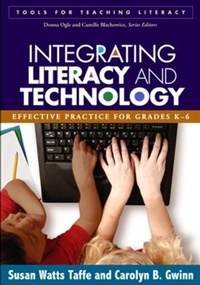
Integrating Literacy and Technology
Effective Practice for Grades K-6
1st Edition
Published on 24. May 2007
Book
Hardback
146 pages
978-1-59385-453-9 (ISBN)
Description
An accessible resource for busy teachers, this informative book sets the stage for using technology effectively in the literacy classroom. The authors take the reader step by step through the ongoing cycle of planning, teaching, and assessment in a technology-rich environment. They demonstrate how to use the Internet and reading and writing software not only to teach core literacy skills, but also to help children develop new reading and communication competencies for the digital age. Vivid classroom examples illustrate specific strategies for explicit instruction, teacher modeling, think-alouds, and interactive demonstration. The book also offers tools and tips to support professional development, including reproducible materials for use by individual teachers or study groups.
Reviews / Votes
"As the new literacies of the Internet and other information and communications technologies enter our worlds, teachers will be increasingly required to make clear and thoughtful decisions about how best to integrate them into the curriculum. This book will be a welcome addition to any teacher's bookshelf as well as a useful textbook for courses. By focusing on purpose-driven and effective practices, Watts Taffe and Gwinn show us how to make the best decisions for each of our students."--Donald J. Leu, PhD, Neag School of Education, University of Connecticut"An excellent resource for classroom teachers who want to achieve a higher level of technology integration in the classroom. The book is full of useful forms and resources for both the teacher and student. In an era when time is of the essence, this book can help teachers accomplish a dual purpose: increasing the literacy achievement of their students while at the same time promoting the skillful use of technology." --Cece Tillman, MEd, Instructional Coach, Davis Elementary School, Trenton, Georgia
"This book clearly and succinctly describes the importance of literacy and technology integration. It is written with respect for the teacher's role, showing how this role becomes even more important as technology is integrated into literacy education. Watts Taffe and Gwinn view technology not as an isolator, but as a tool that can facilitate communication and collaboration among educators and students. This book will be valuable as both a resource for teacher study groups and a text for preservice teachers studying the content and pedagogy of literacy learning."--Patsy Mogush, PhD, Department of Curriculum and Instruction, University of Minnesota
"A practical guide that will assist teachers in their daily instruction. The scenarios and think-aloud strategies are explicitly written, enabling teachers to understand what, why, and how to seamlessly integrate content area and technology. The information on how to address standards and assessment is an added bonus."--Jennifer F. M. Padua, MEd, second-grade teacher, Ewa Elementary School, Ewa, Hawaii
"Having done just about everything in the education arena over the last 30 years, I can say that this book will appeal to a very wide range of readers. As a current third-grade teacher, I have used some of the ideas in shaping some upcoming Web-based studies for my students. Speaking as a professor, I can see using this text as a centerpiece for professional development for both preservice and inservice teachers. The work is well grounded in the educator's everyday experience of designing and fine-tuning instruction and honing in on learning objectives. I have found myself revisiting this book as a touchstone for my thinking about lesson design and planning."--Mary E. MacKay, MS, third-grade teacher, Lincoln Heights Elementary School, Fuquay-Varina, North Carolina 'An excellent resource for classroom teachers who want to achieve a higher level of technology integration in the classroom. The book is full of useful forms and resources for both the teacher and student. In an era when time is of the essence, this book can help teachers accomplish a dual purpose: increasing the literacy achievement of their students while at the same time promoting the skillful use of technology.' - Cece Tillman, MEd, Instructional Coach, Davis Elementary School, Trenton, Georgia, USA
'As the new literacies of the Internet and other information and communications technologies enter our worlds, teachers will be increasingly required to make clear and thoughtful decisions about how best to integrate them into the curriculum. This book will be a welcome addition to any teacher's bookshelf as well as a most useful textbook for courses. By focusing on purpose-driven and effective practices, Watts Taffe and Gwinn show us how to make the best decisions for each of our students.' - Donald J. Leu, PhD, Neag School of Education, University of Connecticut, USA
'This book clearly and succinctly describes the importance of literacy and technology integration. It is written with respect for the teacher's role, showing how this role becomes even more important as technology is integrated into literacy education. Watts Taffe and Gwinn view technology not as an isolator, but as a tool that can facilitate communication and collaboration among educators and students. This book will be valuable as both a resource for teacher study groups and a text for preservice teachers studying the content and pedagogy of literacy learning.' - Patsy Mogush, PhD, Department of Curriculum and Instruction, University of Minnesota, USA
'A practical guide that will assist teachers in their daily instruction. The scenarios and think-aloud strategies are explicitly written, enabling teachers to understand what, why, and how to seamlessly integrate content area and technology. The information on how to address standards and assessment is an added bonus.' - Jennifer F. M. Padua, MEd, second-grade teacher, Ewa Elementary School, Ewa, Hawaii
'Having done just about everything in the education arena over the last 30 years, I can say that this book will appeal to a very wide range of readers. As a current third-grade teacher, I have used some of the ideas in shaping some upcoming Web-based studies for my students. Speaking as a professor, I can see using this text as a centerpiece for professional development for both preservice and inservice teachers. The work is well grounded in the educator's everyday experience of designing and fine-tuning instruction and honing in on learning objectives. I have found myself revisiting this book as a touchstone for my thinking about lesson design and planning.' - Mary E. MacKay, MS, third-grade teacher, Lincoln Heights Elementary School, Fuquay-Varina, North Carolina, USA
More details
Series
Language
English
Place of publication
New York
United States
Target group
College/higher education
Professional and scholarly
Dimensions
Height: 254 mm
Width: 178 mm
Weight
454 gr
ISBN-13
978-1-59385-453-9 (9781593854539)
Copyright in bibliographic data and cover images is held by Nielsen Book Services Limited or by the publishers or by their respective licensors: all rights reserved.
Schweitzer Classification
Other editions
Additional editions
Susan Watts Taffe | Carolyn B. Gwinn
Integrating Literacy and Technology
Effective Practice for Grades K-6
Book
05/2007
1st Edition
Guilford Publications
€27.50
Article exhausted; check different version
Persons
Susan Watts Taffe, PhD, is a researcher and consultant in the field of literacy education. In addition to literacy-technology integration, her research interests include vocabulary development, students experiencing difficulty with reading, and teacher professional development, particularly in culturally and linguistically diverse settings. A frequent speaker at state and national conferences, Dr. Watts Taffe has had articles appear in journals such as The Reading Teacher, Language Arts, Journal of Literacy Research, and Reading Research Quarterly. She has been a special education teacher and reading diagnostician. Dr. Watts Taffe spent 13 years on the faculty of the University of Minnesota, where she was associate professor of elementary and literacy education. In 1996, she received the College of Education and Human Development Distinguished Teaching Award for her work with preservice and inservice teachers. She currently resides in Cincinnati, Ohio.
Carolyn B. Gwinn, PhD, is a researcher and consultant in the field of literacy education; in this capacity, she focuses on the meaningful integration of technology into literacy curricula, infusion of best practices into literacy instruction, and the design and delivery of high-quality professional development. As an elementary curriculum specialist for one of the largest school districts in Minnesota, Dr. Gwinn engages in strategic planning, implementation, and evaluation of literacy-related initiatives and provides leadership to the district's technology and media study committee. She has presented at numerous regional and national conferences and has published articles in professional journals including The Reading Teacher. Dr. Gwinn has been a classroom teacher in grades 1, 4, and 5; a reading specialist; and a resource teacher. She has also taught undergraduate and graduate literacy methods courses at the University of Minnesota, where she has been recognized for her outstanding teaching and leadership in the community.
Carolyn B. Gwinn, PhD, is a researcher and consultant in the field of literacy education; in this capacity, she focuses on the meaningful integration of technology into literacy curricula, infusion of best practices into literacy instruction, and the design and delivery of high-quality professional development. As an elementary curriculum specialist for one of the largest school districts in Minnesota, Dr. Gwinn engages in strategic planning, implementation, and evaluation of literacy-related initiatives and provides leadership to the district's technology and media study committee. She has presented at numerous regional and national conferences and has published articles in professional journals including The Reading Teacher. Dr. Gwinn has been a classroom teacher in grades 1, 4, and 5; a reading specialist; and a resource teacher. She has also taught undergraduate and graduate literacy methods courses at the University of Minnesota, where she has been recognized for her outstanding teaching and leadership in the community.
Content
1. Introduction
2. The Learning Environment for Literacy-Technology Integration
3. Learning about Effective Technology Integration: A Guide for Teachers
4. Planning for Literacy-Technology Integration
5. Teaching Effectively with Technology
6. Using Assessment to Inform Decision Making in the Technology-Enriched Learning Environment
7. The Teacher as Change Agent in the Literacy-Technology Learning Environment
8. The Impact of Technology on Our Journey as Teachers: Looking Back, Looking Forward
*A Glossary of Terms: New Words Associated with New Technologies
*Appendices: Tools for Thinking about Technology Integration
2. The Learning Environment for Literacy-Technology Integration
3. Learning about Effective Technology Integration: A Guide for Teachers
4. Planning for Literacy-Technology Integration
5. Teaching Effectively with Technology
6. Using Assessment to Inform Decision Making in the Technology-Enriched Learning Environment
7. The Teacher as Change Agent in the Literacy-Technology Learning Environment
8. The Impact of Technology on Our Journey as Teachers: Looking Back, Looking Forward
*A Glossary of Terms: New Words Associated with New Technologies
*Appendices: Tools for Thinking about Technology Integration