

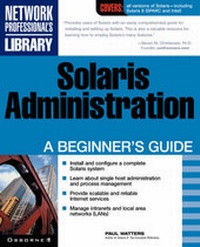
Solaris Administration
A Beginner's Guide
Published on 1. January 2001
Book
Paperback/Softback
436 pages
978-0-07-213155-0 (ISBN)
Description
This guide covers a wide range of issues for the new administrative user of the Solaris program, looking at the user, resources, the server and network management. There are real world examples of configuration files and the installation of third-party software packages, without the assumption that the reader is a "Solaris guru". Eight pages of blueprints cover administration differences between Solaris and Linux, and Solaris and Windows 2000.
More details
Series
Language
English
Place of publication
New York
United States
Publishing group
McGraw-Hill Education - Europe
Target group
College/higher education
Professional and scholarly
Product notice
Paperback (trade)
Illustrations
50 illustrations
Dimensions
Height: 191 mm
Width: 235 mm
Thickness: 22 mm
Weight
746 gr
ISBN-13
978-0-07-213155-0 (9780072131550)
Copyright in bibliographic data and cover images is held by Nielsen Book Services Limited or by the publishers or by their respective licensors: all rights reserved.
Schweitzer Classification
Person
Paul A. Watters (Oakhurst, Austailia,) recently completed his PhD in computer science at Macquarie University, Sydney, Australia. He specializes in building e-commerce and Internet information systems, based on Java, Solaris and open standards like CORBA. He is also a columnist and author for the trade journal Inside Solaris, and is lead author of the Solaris 8 title Solaris 8: The Complete Reference, published by Osborne McGraw-Hill, and co-author of the SuSE Linux Bible, published by IDG.
Content
Part I. Installation; 1. Introduction to Solaris; 2. Installing Solaris Sparc; 3. Installing Solaris Intel; 4. Using the CDE; Part II. Single Host Administration; 5. Shell Usage and Programming; 6. Managing Users and Groups; 7. Processes and System Resources; 8. Package Management and Software Installation; Part III. Managing Internet Services; 9. Electronic Mail; 10. Domain Name Services; 11. The Internet Daemon; 12. Remote Access; 13. Web Services; 14. Security; Part IV. Managing Intranet Services; 15. Samba; 16. DHCP; 17. NFS; 18. NIS/NIS+; 19. Printing; 20. Backups