

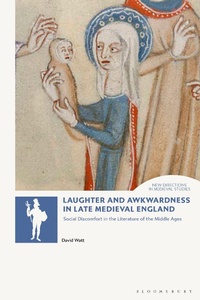
Laughter and Awkwardness in Late Medieval England
Social Discomfort in the Literature of the Middle Ages
Published on 20. March 2025
Book
Paperback/Softback
208 pages
978-1-350-37502-4 (ISBN)
Description
'We live,' according to Adam Kotsko, 'in an awkward age.' While this condition may present some challenges, it may also help us to be more attuned to awkwardness in other ages. This book pairs medieval texts with twenty-first century films or television programmes to explore what the resonance between them can tell us about living together in an awkward age.
In this nuanced and engaging study, David Watt focuses especially, but not exclusively, on the 15th century, which seems to intervene awkwardly in the literary trajectory between Chaucer and the Renaissance. This book's hypothesis is that the social discomfort depicted and engendered by writers as diverse as Thomas Hoccleve, Margery Kempe, and Sir Thomas Malory is a feature rather than a flaw. Laughter and Awkwardness in Late Medieval England explains that these authors have a great deal in common with other fifteenth-century authors, who generated embodied experiences of social discomfort in a range of genres by adopting and adapting literary techniques used by their predecessors and successors in slightly different ways. Like the twenty-first century texts with which they are paired, the late-medieval texts that feature in this book use the relationship between laughter and awkwardness to ask what it means to live with each other and how we can learn to live with ourselves.
In this nuanced and engaging study, David Watt focuses especially, but not exclusively, on the 15th century, which seems to intervene awkwardly in the literary trajectory between Chaucer and the Renaissance. This book's hypothesis is that the social discomfort depicted and engendered by writers as diverse as Thomas Hoccleve, Margery Kempe, and Sir Thomas Malory is a feature rather than a flaw. Laughter and Awkwardness in Late Medieval England explains that these authors have a great deal in common with other fifteenth-century authors, who generated embodied experiences of social discomfort in a range of genres by adopting and adapting literary techniques used by their predecessors and successors in slightly different ways. Like the twenty-first century texts with which they are paired, the late-medieval texts that feature in this book use the relationship between laughter and awkwardness to ask what it means to live with each other and how we can learn to live with ourselves.
Reviews / Votes
[David] Watt does an excellent job of demonstrating how productive the concept of awkwardness is in both medieval and modern works. -- Mary C. Flanner * The Times Literary Supplement *More details
Series
Language
English
Place of publication
London
United Kingdom
Publishing group
Bloomsbury Publishing PLC
Target group
Professional and scholarly
College/higher education
Product notice
Paperback (trade)
Dimensions
Height: 234 mm
Width: 156 mm
Thickness: 11 mm
Weight
300 gr
ISBN-13
978-1-350-37502-4 (9781350375024)
Copyright in bibliographic data and cover images is held by Nielsen Book Services Limited or by the publishers or by their respective licensors: all rights reserved.
Schweitzer Classification
Other editions
Additional editions
David Watt
Laughter and Awkwardness in Late Medieval England
Social Discomfort in the Literature of the Middle Ages
E-Book
08/2023
1st Edition
Bloomsbury Academic
€31.99
Available for download
David Watt
Laughter and Awkwardness in Late Medieval England
Social Discomfort in the Literature of the Middle Ages
E-Book
08/2023
1st Edition
Bloomsbury Academic
€31.99
Available for download
Person
David Watt is Professor in the Department of English, Theatre, Film & Media, at the University of Manitoba, Canada, where he also serves as head of his department.
Content
List of Figures
List of Abbreviations
Note on Quotations
Acknowledgments
Introduction
1. When everything goes pear-shaped: Laughter and Awkwardness in Augustine's Confessions
2. Elated or Gassy? Between Affect and Emotion in The Luttrell Psalter
3. May this be true? The Awkwardness of Accepting Grace in Pearl
4. Creating Tension: Laughter and Anger in Cleanness
5. Virtuous even if it Displeases: Patience
6. The Games People Play: Laughter and Belonging in Sir Gawain and the Green Knight
7. All Shall Be Well: Laughter and Belonging in Julian of Norwich's Revelations of Divine Love
8. Too Much Information? Suggestive Diction in 'I Have a Gentil Cock'
9. Does this stress make me look fat? Awkward Questions in Thomas Hoccleve's La Male Regle
10. You're so vain, you probably think this Psalm is about you: Saving Face in Thomas Hoccleve's Series
11. Great Cause to Laugh: Conversation and Compassion in The Book of Margery Kempe
12. Sing with us, with a merry cheer! The Awkwardness of Going Along With It in Mankind
13. Ever Froward: Standing up for the Audience in The Chester Play of Noah's Flood
14. Disappointing Expectations: Laughter, Awkwardness, and the End of Sir Thomas Malory's Morte Darthur
Conclusion: An Awkward Age?
References
Index
List of Abbreviations
Note on Quotations
Acknowledgments
Introduction
1. When everything goes pear-shaped: Laughter and Awkwardness in Augustine's Confessions
2. Elated or Gassy? Between Affect and Emotion in The Luttrell Psalter
3. May this be true? The Awkwardness of Accepting Grace in Pearl
4. Creating Tension: Laughter and Anger in Cleanness
5. Virtuous even if it Displeases: Patience
6. The Games People Play: Laughter and Belonging in Sir Gawain and the Green Knight
7. All Shall Be Well: Laughter and Belonging in Julian of Norwich's Revelations of Divine Love
8. Too Much Information? Suggestive Diction in 'I Have a Gentil Cock'
9. Does this stress make me look fat? Awkward Questions in Thomas Hoccleve's La Male Regle
10. You're so vain, you probably think this Psalm is about you: Saving Face in Thomas Hoccleve's Series
11. Great Cause to Laugh: Conversation and Compassion in The Book of Margery Kempe
12. Sing with us, with a merry cheer! The Awkwardness of Going Along With It in Mankind
13. Ever Froward: Standing up for the Audience in The Chester Play of Noah's Flood
14. Disappointing Expectations: Laughter, Awkwardness, and the End of Sir Thomas Malory's Morte Darthur
Conclusion: An Awkward Age?
References
Index