

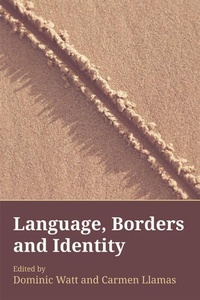
Language, Borders and Identity
Published on 12. October 2014
Book
Paperback/Softback
288 pages
978-0-7486-6977-6 (ISBN)
Description
This book sets out to encompass a broad, geographically diverse spectrum of border contexts, and to illustrate a representative range of methodological approaches used by researchers in the field. Political borders that divide monoglossic and heteroglossic territories are examined, as are regional and local borders. Symbolic borders, which may for example be encoded in the semiotic manipulation of the linguistic landscape, are also considered. We assess the linguistic implications of the presence of borders of the preceding kinds in applied contexts such as language planning and policy (e.g. for multilingual education; protection of minority languages) and border control (via the chapter on language analysis for the determination of origin, 'LADO'). Each border is unique to itself, making generalisations about how language functions in 'borderlands' difficult to formulate. Casting the net as wide as we intend will, however, equip us to develop and refine models of how language is used to construct borders, and to indicate on which side of a border speakers situate themselves. The dual reactive and proactive functions that language serves in this respect are brought into focus, and the interface and tensions between essentialist and constructionist approaches to identity are explored. The book will place particular emphasis on the last of these topics.
More details
Language
English
Place of publication
Edinburgh
United Kingdom
Target group
Professional and scholarly
Illustrations
66 black and white illustrations, 14 black and white tables
Dimensions
Height: 233 mm
Width: 154 mm
Thickness: 20 mm
Weight
442 gr
ISBN-13
978-0-7486-6977-6 (9780748669776)
Copyright in bibliographic data and cover images is held by Nielsen Book Services Limited or by the publishers or by their respective licensors: all rights reserved.
Schweitzer Classification
Other editions
Additional editions
Dominic Watt | Carmen Llamas
Language, Borders and Identity
E-Book
10/2014
Edinburgh University Press
€29.49
Available for download
Dominic Watt | Carmen Llamas
Language, Borders and Identity
E-Book
10/2014
Edinburgh University Press
€0.00
Available for download
Persons
Dominic Watt lectures in Forensic Speech Science at the University of York, UK Carmen Llamas lectures in sociolinguistics at the University of York. She is co-editor (with Dominic Watt) of Language and Identities (2010) and (with Peter Stockwell and Louise Mullany) of The Routledge Companion to Sociolinguistics (2007). Her research deals primarily with phonological variation and change in the North East and the Scottish-English border region.
Content
Introduction, Dominic Watt and Carmen Llamas; 1. Language and Identity on the Scottish/English border, Dominic Watt, Carmen Llamas, Gerry Docherty, Damien Hall and Jennifer Nycz; 2. Where North meets South?: Contact, divergence, and the routinisation of the Fenland dialect boundary, David Britain; 3. Borders in North American English, Charles Boberg; 4. Spanish language variation and ethnic identity in New Mexico: internal and external borders, Neddy A. Vigil and Garland D. Bills; 5. Language use and attitudes as stimuli for phonological change in border Uruguayan Spanish, Mark Waltermire; 6. Religion on the border: The effect of Utah English on English and Spanish use in the Mexican Mormon colonies, Wendy Baker-Smemoe and Breana Jones; 7. Borders within borders: Contexts of language use and local identity configuration in southern Galicia, Jaine Beswick; 8. Perceptual ideology across the Scottish/English border, Chris Montgomery; 9. Wales and Welsh: Boundedness and peripherality, Nikolas Coupland; 10. The political border and linguistic identities in Ireland: What can the linguistic landscape tell us?, Jeffrey L. Kallen; 11. Multilingual Luxembourg: Language and identity at the Romance/Germanic language border, Daniel Redinger and Carmen Llamas; 12. What counts as a linguistic border, for whom, and with what implications? Exploring Occitan and Francoprovencal in Rhone-Alpes, France, Michel Bert and James Costa; 13. Constructing national and international deaf identity: Perceived use of American Sign Language, Elizabeth S. Parks; 14. Borders, variation and identity: Language Analysis for the Determination of Origin (LADO), Kim Wilson and Paul Foulkes