

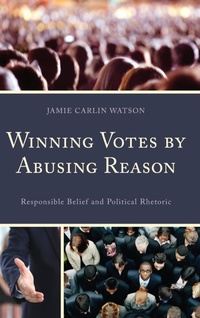
Winning Votes by Abusing Reason
Responsible Belief and Political Rhetoric
Published on 14. December 2016
Book
Hardback
272 pages
978-1-4985-1642-6 (ISBN)
Description
Over the past few decades, psychologists have discovered that human reasoning is defective in surprising ways. We are beset by numerous biases and heuristics, which lead us to reason poorly about things that matter to us. And while there are illuminating evolutionary explanations for how these biases and heuristics may have benefited our species in its phylogeny, psychologists are unanimous that these cognitive dispositions largely corrupt rather than aid our belief-forming practices. In Winning Votes by Abusing Reason: Political Rhetoric and Responsible Belief, Jamie Watson argues that political rhetoric, rather than helping us overcome these defects, exacerbates them. And standard attempts to address this problem, such as deliberative democracy and paternalism, tend to either exclude citizens from important decisions or give them the illusion of reasoning well, perpetuating poor and irresponsible political beliefs. This book concludes that, rather than attempt more political solutions, the most promising approach to forming and preserving responsible political beliefs is to adopt individual principles of epistemic caution. The author brings together insights from political philosophy, social epistemology, behavioral psychology, and agnotology to suggest how we might protect our belief-forming behavior from the corrosive effects of political rhetoric. Recommended for scholars of philosophy, rhetoric, political science, and communications.
Reviews / Votes
If there is anything that characterizes contemporary political discourse it is that everyone is so confident about almost everything. Jamie Watson shows us why this is a mistake and how we can fix it. -- Brandon Warmke, Bowling Green State University The problem of political ignorance is pervasive and stubborn. It affects political discourse, political behavior, and voting, and it negatively affects political outcomes. Jamie Watson's book is original both in its diagnoses and its recommendations. Without any doubt, this is a valuable contribution to the literature. -- Fernando R. Teson, Florida State University College of LawMore details
Language
English
Place of publication
United States
Publishing group
Bloomsbury Publishing Plc
Target group
Professional and scholarly
Dimensions
Height: 235 mm
Width: 157 mm
Thickness: 21 mm
Weight
600 gr
ISBN-13
978-1-4985-1642-6 (9781498516426)
Copyright in bibliographic data and cover images is held by Nielsen Book Services Limited or by the publishers or by their respective licensors: all rights reserved.
Schweitzer Classification
Other editions
Additional editions
E-Book
12/2016
1st Edition
Lexington Books
€107.99
Available for download
E-Book
12/2016
1st Edition
Lexington Books
€107.99
Available for download
Person
Jamie Carlin Watson is assistant professor of philosophy at Broward College.
Content
Contents
Introduction
Part 1: Rhetorical Strategy and Responsible Belief
Chapter 1. Social Epistemology and Political Rhetoric
Chapter 2. Learning from Politicians
Part 2: The Problem of Political Rhetoric
Chapter 3. User Error: Common Fallacies in Political Rhetoric
Chapter 4. Hardware Glitches: Cognitive Biases and Heuristics in Politics
Chapter 5. System Failure: Social Biases
Chapter 6. Political and Moral Expertise
Part 3: Forming Responsible Political Beliefs
Chapter 7. Knowing and Voting: Democratic Solutions
Chapter 8. Nudges and Shoves: Paternalistic Solutions
Chapter 9. Epistemic Virtue and Individual Responsibility
Bibliography
About the Author
Introduction
Part 1: Rhetorical Strategy and Responsible Belief
Chapter 1. Social Epistemology and Political Rhetoric
Chapter 2. Learning from Politicians
Part 2: The Problem of Political Rhetoric
Chapter 3. User Error: Common Fallacies in Political Rhetoric
Chapter 4. Hardware Glitches: Cognitive Biases and Heuristics in Politics
Chapter 5. System Failure: Social Biases
Chapter 6. Political and Moral Expertise
Part 3: Forming Responsible Political Beliefs
Chapter 7. Knowing and Voting: Democratic Solutions
Chapter 8. Nudges and Shoves: Paternalistic Solutions
Chapter 9. Epistemic Virtue and Individual Responsibility
Bibliography
About the Author