

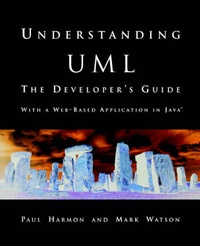
Understanding UML
The Developer's Guide
Published on 9. December 1997
Book
Paperback/Softback
367 pages
978-1-55860-465-0 (ISBN)
Description
The Unified Modeling Language (UML) is a third generation method for specifying, visualizing, and documenting an object-oriented system under development. It unifies the three leading object-oriented methods and others to serve as the basis for a common, stable, and expressive object-oriented development notation. As the complexity of software applications increases, so does the developer's need to design and analyze applications before developing them. This practical introduction to UML provides software developers with an overview of this powerful new design notation, and teaches Java programmers to analyse and design object-oriented applications using the UML notation.
Reviews / Votes
"...(an) exceptionally balanced and informative text." --Rich DraganMore details
Series
Language
English
Place of publication
San Francisco
United States
Publishing group
Elsevier Science & Technology
Target group
Professional and scholarly
Weight
770 gr
ISBN-13
978-1-55860-465-0 (9781558604650)
Copyright in bibliographic data and cover images is held by Nielsen Book Services Limited or by the publishers or by their respective licensors: all rights reserved.
Schweitzer Classification
Person
Mark Watson is an independent software developer with extensive software engineering experience. He has worked at Angel Studios as a game programmer for Nintendo and Windows 95 games, with SAIC on the development of tools for expert systems, and on natural language processing and neural network systems. He is the developer of a real-time distributed expert system used by regional telephone systems to detect fraud, and is the author of eight books.
Content
1 Introduction
2 The Vocabulary of Object Technology
3 A Simple Object-Oriented Methodology
4 The Unified Modeling Language
5 Coding Applications in Java
6 Java Development with an Object-Oriented Modeling Tool
7 Business Process Reengineering
8 Use Case Diagrams and Ideal Object Models
9 CRC Cards
10 UML Class and Object Diagrams
11 UML Sequence and Collaboration Diagrams
12 UML State and Activity Diagrams
13 Designing an Object-Oriented System
14 Choosing an Object-Oriented Architecture
15 Expanding Your Design
Appendix A Code for the SalesWeb Example
Appendix B A Comparison of UML, Booch, and MOT Notations
Appendix C Products Mentioned in the Book
2 The Vocabulary of Object Technology
3 A Simple Object-Oriented Methodology
4 The Unified Modeling Language
5 Coding Applications in Java
6 Java Development with an Object-Oriented Modeling Tool
7 Business Process Reengineering
8 Use Case Diagrams and Ideal Object Models
9 CRC Cards
10 UML Class and Object Diagrams
11 UML Sequence and Collaboration Diagrams
12 UML State and Activity Diagrams
13 Designing an Object-Oriented System
14 Choosing an Object-Oriented Architecture
15 Expanding Your Design
Appendix A Code for the SalesWeb Example
Appendix B A Comparison of UML, Booch, and MOT Notations
Appendix C Products Mentioned in the Book