

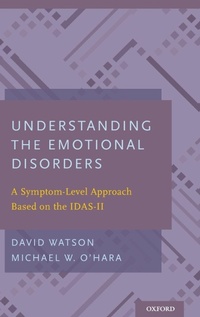
Understanding the Emotional Disorders
A Symptom-Level Approach Based on the IDAS-II
Published on 25. May 2017
Book
Hardback
352 pages
978-0-19-930109-6 (ISBN)
Description
Improving the measurement of symptoms of emotional disorders has been an important goal of mental health research. In direct response to this need, the Expanded Version of the Inventory of Depression and Anxiety Symptoms (IDAS-II) was developed to assess symptom dimensions underlying psychological disorders. Unlike other scales that serve as screening instruments used for diagnostic purposes, the IDAS-II is not closely tethered to the Diagnostic and Statistical Manual of Mental Disorders (DSM); rather, its scales cut across DSM boundaries to examine psychopathology in a dimensional rather than a categorical way. Developed by authors David Watson and Michael O'Hara, the IDAS-II has broad implications for our understanding of psychopathology.
Understanding the Emotional Disorders is the first manual for how to use the IDAS-II and examines important, replicable symptom dimensions contained within five adjacent diagnostic classes in the DSM-5: depressive disorders, bipolar and related disorders, anxiety disorders, obsessive-compulsive and related disorders, and trauma- and stressor-related disorders. It reviews problems and limitations associated with traditional, diagnosis-based approaches to studying psychopathology and establishes the theoretical and clinical value of analyzing specific types of symptoms within the emotional disorders. It demonstrates that several of these disorders contain multiple symptom dimensions that clearly can be differentiated from one another. Moreover, these symptom dimensions are highly robust and generalizable and can be identified in multiple types of data, including self-ratings, semi-structured interviews, and clinicians' ratings. Furthermore, individual symptom dimensions often have strikingly different correlates, such as varying levels of criterion validity, incremental predictive power, and diagnostic specificity. Consequently, it is more informative to examine these specific types of symptoms, rather than the broader disorders. The book concludes with the development of a more comprehensive, symptom-based model that subsumes various forms of psychopathology-including sleep disturbances, eating- and weight-related problems, personality pathology, psychosis/thought disorder, and hypochondriasis-beyond the emotional disorders.
Understanding the Emotional Disorders is the first manual for how to use the IDAS-II and examines important, replicable symptom dimensions contained within five adjacent diagnostic classes in the DSM-5: depressive disorders, bipolar and related disorders, anxiety disorders, obsessive-compulsive and related disorders, and trauma- and stressor-related disorders. It reviews problems and limitations associated with traditional, diagnosis-based approaches to studying psychopathology and establishes the theoretical and clinical value of analyzing specific types of symptoms within the emotional disorders. It demonstrates that several of these disorders contain multiple symptom dimensions that clearly can be differentiated from one another. Moreover, these symptom dimensions are highly robust and generalizable and can be identified in multiple types of data, including self-ratings, semi-structured interviews, and clinicians' ratings. Furthermore, individual symptom dimensions often have strikingly different correlates, such as varying levels of criterion validity, incremental predictive power, and diagnostic specificity. Consequently, it is more informative to examine these specific types of symptoms, rather than the broader disorders. The book concludes with the development of a more comprehensive, symptom-based model that subsumes various forms of psychopathology-including sleep disturbances, eating- and weight-related problems, personality pathology, psychosis/thought disorder, and hypochondriasis-beyond the emotional disorders.
More details
Language
English
Place of publication
New York
United States
Target group
Professional and scholarly
Dimensions
Height: 240 mm
Width: 161 mm
Thickness: 23 mm
Weight
693 gr
ISBN-13
978-0-19-930109-6 (9780199301096)
Copyright in bibliographic data and cover images is held by Nielsen Book Services Limited or by the publishers or by their respective licensors: all rights reserved.
Schweitzer Classification
Other editions
Additional editions
David Watson | Michael W. O'Hara
Understanding the Emotional Disorders
A Symptom-Level Approach Based on the IDAS-II
E-Book
03/2017
1st Edition
OUP eBook
€62.99
Available for download
David Watson | Michael W. O'Hara
Understanding the Emotional Disorders
A Symptom-Level Approach Based on the IDAS-II
E-Book
03/2017
1st Edition
OUP eBook
€63.49
Available for download
Persons
David Watson, PhD, is Andrew J. McKenna Family Professor of Psychology, University of Notre Dame. Dr. Watson is a personality psychologist with specific expertise in clinical and personality assessment. His work investigates the structure and measurement of personality, emotion, and psychopathology, as well as examining how personality traits relate to clinical disorders. The long-term goal of this work is develop comprehensive models that integrate normal-range and pathological processes into a single overarching scheme.
Michael W. O'Hara, PhD, is Professor of Psychological and Brain Sciences, Starch Faculty Fellow, and Director of Clinical Training at the University of Iowa, where he has been for 36 years. He has a long history of scholarship and external support in depression, particularly in the epidemiology of perinatal depression, its consequences for mothers and children, and its prevention and treatment. He has previously served as president of the Society for Research in Psychopathology and the Marce Society for Perinatal Mental Health.
Michael W. O'Hara, PhD, is Professor of Psychological and Brain Sciences, Starch Faculty Fellow, and Director of Clinical Training at the University of Iowa, where he has been for 36 years. He has a long history of scholarship and external support in depression, particularly in the epidemiology of perinatal depression, its consequences for mothers and children, and its prevention and treatment. He has previously served as president of the Society for Research in Psychopathology and the Marce Society for Perinatal Mental Health.
Content
Preface
Chapter 1: Understanding the Emotional Disorders
Chapter 2: Development of the IDAS & IDAS-II
Chapter 3: The Structure, Specificity and Validity of Depression Symptoms
Chapter 4: Positive Mood Dysfunction in Psychopathology
Chapter 5: The Nature and Structure of Bipolar Symptoms
Chapter 6: Anger and Psychopathology
Chapter 7: The Structure, Validity and Specificity of PTSD Symptoms
Chapter 8: Anxiety Symptoms
Chapter 9: The Structure, Validity and Specificity of OCD Symptoms
Chapter 10: Toward a Comprehensive Symptom-Based Model of Psychopathology
About the Authors
Index
Chapter 1: Understanding the Emotional Disorders
Chapter 2: Development of the IDAS & IDAS-II
Chapter 3: The Structure, Specificity and Validity of Depression Symptoms
Chapter 4: Positive Mood Dysfunction in Psychopathology
Chapter 5: The Nature and Structure of Bipolar Symptoms
Chapter 6: Anger and Psychopathology
Chapter 7: The Structure, Validity and Specificity of PTSD Symptoms
Chapter 8: Anxiety Symptoms
Chapter 9: The Structure, Validity and Specificity of OCD Symptoms
Chapter 10: Toward a Comprehensive Symptom-Based Model of Psychopathology
About the Authors
Index