

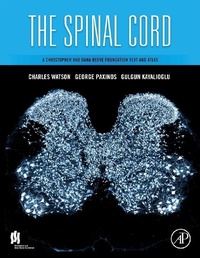
The Spinal Cord
A Christopher and Dana Reeve Foundation Text and Atlas
Published on 14. November 2008
Book
Hardback
408 pages
978-0-12-374247-6 (ISBN)
Description
Many hundreds of thousands suffer spinal cord injuries leading to loss of sensation and motor function in the body below the point of injury. Spinal cord research has made some significant strides towards new treatment methods, and is a focus of many laboratories worldwide. In addition, research on the involvement of the spinal cord in pain and the abilities of nervous tissue in the spine to regenerate has increasingly been on the forefront of biomedical research in the past years. The Spinal Cord, a collaboration with the Christopher and Dana Reeve Foundation, is the first comprehensive book on the anatomy of the mammalian spinal cord. Tens of thousands of articles and dozens of books are published on this subject each year, and a great deal of experimental work has been carried out on the rat spinal cord. Despite this, there is no comprehensive and authoritative atlas of the mammalian spinal cord. Almost all of the fine details of spinal cord anatomy must be searched for in journal articles on particular subjects. This book addresses this need by providing both a comprehensive reference on the mammalian spinal cord and a comparative atlas of both rat and mouse spinal cords in one convenient source. The book provides a descriptive survey of the details of mammalian spinal cord anatomy, focusing on the rat with many illustrations from the leading experts in the field and atlases of the rat and the mouse spinal cord. The rat and mouse spinal cord atlas chapters include photographs of Nissl stained transverse sections from each of the spinal cord segments (obtained from a single unfixed spinal cord), detailed diagrams of each of the spinal cord segments pictured, delineating the laminae of Rexed and all other significant neuronal groupings at each level and photographs of additional sections displaying markers such as acetylcholinesterase (AChE), calbindin, calretinin, choline acetlytransferase, neurofilament protein (SMI 32), enkephalin, calcitonin gene-related peptide (CGRP), and neuronal nuclear protein (NeuN).
Reviews / Votes
"This atlas provides an excellent, detailed map of the entire spinal cord of both rat and mouse. The photomicrographs are outstanding, the labelling is clear and the illustrations should serve as outstanding examples of what high quality staining and immunocytochemistry should look like. This information has not been available in any atlas of the CNS before, and will be an extremely useful resource for all neuroscientist interested in this part of the nervous system and a 'must-have' for spinal cord labs." --Jacqueline C. Bresnahan, Professor, Department of Neurological Surgery, Brain and Spinal Injury Center, University of California at San Francisco, USA"The Spinal Cord is an authoritative and detailed account of the development, organization and function of the spinal cord. Written by a series of experts, the book contains enlightening chapters that cover the anatomy and the architecture of the spinal cord in a clear and logical fashion. Attention to special topics, such as spinal cord injury and micturition, is unprecedented and unusually informative. The comprehensive atlas, along with the diagrams and list of references, will be of considerable use to the students of the nervous system, as well as the most senior of investigators. It is an excellent volume!" --Moses V. Chao, Professor of Cell Biology, Physiology and Neuroscience and Psychiatry, Molecular Neurobiology Program, Skirball Institute of Biomolecular Medicine, NYU School of Medicine, New York, USAMore details
Language
English
Place of publication
San Diego
United States
Publishing group
Elsevier Science Publishing Co Inc
Target group
Professional and scholarly
College/higher education
Spinal cord researchers including anatomists, physiologists, neuropharmacologists, and clinicians.
Product notice
sewn/stitched
Cloth over boards
Dimensions
Height: 288 mm
Width: 225 mm
Thickness: 29 mm
Weight
1544 gr
ISBN-13
978-0-12-374247-6 (9780123742476)
Copyright in bibliographic data and cover images is held by Nielsen Book Services Limited or by the publishers or by their respective licensors: all rights reserved.
Schweitzer Classification
Other editions
Additional editions
Charles Watson | Ma Paxinos AO (BA | Gulgun Kayalioglu
The Spinal Cord
A Christopher and Dana Reeve Foundation Text and Atlas
E-Book
11/2009
Academic Press
€155.00
Available for download
Persons
Charles Watson is a neuroscientist and public health physician. His qualifications included a medical degree (MBBS) and two research doctorates (MD and DSc). He is Professor Emeritus at Curtin University, and holds adjunct professorial research positions at the University of New South Wales, the University of Queensland, and the University of Western Australia.
He has published over 100 refereed journal articles and 40 book chapters, and has co-authored over 25 books on brain and spinal cord anatomy. The Paxinos Watson rat brain atlas has been cited over 80,000 times. His current research is focused on the comparative anatomy of the hippocampus and the claustrum.
He was awarded the degree of Doctor of Science by the University of Sydney in 2012 and received the Distinguished Achievement Award of the Australasian Society for Neuroscience in 2018. George Paxinos has written 62 books on the brain of humans, monkeys, rodents and birds. His first atlas, The Rat Brain in Stereotaxic Coordinates, is the most cited neuroscience publication. His Atlas of the Human Brain received The Award for Excellence in Publishing in Medical Science (Assoc American Publishers, 1997) and The British Medical Association Illustrated Book Award (2016). His eco-fiction book A River Divided (georgepaxinos.com.au) considers the question of whether the brain in the Goldilocks Zone - the right "size? for survival.
He has published over 100 refereed journal articles and 40 book chapters, and has co-authored over 25 books on brain and spinal cord anatomy. The Paxinos Watson rat brain atlas has been cited over 80,000 times. His current research is focused on the comparative anatomy of the hippocampus and the claustrum.
He was awarded the degree of Doctor of Science by the University of Sydney in 2012 and received the Distinguished Achievement Award of the Australasian Society for Neuroscience in 2018. George Paxinos has written 62 books on the brain of humans, monkeys, rodents and birds. His first atlas, The Rat Brain in Stereotaxic Coordinates, is the most cited neuroscience publication. His Atlas of the Human Brain received The Award for Excellence in Publishing in Medical Science (Assoc American Publishers, 1997) and The British Medical Association Illustrated Book Award (2016). His eco-fiction book A River Divided (georgepaxinos.com.au) considers the question of whether the brain in the Goldilocks Zone - the right "size? for survival.
Content
1. The organization of the spinal cord2. Development of the spinal cord3. The vertebral column and the spinal meninges4. The spinal nerves5. The spinal cord blood vessels6. Cytoarchitecture of the spinal cord7. Localization of motoneurons in the spinal cord8. Spinal autonomic preganglionic neurons: the visceral efferent system of the spinal cord9. Central nervous system control of micturition10. Projections from the spinal cord to the brain11. Projections from the brain to the spinal cord12. The propriospinal system13. Spinal cord transmitter substances14. Spinal cord injury: experimental animal models and relation to human therapy15. An atlas of the mouse spinal cord16. An atlas of the rat spinal cord17. Toward a spinal cord ontology