

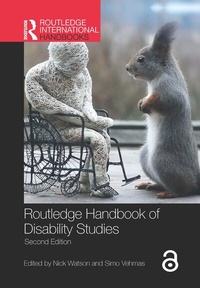
Routledge Handbook of Disability Studies
2nd Edition
Published on 29. October 2019
Book
Hardback
562 pages
978-1-138-36530-8 (ISBN)
Description
This fully revised and expanded second edition of the Routledge Handbook of Disability Studies takes a multidisciplinary approach to disability and provides an authoritative and up-to-date overview of the main issues in the field around the world today. Adopting an international perspective and arranged thematically, it surveys the state of the discipline, examining emerging and cutting-edge areas as well as core areas of contention.
Divided in five parts, this comprehensive handbook covers:
Different models and approaches to disability
How key impairment groups have engaged with disability studies and the writings within the discipline
Policy and legislation responses to disability studies and to disability activism
Disability studies and its interaction with other disciplines, such as history, philosophy, sport, and science and technology studies
Disability studies and different life experiences, examining how disability and disability studies intersects with ethnicity, sexuality, gender, childhood and ageing
Containing 15 revised chapters and 12 new chapters from an international selection of leading scholars, this authoritative handbook is an invaluable reference for all academics, researchers, and more advanced students in disability studies and associated disciplines such as sociology, health studies and social work.
Chapter 6 of this book is freely available as a downloadable Open Access PDF at http://www.taylorfrancis.com under a Creative Commons Attribution-Non Commercial-No Derivatives (CC-BY-NC-ND) 4.0 license.
Divided in five parts, this comprehensive handbook covers:
Different models and approaches to disability
How key impairment groups have engaged with disability studies and the writings within the discipline
Policy and legislation responses to disability studies and to disability activism
Disability studies and its interaction with other disciplines, such as history, philosophy, sport, and science and technology studies
Disability studies and different life experiences, examining how disability and disability studies intersects with ethnicity, sexuality, gender, childhood and ageing
Containing 15 revised chapters and 12 new chapters from an international selection of leading scholars, this authoritative handbook is an invaluable reference for all academics, researchers, and more advanced students in disability studies and associated disciplines such as sociology, health studies and social work.
Chapter 6 of this book is freely available as a downloadable Open Access PDF at http://www.taylorfrancis.com under a Creative Commons Attribution-Non Commercial-No Derivatives (CC-BY-NC-ND) 4.0 license.
More details
Edition
2nd edition
Language
English
Place of publication
London
United Kingdom
Publishing group
Taylor & Francis Ltd
Target group
College/higher education
Professional and scholarly
Illustrations
11 s/w Abbildungen, 1 s/w Photographie bzw. Rasterbild, 10 s/w Zeichnungen, 4 s/w Tabellen
4 Tables, black and white; 10 Line drawings, black and white; 1 Halftones, black and white; 11 Illustrations, black and white
Dimensions
Height: 246 mm
Width: 174 mm
Weight
920 gr
ISBN-13
978-1-138-36530-8 (9781138365308)
Copyright in bibliographic data and cover images is held by Nielsen Book Services Limited or by the publishers or by their respective licensors: all rights reserved.
Schweitzer Classification
Other editions
Additional editions
Nick Watson | Alan Roulstone | Carol Thomas
Routledge Handbook of Disability Studies
Book
09/2022
2nd Edition
Routledge
€73.60
Shipment within 10-20 days
Nick Watson | Alan Roulstone | Carol Thomas
Routledge Handbook of Disability Studies
E-Book
10/2019
2nd Edition
Routledge
€64.49
Available for download
Nick Watson | Alan Roulstone | Carol Thomas
Routledge Handbook of Disability Studies
E-Book
10/2019
2nd Edition
Routledge
€64.49
Available for download
Previous edition
Nick Watson | Alan Roulstone | Carol Thomas
Routledge Handbook of Disability Studies
Book
02/2012
1st Edition
Routledge
€297.12
Withdrawn from sale
Persons
Nick Watson is Professor of Disability Research and Director of the Centre for Disability Research at the University Glasgow, UK. He has written on a range of disability issues including disability and technology, disability and identity and disability theory. He is on the executive editorial board of Disability & Society and is Director of What Works Scotland.
Simo Vehmas is Professor of Special Education at Stockholm University, Sweden. He has written on various theoretical and ethical issues such as the ontological formation of disability and the moral significance of intellectual disability regarding moral status and sexuality.
Simo Vehmas is Professor of Special Education at Stockholm University, Sweden. He has written on various theoretical and ethical issues such as the ontological formation of disability and the moral significance of intellectual disability regarding moral status and sexuality.
Content
List of figures
List of tables
List of contributors; Part I: Theorising Disability; 1. Disability studies: Into the multidisciplinary future Simo Vehmas and Nick Watson; 2. Understanding the Social Model of Disability: past, present and future Colin Barnes; 3. Critical Disability Studies: rethinking the conventions for the age of postmodernity Margrit Shildrick; 4. "Minority Model: From Liberal to Neo-Liberal Futures of Disability" David Mitchell and Sharon Snyder; 5. The ICF and Its Relationship to Disability Studies Jerome E. Bickenbach; 6. Disability and Human Rights Lucy Series New Addition; 7. Fear, pity and disgust: Emotions and the non-disabled imaginary Bill Hughes; 8. Psycho-emotional disablism: The missing link? Donna Reeve; 9. The Biopolitics of Disability and Animality in Harriet McBryde Johnson Jan Grue and Michael Lundblad; 10. Some problems with disability research Nick Watson; Part II: Theorising impairment and impairment effects; 11. Deaf identities in disability studies: with us or without us? Jackie Leach Scully; 12. Theorising the Position of People with Learning Difficulties within Disability Studies: Progress and pitfalls Kirsten Stalker; 13. Long term disabling Conditions and Disability Theory Sasha Scambler; 14. Critical realism and the 'fourth wave': Deepening and broadening social perspective on mental distress Richard Brunner; 15. It's about time! Understanding the Experience of Speech Impairment Kevin Paterson; 16. Blindness. Sightedness: Disability studies and the defiance of di-vision Ben Whitburn and Rod Michalko; Part III: Social Policy and Disability: Health, Personal Assistance, Employment and Education; 17. Social Suffering in the Neoliberal Age: Surplusisty and the partially Disabled Subject Karen Soldatic; 18. Disabled People and Employment: A UK Perspective Rosa Morris; 19. Disability Studies, Inclusive Education & Exclusion. Michele Moore, Roger Slee; 20. Independent living and the failure of governments Charlotte Pearson; 21. Diagnosis as Social Practice and the Possibility of Interruption Scott Danforth; 22. Boundary maintenance: Exploring the intersections of disability and migration Nicola Burns; 23. Disability in developing countries Tom Shakespeare; Part IV: Disability Studies and Interdisciplinarity; 24. The Metanarrative of Disability: Social encounters, cultural representation and critical avoidance David Bolt; 25. What can philosophy tell us about disability? Simo Vehmas and Christopher A. Riddle; 26. The Psychology of Disability Dan Goodley; 27. Challenging the Impairment/Disability Divide: Disability History and the Social Model of Disability Michael Rembis; 28. Disability, sport and physical activity Brett Smith and Andrew C. Sparkes; 29. We have never been able-bodied: thoughts on dis/ability and subjectivity from Science and Technology Studies Vasilis Galis; Section V: Contextualising the Disability experience; 30. Feminism and Disability: A Cartography of Multiplicity Ana Be; 31. Disability and sexuality Xanthe Hunt; 32. Race/ethnicity and disability studies: towards an explicitly intersectional approach Deborah Stienstra; 33. Mothering and Disability: from eugenics to newgenics Claudia Malacrida; 34. Understanding disabled families: Replacing tales of burden with ties of interdependency Janice McLaughlin; 35. 'I Hope He Dies Before Me' - Unraveling the Debates About Aging and People with Intellectual Disability Christine Bigby; Index
List of tables
List of contributors; Part I: Theorising Disability; 1. Disability studies: Into the multidisciplinary future Simo Vehmas and Nick Watson; 2. Understanding the Social Model of Disability: past, present and future Colin Barnes; 3. Critical Disability Studies: rethinking the conventions for the age of postmodernity Margrit Shildrick; 4. "Minority Model: From Liberal to Neo-Liberal Futures of Disability" David Mitchell and Sharon Snyder; 5. The ICF and Its Relationship to Disability Studies Jerome E. Bickenbach; 6. Disability and Human Rights Lucy Series New Addition; 7. Fear, pity and disgust: Emotions and the non-disabled imaginary Bill Hughes; 8. Psycho-emotional disablism: The missing link? Donna Reeve; 9. The Biopolitics of Disability and Animality in Harriet McBryde Johnson Jan Grue and Michael Lundblad; 10. Some problems with disability research Nick Watson; Part II: Theorising impairment and impairment effects; 11. Deaf identities in disability studies: with us or without us? Jackie Leach Scully; 12. Theorising the Position of People with Learning Difficulties within Disability Studies: Progress and pitfalls Kirsten Stalker; 13. Long term disabling Conditions and Disability Theory Sasha Scambler; 14. Critical realism and the 'fourth wave': Deepening and broadening social perspective on mental distress Richard Brunner; 15. It's about time! Understanding the Experience of Speech Impairment Kevin Paterson; 16. Blindness. Sightedness: Disability studies and the defiance of di-vision Ben Whitburn and Rod Michalko; Part III: Social Policy and Disability: Health, Personal Assistance, Employment and Education; 17. Social Suffering in the Neoliberal Age: Surplusisty and the partially Disabled Subject Karen Soldatic; 18. Disabled People and Employment: A UK Perspective Rosa Morris; 19. Disability Studies, Inclusive Education & Exclusion. Michele Moore, Roger Slee; 20. Independent living and the failure of governments Charlotte Pearson; 21. Diagnosis as Social Practice and the Possibility of Interruption Scott Danforth; 22. Boundary maintenance: Exploring the intersections of disability and migration Nicola Burns; 23. Disability in developing countries Tom Shakespeare; Part IV: Disability Studies and Interdisciplinarity; 24. The Metanarrative of Disability: Social encounters, cultural representation and critical avoidance David Bolt; 25. What can philosophy tell us about disability? Simo Vehmas and Christopher A. Riddle; 26. The Psychology of Disability Dan Goodley; 27. Challenging the Impairment/Disability Divide: Disability History and the Social Model of Disability Michael Rembis; 28. Disability, sport and physical activity Brett Smith and Andrew C. Sparkes; 29. We have never been able-bodied: thoughts on dis/ability and subjectivity from Science and Technology Studies Vasilis Galis; Section V: Contextualising the Disability experience; 30. Feminism and Disability: A Cartography of Multiplicity Ana Be; 31. Disability and sexuality Xanthe Hunt; 32. Race/ethnicity and disability studies: towards an explicitly intersectional approach Deborah Stienstra; 33. Mothering and Disability: from eugenics to newgenics Claudia Malacrida; 34. Understanding disabled families: Replacing tales of burden with ties of interdependency Janice McLaughlin; 35. 'I Hope He Dies Before Me' - Unraveling the Debates About Aging and People with Intellectual Disability Christine Bigby; Index