

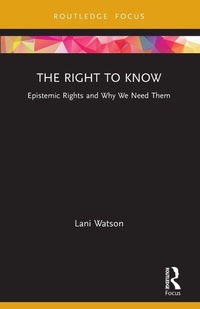
The Right to Know
Epistemic Rights and Why We Need Them
1st Edition
Published on 30. May 2022
Book
Paperback/Softback
126 pages
978-1-032-03910-7 (ISBN)
Description
We speak of the right to know with relative ease. You have the right to know the results of a medical test or to be informed about the collection and use of personal data. But what exactly is the right to know, and who should we trust to safeguard it?
This book provides the first comprehensive examination of the right to know and other epistemic rights: rights to goods such as information, knowledge and truth. These rights play a prominent role in our information-centric society and yet they often go unnoticed, disregarded and unprotected. As such, those who control what we know, or think we know, exert an influence on our lives that is often as dangerous as it is imperceptible.
Beginning with a rigorous but accessible philosophical account of epistemic rights, Lani Watson examines the harms caused by epistemic rights violations, drawing on case studies across medical, political and legal contexts. She investigates who has the right to what information, who is responsible for the quality and circulation of information and what epistemic duties we have towards each other. This book is essential reading for philosophers, legal theorists and anyone concerned with the protection and promotion of information, knowledge and truth.
.
This book provides the first comprehensive examination of the right to know and other epistemic rights: rights to goods such as information, knowledge and truth. These rights play a prominent role in our information-centric society and yet they often go unnoticed, disregarded and unprotected. As such, those who control what we know, or think we know, exert an influence on our lives that is often as dangerous as it is imperceptible.
Beginning with a rigorous but accessible philosophical account of epistemic rights, Lani Watson examines the harms caused by epistemic rights violations, drawing on case studies across medical, political and legal contexts. She investigates who has the right to what information, who is responsible for the quality and circulation of information and what epistemic duties we have towards each other. This book is essential reading for philosophers, legal theorists and anyone concerned with the protection and promotion of information, knowledge and truth.
.
Reviews / Votes
"Watson makes a powerful and timely case for the adoption of a rights framework to understand and address the wrongs resulting from doubt mongering and misinformation campaigns. Written in a lucid and accessible style this book provides a defence of citizens' right to know and of institutions and corporations' duty to inform. It lays the groundwork for what promises to be a whole new area of inquiry." - Alessandra Tanesini, Cardiff University, UK "Watson makes a powerful and timely case for the adoption of a rights framework to understand and address the wrongs resulting from doubt mongering and misinformation campaigns. Written in a lucid and accessible style this book provides a defence of citizens' right to know and of institutions and corporations' duty to inform. It lays the groundwork for what promises to be a whole new area of inquiry." - Alessandra Tanesini, Cardiff University, UKMore details
Series
Language
English
Place of publication
London
United Kingdom
Publishing group
Taylor & Francis Ltd
Target group
College/higher education
Postgraduate and Undergraduate
Dimensions
Height: 216 mm
Width: 140 mm
Thickness: 7 mm
Weight
172 gr
ISBN-13
978-1-032-03910-7 (9781032039107)
Copyright in bibliographic data and cover images is held by Nielsen Book Services Limited or by the publishers or by their respective licensors: all rights reserved.
Schweitzer Classification
Other editions
Additional editions
Book
05/2021
1st Edition
Routledge
€76.80
Shipment within 10-20 days
E-Book
05/2021
1st Edition
Routledge
€31.49
Available for download
E-Book
05/2021
1st Edition
Routledge
€31.49
Available for download
Person
Content
Introduction 1. What Are Epistemic Rights? 2. Who Has Epistemic Rights? 3. When Are Epistemic Rights Violated? 4. Who Gets Hurt? 5. Why do We Need Epistemic Rights?