

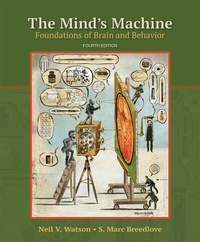
The Mind's Machine
Foundations of Brain and Behavior
4th Edition
Published in January 2022
Book
Paperback/Softback
624 pages
978-0-19-754281-1 (ISBN)
Description
The Mind's Machine imparts the core concepts of behavioral neuroscience to students in a diverse range of disciplines, including not only psychology and the other life sciences, but art, philosophy, media studies, linguistics, and the like. Now featuring Oxford Insight for adaptive learning, integrated with interactive learning tools, The Mind's Machine, Fourth Edition, offers a streamlined text, full-color art, novel pedagogical features, and
real-life examples and analogies to engage students new to neuroscience without sacrificing accuracy. This accessible, reader-friendly book is appropriate for brain and behavior, biopsychology, and physiological psychology courses.
real-life examples and analogies to engage students new to neuroscience without sacrificing accuracy. This accessible, reader-friendly book is appropriate for brain and behavior, biopsychology, and physiological psychology courses.
Reviews / Votes
The Mind's Machine is a must-have textbook for any student, in any field, wanting to learn how and why we do the things we do. It is up-to-date and cleverly written with beautiful illustrations within the chapters and visual summaries. * Alicia Walf, Rensselaer Polytechnic Institute * This is a very readable introduction to the biological bases of behavior. It includes helpful graphics, useful study aides, both in the book and online, and well curated animations, videos, research vignettes, and study guides and quizzes to aid students learning and help instructors improve their course delivery. * Christina Williams, Duke University * "The mind and the machine has some of the best figures of any textbook. The text is very easy to read, and the structure of the material follows my course structure fairly closely."-Anonymous "A very well written textbook with some quirky artwork, very detailed pedagogical elements and aids on every page directed toward student's comprehension. It is very useful also to start class discussions due to the wealth of external links and cultural references, which makes it relevant for the modern student. The modular organization is also a welcoming feature which makes it easier to prepare classes and assign reading."-Anonymous "A very readable introduction to the biological bases of behavior that includes helpful graphics, useful study aides both in the book and on-line, and well curated animations, videos, research vignettes, and study guides and quizzes to aid students learning and help instructors improve their course delivery."-Christina Williams, Duke University "A very nice intro level text, appropriate for psychology majors at an intermediate level. The authors are knowledgeable and have been working on these texts for a very long time. The price is reasonable." -Mark S. Schmidt, Columbus State UniversityMore details
Edition
4th Revised edition
Language
English
Place of publication
New York
United States
Target group
College/higher education
Edition type
Revised edition
ISBN-13
978-0-19-754281-1 (9780197542811)
Copyright in bibliographic data and cover images is held by Nielsen Book Services Limited or by the publishers or by their respective licensors: all rights reserved.
Schweitzer Classification
Persons
Neil V. Watson and the members of his lab at Simon Fraser University in Vancouver, Canada study sex-related aspects of the structure and function of the nervous system, with ongoing grant support from the Natural Sciences and Engineering Research Council of Canada. His research, which spans from the effects of hormones and pollutants on the structure of the nervous system to the relationships among social factors, cognition, and steroids in humans,
has appeared in a variety of journals, including the Journal of Neuroscience, the Proceedings of the National Academy of Science, and Brain Research. Dr. Watson received his undergraduate and master's degrees from the University of Western Ontario and his Ph.D. from the University of British Columbia. Following a
postdoctoral fellowship at the University of California, Berkeley, he joined the faculty at SFU in 1996 where he is now Professor of Behavioral Neuroscience and Chair of Psychology. He teaches biological psychology to hundreds of
undergraduate and graduate students each year.
S. Marc Breedlove, the Barnett Rosenberg Professor of Neuroscience at Michigan State University, has written over 130 scientific articles investigating the role of hormones in shaping the developing and adult nervous system, publishing in journals including Science, Nature, Nature Neuroscience, and the Proceedings of the National Academy of Science. He is also passionate about teaching-in the classroom, and in the greater community through interviews with the Washington Post,
Los Angeles Times, New York Times, and Newsweek, as well as broadcast programs such as All Things Considered, Good Morning America, and Sixty Minutes. He has active grant support from the National Institute of Neurological Disorders and Stroke and the National Institute of Mental Health. Dr. Breedlove is a Fellow of
the American Association for the Advancement of Science and the Association for Psychological Science.
has appeared in a variety of journals, including the Journal of Neuroscience, the Proceedings of the National Academy of Science, and Brain Research. Dr. Watson received his undergraduate and master's degrees from the University of Western Ontario and his Ph.D. from the University of British Columbia. Following a
postdoctoral fellowship at the University of California, Berkeley, he joined the faculty at SFU in 1996 where he is now Professor of Behavioral Neuroscience and Chair of Psychology. He teaches biological psychology to hundreds of
undergraduate and graduate students each year.
S. Marc Breedlove, the Barnett Rosenberg Professor of Neuroscience at Michigan State University, has written over 130 scientific articles investigating the role of hormones in shaping the developing and adult nervous system, publishing in journals including Science, Nature, Nature Neuroscience, and the Proceedings of the National Academy of Science. He is also passionate about teaching-in the classroom, and in the greater community through interviews with the Washington Post,
Los Angeles Times, New York Times, and Newsweek, as well as broadcast programs such as All Things Considered, Good Morning America, and Sixty Minutes. He has active grant support from the National Institute of Neurological Disorders and Stroke and the National Institute of Mental Health. Dr. Breedlove is a Fellow of
the American Association for the Advancement of Science and the Association for Psychological Science.
Content
1. Cells and Structures: The Anatomy of the Nervous System
2. Neurophysiology: The Generation, Transmission, and Integration of Neural Signals
3. The Chemistry of Behavior: Neurotransmitters and Neuropharmacology
4. Development of the Brain
5. The Sensorimotor System
6. Hearing, Balance, Taste, and Smell
7. Vision: From Eye to Brain
8. Hormones and Sex
9. Homeostasis: Active Regulation of the Internal Environment
10. Biological Rhythms and Sleep
11. Emotions, Aggression, and Stress
12. Psychopathology: The Biology of Behavioral Disorders
13. Memory, Learning, and Development
14. Attention and Higher Cognition
15. Language and Lateralization
2. Neurophysiology: The Generation, Transmission, and Integration of Neural Signals
3. The Chemistry of Behavior: Neurotransmitters and Neuropharmacology
4. Development of the Brain
5. The Sensorimotor System
6. Hearing, Balance, Taste, and Smell
7. Vision: From Eye to Brain
8. Hormones and Sex
9. Homeostasis: Active Regulation of the Internal Environment
10. Biological Rhythms and Sleep
11. Emotions, Aggression, and Stress
12. Psychopathology: The Biology of Behavioral Disorders
13. Memory, Learning, and Development
14. Attention and Higher Cognition
15. Language and Lateralization