

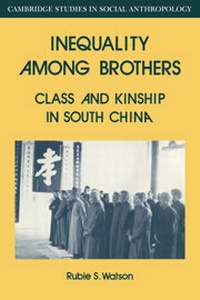
Inequality Among Brothers
Class and Kinship in South China
Published on 26. April 1985
Book
Hardback
203 pages
978-0-521-26770-0 (ISBN)
Description
Using historical documents and evidence gathered in the field, Rubie Watson provides a social history of the 600-year-old Chinese lineage village of Ha Tsuen in the New Territories of Hong Kong, and demonstrates the crucial role that the lineage played in the evolution of the community from a few scattered households in the fourteenth century into a regional power from the 1700s onwards. Despite a patrilineal ideology that extols the virtues of brotherhood and equality, Dr Watson shows that the lineage has in fact played a central role in the formation, development and maintenance of an elite class of landlords and merchants, who, even though their economic importance has now declined, continue to exert political control. Dr Watson examines the dynamics of interclass relations within a single lineage and shows how these relations have been transformed as a consequence of the growth of wage labour.
More details
Series
Language
English
Place of publication
Cambridge
United Kingdom
Target group
Professional and scholarly
Dimensions
Height: 235 mm
Width: 160 mm
Thickness: 20 mm
Weight
422 gr
ISBN-13
978-0-521-26770-0 (9780521267700)
Copyright in bibliographic data and cover images is held by Nielsen Book Services Limited or by the publishers or by their respective licensors: all rights reserved.
Schweitzer Classification
Other editions
New editions
Book
09/2007
Cambridge University Press
€48.60
Shipment within 15-20 days
Additional editions
Book
09/2007
Cambridge University Press
€48.60
Shipment within 15-20 days
Content
Preface; Maps; 1. Introduction; 2. The development of the Teng lineage: Ha Tsuen's early history; 3. Lineage organization and ideology; 4. Economic organization: the land and the market; 5. Local political organization; 6. Class differences in Ha Tsuen: the social and cultural dimension; 7. Marriage, affinity and class; 8. Economic and political changes: 1945-1978; 9. Social and cultural transformations; 10. Class and kinship; References; Glossary; Index.