

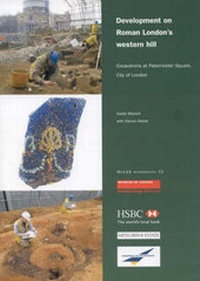
Development on Roman London's Western Hill
Excavations at Paternoster Square, City of London
Published on 30. October 2007
Book
Paperback/Softback
132 pages
978-1-901992-66-3 (ISBN)
Description
Redevelopment of Paternoster Square in 2000-2001 provided the opportunity to reassess 1960s work at the site and review Roman activity on the western hill, south of the main east-west road from London to Silchester. Natural stream channels recorded at Paternoster and nearby sites drained south-westwards towards the Fleet river, rather than to the Thames as had been previously thought. The earliest Roman activity was associated with the c.AD 50 establishment of the main road, contemporary quarries and boundary ditches. One ditch contained two young male inhumation burials and a dog skeleton. Rudimentary buildings south of the road may have been briefly used during initial construction activity. Clay and timber strip buildings along the south side of the main road, and secondary roads leading southwards, date to the pre-Boudican period. The roads and roadside properties were re-established after the Boudican fire. Late 1st-century buildings included residential, commercial and small-scale industrial activities. Two 2nd-century kilns may be associated with brass making and include a crucible. Glassworking debris and furnace material was probably redeposited from nearby. Post-Hadrianic occupation included substantial buildings with tessellated floors and painted plaster walls set back from the roads. Activity declined in the later Roman period and five 4th-century burials cut into a disused secondary road. The southwest part of the site was largely external, with evidence for animal husbandry and bread wheat preparation, rare within Roman contexts. The large assembly of pre-Boudican pottery and other finds from the site includes Lyon ware and types of hinged brooches often associated with the military. A copper-alloy name-tag identified an auxiliary soldier, probably from the lower Rhineland or Cologne, and the early animal bone assemblage was made up of high status kitchen waste of the sort produced by army supply trains, but the overall evidence could indicate a civil context which includes some military involvement.
More details
Series
Language
English
Place of publication
London
United Kingdom
Publishing group
Museum of London Archaeology
Target group
College/higher education
Professional and scholarly
Illustrations
116 illus, 28 tabs
Dimensions
Height: 297 mm
Width: 210 mm
ISBN-13
978-1-901992-66-3 (9781901992663)
Copyright in bibliographic data and cover images is held by Nielsen Book Services Limited or by the publishers or by their respective licensors: all rights reserved.
Schweitzer Classification
Persons
by Sadie Watson and Kieron Heard