

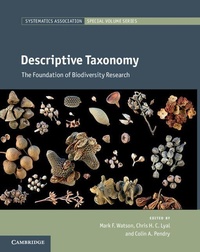
Descriptive Taxonomy
The Foundation of Biodiversity Research
Published on 8. January 2015
Book
Hardback
339 pages
978-0-521-76107-9 (ISBN)
Description
In an age when biodiversity is being lost at an unprecedented rate, it is vital that floristic and faunistic information is up to date, reliable and easily accessible for the formulation of effective conservation strategies. Electronic data management and communication are transforming descriptive taxonomy radically, enhancing both the collection and dissemination of crucial data on biodiversity. This volume is written by scientists at the forefront of current developments of floras and faunas, along with specialists from applied user groups. The chapters review novel methods of research, development and dissemination, which aim to maximise the relevance and impact of data. Regional case studies are used to illustrate the outputs and impacts of taxonomic research. Integrated approaches are presented which have the capacity to accelerate the production of floras and faunas and to better serve the needs of a widening audience.
Reviews / Votes
'An informative collection of emerging issues and cutting-edge technology in taxonomy and biodiversity assessment ... With contributions from 47 biodiversity and taxonomy experts in the UK (plus the US and Ireland), the book describes the challenges related to communicating taxonomy to a wider audience (e.g., through digital field guides); guiding the increased use of genetic information in both taxonomy and conservation; and identifying taxonomic trends impacting biodiversity assessment and conservation. Clearly the gap between taxonomists and conservationists can be closed through the movement toward digitization, online access to collections and checklists, and open access and Creative Commons copyright practices ... This book will be particularly beneficial for researchers who develop or use assessment or monitoring tools.' A. L. Mayer, Choice 'A recommended text for those working in taxonomy and searching for an accessible update on current practices.' Paul Ashton, The BiologistMore details
Series
Language
English
Place of publication
Cambridge
United Kingdom
Target group
Professional and scholarly
Illustrations
6 Tables, black and white; 11 Plates, color; 25 Halftones, unspecified; 11 Line drawings, unspecified
Dimensions
Height: 260 mm
Width: 208 mm
Thickness: 23 mm
Weight
973 gr
ISBN-13
978-0-521-76107-9 (9780521761079)
Copyright in bibliographic data and cover images is held by Nielsen Book Services Limited or by the publishers or by their respective licensors: all rights reserved.
Schweitzer Classification
Other editions
Additional editions
Mark F. Watson | Chris Lyal | Colin Pendry
Descriptive Taxonomy
The Foundation of Biodiversity Research
E-Book
03/2015
Cambridge University Press
€72.99
Available for download
Mark F. Watson | Chris H. C. Lyal | Colin A. Pendry
Descriptive Taxonomy
The Foundation of Biodiversity Research
E-Book
02/2015
Cambridge University Press
€85.99
Available for download
Persons
Mark Watson is Head of the Major Floras research programme at the Royal Botanic Garden Edinburgh (RBGE), where he leads the Flora of Nepal team. He is a taxonomic botanist and expert in floristic research in the Sino-Himalayan region, with over 23 years' experience at RBGE in floristics, fieldwork and biodiversity informatics. Chris Lyal is a researcher at the Natural History Museum in London, with over 40 years' experience in insect taxonomy, including fieldwork in many countries. He has worked on the digitisation of taxonomic literature to address the 'taxonomic impediment' - the shortage of taxonomists and taxonomic tools that hinders work in other areas of biodiversity research and management. Colin Pendry is an editor for the Flora of Nepal based at RBGE. His background is in ecology, and for the last 20 years he has worked as a plant taxonomist. He has extensive experience of fieldwork in the UK, South East Asia, Latin America, the Caribbean and Nepal and is at the forefront of developments in RBGE's fieldwork methods.
Content
List of contributors; Introduction M. F. Watson and C. Lyal; Part I. The Widening Audience: 1. Floras yesterday, today and tomorrow A. G. Miller, M. Hall, M. F. Watson, S. G. Knees, C. Pendry and M. R. Pullan; 2. Current uses and future perspectives for conservation biology B. Collen; 3. The present and future value of Floras for functional ecologists J. Dick, R. Smith and R. Wadsworth; 4. A publisher's perspective: making biodiversity information available and relevant to a wide audience J. Connor; Part II. The Products of Descriptive Taxonomy: 5. Lessons learned from two projects, the Fauna Europaea and the Checklist delle specie della fauna italiana A. Minelli; 6. Flora Europaea and Euro+Med S. L. Jury; 7. Increasing the utility of the regional African Floras D. W. Kirkup, P. Malcolm and A. Paton; 8. Cybertruffle: an on-line resource for mycology D. W. Minter; 9. Zooplankton Identification Manual for North European Seas (ZIMNES) L. C. Hastie; 10. A field guide to the dragonflies and damselflies of Britain and Ireland S. J. Brooks; 11. Sangha Trees: an identification and training guide to the trees of the northern Republic of Congo A. H. Wortley and D. J. Harris; 12. Millennium Seed Bank collector guides D. Hopkins; 13. Training in tropical plant identification D. J. Harris, S. Bridgewater and J.-M. Moutsambote; 14. Field identification of vectors and pathogens of military significance A. G. Gutierrez; Part III. The Influence of Technology on Data Gathering in the Field: 15. The changing role of collections and field research S. Knapp; 16. Field methods for inventorying insects C. L. Haeuser and K. Riede; 17. From seabed to world wide web: an overview of marine zoological sampling, data processing and potential production of digital marine faunas A. L. Allcock and M. Ryan; 18. Advancements in electronic data capture for botanical field research in temperate regions M. F. Watson, A. G. Miller, M. R. Pullan, C. Pendry and S. G. Knees; Part IV. New Technologies: Their Current Use and Future Potential: 19. Extending floras and faunas to include users' views A. L. Weitzman and C. Lyal; 20. Taxa, taxon names and globally unique identifiers in perspective R. Hyam; 21. E-publishing descriptive taxonomy: the convergence of taxonomic journals and databases V. S. Smith; 22. DNA barcoding in floral and faunal research S. E. Miller; Index.