

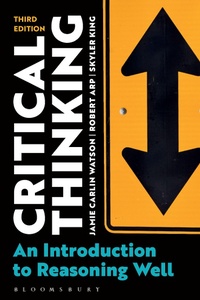
Critical Thinking
An Introduction to Reasoning Well
3rd Edition
Published on 22. February 2024
Book
Paperback/Softback
536 pages
978-1-350-23293-8 (ISBN)
Description
'You shouldn't drink too much. The Earth is round. Milk is good for your bones.' Are any of these claims true? How can you tell? Can you ever be certain you are right?
For anyone tackling philosophical logic for the first time, here is a practical guide to the skills required to think critically. From the basics of good reasoning to the difference between claims, evidence and arguments, Jamie Carlin Watson, Robert Arp and Skyler King cover the topics found in an introductory course.
Now revised and fully updated, this 3rd edition gives you the chance to develop critical thinking skills that can be used in and out of the classroom. Two new chapters on reasoning in the age of conspiracy theories and fake news demonstrate how to apply reason and avoid being dissuaded by the persuasive power of evidence-free emoting. Features include a glossary, chapter goals, more student-friendly exercises, study questions, diagrams, and suggestions for further reading. Chapter topics, organised around real-life examples such as predicting the weather, a murder mystery and the Ouija board, cover:
- the structure, formation, analysis and recognition of arguments
- deductive validity and soundness
- inductive strength and cogency
- inference to the best explanation
- truth tables
- tools for argument assessment
- informal and formal fallacies
This entertaining and easy-to-follow introduction is a complete beginner's tool set to good reasoning, analyzing and arguing.
For anyone tackling philosophical logic for the first time, here is a practical guide to the skills required to think critically. From the basics of good reasoning to the difference between claims, evidence and arguments, Jamie Carlin Watson, Robert Arp and Skyler King cover the topics found in an introductory course.
Now revised and fully updated, this 3rd edition gives you the chance to develop critical thinking skills that can be used in and out of the classroom. Two new chapters on reasoning in the age of conspiracy theories and fake news demonstrate how to apply reason and avoid being dissuaded by the persuasive power of evidence-free emoting. Features include a glossary, chapter goals, more student-friendly exercises, study questions, diagrams, and suggestions for further reading. Chapter topics, organised around real-life examples such as predicting the weather, a murder mystery and the Ouija board, cover:
- the structure, formation, analysis and recognition of arguments
- deductive validity and soundness
- inductive strength and cogency
- inference to the best explanation
- truth tables
- tools for argument assessment
- informal and formal fallacies
This entertaining and easy-to-follow introduction is a complete beginner's tool set to good reasoning, analyzing and arguing.
Reviews / Votes
This book provides a comprehensive, yet accessible, approach to critical thinking. It is perfect for any introductory course on logic or critical reasoning or for anyone who just wishes to think better. The application of these tools to conspiracy theories and fake news shows that logic can be interesting, timely, and essential. * Benjamin W. McCraw, Instructor in Philosophy, University of South Carolina Upstate, USA * The new edition of this excellent textbook teaches critical thinking skills that today's students need in ways they will appreciate. * William Irwin, Professor of Philosophy, King's College, USA *More details
Edition
3rd edition
Language
English
Place of publication
London
United Kingdom
Publishing group
Bloomsbury Publishing PLC
Target group
College/higher education
Dimensions
Height: 231 mm
Width: 155 mm
Thickness: 30 mm
Weight
808 gr
ISBN-13
978-1-350-23293-8 (9781350232938)
Copyright in bibliographic data and cover images is held by Nielsen Book Services Limited or by the publishers or by their respective licensors: all rights reserved.
Schweitzer Classification
Other editions
Additional editions
E-Book
01/2024
3rd Edition
Bloomsbury Academic
€28.49
Available for download
E-Book
01/2024
3rd Edition
Bloomsbury Academic
€28.49
Available for download
Persons
Jamie Carlin Watson is Assistant Professor of Medical Humanities and Bioethics at the University of Arkansas for Medical Sciences, USA. He is author of Expertise: A Philosophical Introduction (Bloomsbury, 2020).
Robert Arp is a Researcher and Analyst for projects with the US Army at Ft. Leavenworth, USA. He is the author of 1001 Ideas that Changed the Way We Think (2013). He is also co-editor of South Park and Philosophy (2006), Batman and Philosophy (2008) and Philosophy and Breaking Bad (2017).
Skyler King is Graduate Teaching Assistant at the University of Kansas, USA.
Robert Arp is a Researcher and Analyst for projects with the US Army at Ft. Leavenworth, USA. He is the author of 1001 Ideas that Changed the Way We Think (2013). He is also co-editor of South Park and Philosophy (2006), Batman and Philosophy (2008) and Philosophy and Breaking Bad (2017).
Skyler King is Graduate Teaching Assistant at the University of Kansas, USA.
Content
Preface to the Third Edition
Part I: The Basics of Good Reasoning
1. The Basic Tools of Reasoning
2. Evaluating Arguments
Part II: Deductive Reasoning
3. Thinking and Reasoning with Categories
4. Basic Propositional Logic
5. Truth Tables
6. Rules of Inference
Part III: Inductive Reasoning
7. Probability and Induction
Real-life Examples
8. Inductive Arguments
Real-life Examples
9. Experiment and Inference to the Best Explanation
10. Informal Fallacies
Real-life Examples
Part IV: Application
11. Putting it All Together
12. Reasoning in the age of Conspiracy Theories
13. Reasoning in the age of Fake News
Glossary
Index
Part I: The Basics of Good Reasoning
1. The Basic Tools of Reasoning
2. Evaluating Arguments
Part II: Deductive Reasoning
3. Thinking and Reasoning with Categories
4. Basic Propositional Logic
5. Truth Tables
6. Rules of Inference
Part III: Inductive Reasoning
7. Probability and Induction
Real-life Examples
8. Inductive Arguments
Real-life Examples
9. Experiment and Inference to the Best Explanation
10. Informal Fallacies
Real-life Examples
Part IV: Application
11. Putting it All Together
12. Reasoning in the age of Conspiracy Theories
13. Reasoning in the age of Fake News
Glossary
Index