

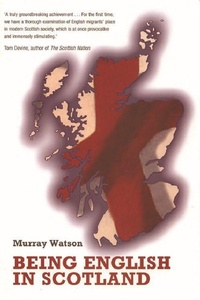
Being English in Scotland
Will be published approx. on 20. October 2003
Book
Paperback/Softback
224 pages
978-0-7486-1859-0 (ISBN)
Description
Boldly venturing into new territory, Being English in Scotland reveals how a massive increase of English settlers has unobtrusively formed Scotland's most significant migrant community in modern times. The history of relations between England and Scotland is always passionate and often controversial. What is extraordinary is that the pervasive spread and influence of English migration north of the Border has been largely ignored until now.Using a range of different sources including oral history contributions from English people living all over Scotland, Murray Watson explores how the English merged into and contributed to Scottish society in the second half of the twentieth century. Many of the myths surrounding the English in Scotland are dispelled and what emerges instead is that the migratory experience has been extremely complex and multi-faceted in nature. The near-invisible absorption of so many English-born migrants has far-reaching implications for the host communities at a local, regional and national level, as well as influencing Scotland's economy, its demography, culture and society. At a political and constitutional level, after a number of false starts, Scotland has gained some measure of devolved autonomy. And here, English migrants have shown a range of fascinating responses in the reconstruction of their own identities. In leaving behind the undoubted insecurities and uncertainties about what it means to be English, their reactions to moving to a country with strong traditions of national feeling has been intriguing and surprising.The first comprehensive exploration of the complex process of English migration into Scotland, Being English in Scotland challenges us with as many questions as answers.Key Features:*The first full-scale coverage of the English in Scotland - Scotland's largest migrant group (over 366,000 English-born adults live in Scotland).*Challenges many of the commonly-held assumptions and myths abou
Reviews / Votes
A stimulating and challenging examination of a significant aspect of the Anglo-Scottish relationship ! A readable, thought-provoking book. A fascinating examination of the place in Scottish society of Scotland's largest migrant group. Contributes to a notable void in migration studies ! raises many interesting issues regarding the migration process ! the book makes a significant contribution ! The 'hidden' nature of English migrants in Scotland is an important finding ! Useful testimonies have been recorded ! There is no doubt that a book examining the English in Scotland has been long overdue. This book will therefore be of interest to many. This book is a truly ground breaking achievement. Despite their importance, English immigrants in Scotland have received little attention from scholars. Now, for the first time, we have a thorough examination of their place in modern Scottish society which is at once provocative and immensely stimulating. Being English in Scotland deserves a wide readership. -- Tom Devine, author of The Scottish Nation Watson's premise is that historians have consistently ignored Scotland's largest migrant group, the English, and he aims to fill this gap. In so doing, he has produced a readable and at times humorous account ! [Watson] has an uncanny ability to identify intriguing features within the heterogenous forms of English migration into Scotland. A stimulating and challenging examination of a significant aspect of the Anglo-Scottish relationship ! A readable, thought-provoking book. A fascinating examination of the place in Scottish society of Scotland's largest migrant group. Contributes to a notable void in migration studies ! raises many interesting issues regarding the migration process ! the book makes a significant contribution ! The 'hidden' nature of English migrants in Scotland is an important finding ! Useful testimonies have been recorded ! There is no doubt that a book examining the English in Scotland has been long overdue. This book will therefore be of interest to many. This book is a truly ground breaking achievement. Despite their importance, English immigrants in Scotland have received little attention from scholars. Now, for the first time, we have a thorough examination of their place in modern Scottish society which is at once provocative and immensely stimulating. Being English in Scotland deserves a wide readership. Watson's premise is that historians have consistently ignored Scotland's largest migrant group, the English, and he aims to fill this gap. In so doing, he has produced a readable and at times humorous account ! [Watson] has an uncanny ability to identify intriguing features within the heterogenous forms of English migration into Scotland.More details
Language
English
Place of publication
Edinburgh
United Kingdom
Target group
Professional and scholarly
Product notice
Paperback (trade)
Unsewn / adhesive bound
Dimensions
Height: 235 mm
Width: 157 mm
Thickness: 14 mm
Weight
343 gr
ISBN-13
978-0-7486-1859-0 (9780748618590)
Copyright in bibliographic data and cover images is held by Nielsen Book Services Limited or by the publishers or by their respective licensors: all rights reserved.
Schweitzer Classification
Person
Murray Watson conducted research about the English in Scotland at the University of Dundee. Born in Scotland in 1947, he emigrated as a child to the West Indies, then went to read economic history at the University of Kent. After pursuing a career in marketing, mostly in England, he returned to his native Scottish Borders with his English-born wife in 1998.
Content
1. A Gentle Wooing; 2. Exposing an Inexplicable Gap in Scottish History; 3. Scotland's Largest Minority Group; 4. 'There are more people of English birth than ever before' - Introducing the Oral Testimonies; 5. Taking the High Road; 6. Structural 'Invisibility'; 7. Fitting in - the Process of Integration; 8. Anglophobia; 9. Sport, Politics and the Media; 10. National Identities; 11. Conclusion; Bibliography.