

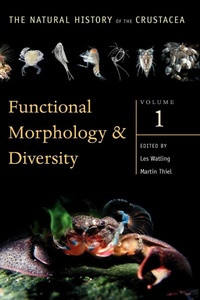
Functional Morphology and Diversity
Published on 16. January 2013
Book
Hardback
516 pages
978-0-19-539803-8 (ISBN)
Description
Crustaceans are increasingly used as model organisms in all fields of biology, including neurobiology, developmental biology, animal physiology, evolutionary ecology, biogeography, and resource management. One reason for the increasing use of crustacean examples is the wide range of phenotypes found in this group and the diversity of environments they inhabit; few other taxa exhibit such a variety of body shapes and adaptations to particular habitats and environmental conditions. A good overview of their functional morphology is essential to understanding many aspects of their biology.
This volume is the first in The Natural History of Crustacea series, a ten-volume series that will treat all aspects of crustacean biology, physiology, behavior, and evolution. The series updates and synthesizes a growing wealth of information on the natural history of this remarkable group. Functional Morphology and Diversity explores the functional morphology of crustaceans, which cover the main body parts and systems. The book brings together a group of internationally recognized-and up-and-coming-experts in fields related to systematics and morphology. Contributing authors study a range of crustacean taxa and topics, and thus the volume provides a compact overview of the great phenotypic diversity and their function found among crustaceans. The first broad treatment of Crustacea in decades, the book will be invaluable for researchers and students in this and related fields.
This volume is the first in The Natural History of Crustacea series, a ten-volume series that will treat all aspects of crustacean biology, physiology, behavior, and evolution. The series updates and synthesizes a growing wealth of information on the natural history of this remarkable group. Functional Morphology and Diversity explores the functional morphology of crustaceans, which cover the main body parts and systems. The book brings together a group of internationally recognized-and up-and-coming-experts in fields related to systematics and morphology. Contributing authors study a range of crustacean taxa and topics, and thus the volume provides a compact overview of the great phenotypic diversity and their function found among crustaceans. The first broad treatment of Crustacea in decades, the book will be invaluable for researchers and students in this and related fields.
More details
Series
Language
English
Place of publication
New York
United States
Target group
College/higher education
Researchers and students working on Crustacea, as well as biologists studying other taxa.
Dimensions
Height: 260 mm
Width: 183 mm
Thickness: 32 mm
Weight
1155 gr
ISBN-13
978-0-19-539803-8 (9780195398038)
Copyright in bibliographic data and cover images is held by Nielsen Book Services Limited or by the publishers or by their respective licensors: all rights reserved.
Schweitzer Classification
Other editions
Additional editions
Les Watling | Martin Thiel
Functional Morphology and Diversity
E-Book
12/2012
OUP eBook
€191.99
Available for download
Persons
Les Watling is Professor in the Department of Zoology at the University of Hawaii.
Martin Thiel is Professor of Marine Biology at the Universidad Catolica del Norte in Chile.
Martin Thiel is Professor of Marine Biology at the Universidad Catolica del Norte in Chile.
Content
Chapter 1: Comments on Crustacean Biodiversity and Disparity of Body Plans ; Frederick S. Schram ; Chapter 2: Evolution of Crustacean Appendages ; Joachim T. Haug, Andreas Maas, Carolin Haug and Dieter Waloszek ; Chapter 3: Mechanisms of Limb Patterning in Crustaceans ; Terri A. Williams ; Chapter 4: The Crustacean Carapace - Morphology, Function, Development, and Phylogenetic History ; Jorgen Olesen ; Chapter 5: The Crustacean Integument: Structure and Function ; Richard Dillaman, Robert Roer, Thomas Shafer and Shannon Modla ; Chapter 6: The Crustacean Integument: Setae, Setules and other Ornamentation ; Anders Garm and Les Watling ; Chapter 7: Antennules and Antennae in the Crustacea ; Geoff Boxshall & Damia Jaume ; Chapter 8: Feeding and Digestive System ; Les Watling ; Chapter 9: Appendage Diversity and Modes of Locomotion: Walking ; Jim Belanger ; Chapter 10: Morphological Adaptations of Crustaceans for Digging and Burrowing ; Zen Faulkes ; Chapter 11: Appendage Diversity and Modes of Locomotion: Swimming at Intermediate Reynolds Numbers ; Jeannette Yen ; Chapter 12: Swimming Fast and Furious: Body and Limb Propulsion at Higher Reynolds Numbers ; Michel Boudrias ; Chapter 13: Adaptive Modification of Appendages for Grooming (Cleaning; Antifouling) and Reproduction in the Crustacea ; Raymond T. Bauer ; Chapter 14: Circulatory System and Respiration ; Christian S. Wirkner & Stefan Richter ; Chapter 15: Functional Anatomy of the Reproductive System ; Laura S. Lopez Greco ; Chapter 16: Structure of the Nervous System: General Design and Gross Anatomy ; Jeremy M. Sullivan & Jens Herberholz