

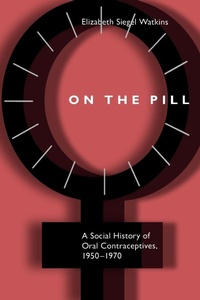
On the Pill
A Social History of Oral Contraceptives, 1950-1970
Published on 9. November 2001
Book
Paperback/Softback
208 pages
978-0-8018-6821-4 (ISBN)
Description
"In 1968, a popular writer ranked the pill's importance with the discovery of fire and the developments of tool-making, hunting, agriculture, urbanism, scientific medicine, and nuclear energy. Twenty-five years later, the leading British weekly, the Economist, listed the pill as one of the seven wonders of the modern world. The image of the oral contraceptive as revolutionary persists in popular culture, yet the nature of the changes it supposedly brought about has not been fully investigated. After more than thirty-five years on the market, the role of the pill is due for a thorough examination."-from the Introduction In this fresh look at the pill's cultural and medical history, Elizabeth Siegel Watkins re-examines the scientific and ideological forces that led to its development, the part women played in debates over its application, and the role of the media, medical profession, and pharmaceutical industry in deciding issues of its safety and meaning. Her study helps us not only to understand the contraceptive revolution as such but also to appreciate the misinterpretations that surround it.
Reviews / Votes
This is an exemplary study of how the nation which first had access to oral contraceptives first came to terms with their advantages, and their drawbacks. -- Jon Turney Times Literary Supplement Intelligent and well-structured... An admirable exercise in social history. -- Richard Davenport-Hines Nature A particularly fascinating issue, trim and focused, sophisticated and helpful, fresh and very interesting. -- Rickie Solinger American Historical Review In every carefully organized, lucidly written chapter Watkins provides surprising corrections to conventional thinking about the new birth control method... One especially noteworthy theme is the book's exploration of the politics of the pill, including Planned Parenthood [Federation] of America's concerted efforts to rebut critics, federal officials' dramatically shifting positions from the 1950s to the 1970s on birth control, population control and family planning, and pill-induced tensions among feminists. -- Janet Farrell Brodie Journal of American History Any study of the development of the birth-control pill will be centrally concerned with the expansion of women's reproductive choices. But, as this book so clearly demonstrates, it involves other questions too. In part, it is about the risks that come with the ingestion of oral contraception. It is about the relationship between women and doctors, between women and their partners and betwen science, medicine and the media. Not least, it is about how women have responded differently to this intervention into their bodies. Underpinned by some excellent archival material, interviews with key individuals and an extensive use of the newspapers, magazines and medical journals of the time, this study is particularly strong in its discussion of concerns over the safety of the Pill... This is not the only area of interest within this valuable book. Anyone concerned with the debate over scientific advance and medical authority will find this a highly stimulating study... For her, the Pill brought the possibility of voluntary pregnancy, and feminist (and other) critics of its medical effects and social repercussions will need to engage carefully with her arguments if this important debate is to be taken to a new level. -- Martin Durham Journal of American StudiesMore details
Language
English
Place of publication
Baltimore, MD
United States
Target group
Professional and scholarly
Product notice
Paperback (trade)
Illustrations
7 s/w Abbildungen
7 Illustrations, black and white
Dimensions
Height: 229 mm
Width: 152 mm
Thickness: 13 mm
Weight
352 gr
ISBN-13
978-0-8018-6821-4 (9780801868214)
DOI
10.56021/9780801858765
Copyright in bibliographic data and cover images is held by Nielsen Book Services Limited or by the publishers or by their respective licensors: all rights reserved.
Schweitzer Classification
Other editions
Additional editions
E-Book
11/2001
Johns Hopkins University Press
€22.49
Available for download

Book
01/1999
Johns Hopkins University Press
€73.23
Article not available for order
Person
Elizabeth Siegel Watkins is an associate professor in the History of Health Sciences at the University of California, San Francisco.
Content
Contents: Acknowledgments Introduction Chapter 1: Genesis of the Pill Chapter 2: Physicians, Patients, and the New Oral Contraceptives Chapter 3: Sex, Population, and the Pill Chapter 4: Debating the Safety of the Pill Chapter 5: Oral Contraceptives and Informed Consent Chapter 6: Conclusion Notes Bibliographical Essay Index