

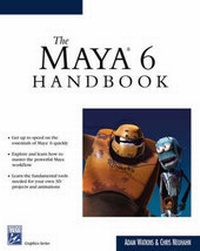
The Maya 6 Handbook
Published on 1. October 2004
Book
Mixed media product
400 pages
978-1-58450-351-4 (ISBN)
Description
Maya[registered] is one of the most widely used 3D animation programs available. It is used in every major movie and by most special effects and game studios. With its new competitive pricing, its user base continues to grow, and with each new release, Maya expands its already impressive feature set. These new features keep Maya users loyal and anxious to upgrade. The Maya 5.X Handbook is a completely updated edition of the best-selling Maya 4.5 Handbook. It not only teaches users how to utilize the new features, but provides a complete guide to the fundamentals of this powerful program. Unlike many books that use a variety of unrelated tutorials, this book uses a complete, practical project for users to work through as they learn to model, render, and animate in Maya. By the conclusion of the book users will understand how and why Maya works, providing them with the knowledge they need to adapt the tools to a variety of tasks and projects. The companion CD-ROM includes all the figures from the book in full color, as well as the Maya files used in the completion of the exercises.
Maya[registered] is one of the most widely used 3D animation programs available. It is used in every major movie and by most special effects and game studios. With its new competitive pricing, its user base continues to grow, and with each new release, Maya expands its already impressive feature set. These new features keep Maya users loyal and anxious to upgrade. The Maya 5.X Handbook is a completely updated edition of the best-selling Maya 4.5 Handbook. It not only teaches users how to utilize the new features, but provides a complete guide to the fundamentals of this powerful program. Unlike many books that use a variety of unrelated tutorials, this book uses a complete, practical project for users to work through as they learn to model, render, and animate in Maya. By the conclusion of the book users will understand how and why Maya works, providing them with the knowledge they need to adapt the tools to a variety of tasks and projects. The companion CD-ROM includes all the figures from the book in full color, as well as the Maya files used in the completion of the exercises.
Maya[registered] is one of the most widely used 3D animation programs available. It is used in every major movie and by most special effects and game studios. With its new competitive pricing, its user base continues to grow, and with each new release, Maya expands its already impressive feature set. These new features keep Maya users loyal and anxious to upgrade. The Maya 5.X Handbook is a completely updated edition of the best-selling Maya 4.5 Handbook. It not only teaches users how to utilize the new features, but provides a complete guide to the fundamentals of this powerful program. Unlike many books that use a variety of unrelated tutorials, this book uses a complete, practical project for users to work through as they learn to model, render, and animate in Maya. By the conclusion of the book users will understand how and why Maya works, providing them with the knowledge they need to adapt the tools to a variety of tasks and projects. The companion CD-ROM includes all the figures from the book in full color, as well as the Maya files used in the completion of the exercises.
More details
Language
English
Place of publication
Hingham
United States
Publishing group
Cengage Learning, Inc
Target group
College/higher education
Illustrations
Illustrations
Dimensions
Height: 235 mm
ISBN-13
978-1-58450-351-4 (9781584503514)
Copyright in bibliographic data and cover images is held by Nielsen Book Services Limited or by the publishers or by their respective licensors: all rights reserved.
Schweitzer Classification
Persons
Adam Watkins (San Antonio, TX) is the director of Computer Arts at the University of the Incatnate Word is San Antonio, Texas. He has a BFA in theater set and lighting design, and an MFA in graphic design. He is also the author of The Maya 4.5 Handbook, The Cinema 4D R8 Handbook and the Final Cut Pro 3 & DVD Studio Pro Handbook. He currently teaches a number of 3D graphics courses, including several on Maya. Chris Neuhahn (Los Angeles, CA) has been working in 3D animation professionally since 1996. He has served as an animator/team lead on MYST III: Exile, part of the bestselling video game series, lead cinematic animator and TD for Pitfall Harry, and visual effects supervisor for Freedom's Gate.
Adam Watkins (San Antonio, TX) is the director of Computer Arts at the University of the Incatnate Word is San Antonio, Texas. He has a BFA in theater set and lighting design, and an MFA in graphic design. He is also the author of The Maya 4.5 Handbook, The Cinema 4D R8 Handbook and the Final Cut Pro 3 & DVD Studio Pro Handbook. He currently teaches a number of 3D graphics courses, including several on Maya. Chris Neuhahn (Los Angeles, CA) has been working in 3D animation professionally since 1996. He has served as an animator/team lead on MYST III: Exile, part of the bestselling video game series, lead cinematic animator and TD for Pitfall Harry, and visual effects supervisor for Freedom's Gate.
Adam Watkins (San Antonio, TX) is the director of Computer Arts at the University of the Incatnate Word is San Antonio, Texas. He has a BFA in theater set and lighting design, and an MFA in graphic design. He is also the author of The Maya 4.5 Handbook, The Cinema 4D R8 Handbook and the Final Cut Pro 3 & DVD Studio Pro Handbook. He currently teaches a number of 3D graphics courses, including several on Maya. Chris Neuhahn (Los Angeles, CA) has been working in 3D animation professionally since 1996. He has served as an animator/team lead on MYST III: Exile, part of the bestselling video game series, lead cinematic animator and TD for Pitfall Harry, and visual effects supervisor for Freedom's Gate.
Content
Chapter 1: Maya Work Flow and Interface; Chapter 2: Getting Started with Modeling; Chapter 3: NURBS and Component-Level Editing; Chapter 4: NURBS Continued; Chapter 5: Component Level Editing and Booleans; Chapter 6: SubDivision Surface Modeling; Chapter 7: Materials and Texturing; Chapter 8: Custom Texture Maps in Materials; Chapter 9: Lighting and Rendering; Chapter 10: Creating a Skeletal System for a Hummingbird; Chapter 11: Animation - Animating the Hummingbird; Appendix A: Which Hardware to Use?; Appendix B: About the CD-ROM, Index