

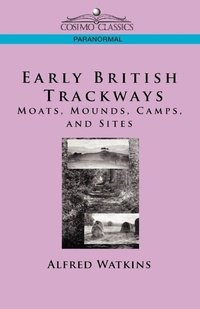
Early British Trackways
Moats, Mounds, Camps and Sites
Published on 1. November 2005
Book
Paperback/Softback
64 pages
978-1-59605-469-1 (ISBN)
Description
These¬-if ancient-seem to be invariably on (not merely alongside) a ley, and in many cases are at the crossing of two leys, thus appropriating the sighting point to a new use.
-from "Churches"
Were the significant sites of ancient Britain deliberately aligned along an invisible web of power? Or is it a mere coincidence that so many locations associated with worship and arcane knowledge are situated in unique spatial relationship to one another?
Self-taught photographer and anthropologist Alfred Watkins was the first to discover the "ley lines" apparently connecting the churches, megaliths, earthen mounds, holy wells, and other places of power in Britain, and he published his results in this 1922 book.
Though he offers no extraordinary explanation of their meaning-except, perhaps, that the leys represent ancient trade routes-others have associated ley lines with UFOs, crop circles, dowsing, and other paranormal phenomena. Long out of print, this foundational work is a vital resource for students of the supernatural.
British photographer and amateur archaeologist ALFRED WATKINS (1855-1935) was a fellow of the Royal Photographic Society and served as president of the Woolhope Naturalists' Field Club in 1919. He also wrote The Old Straight Track (1925) and The Ley Hunter's Manual (1927).
More details
Series
Language
English
Place of publication
United States
Product notice
Paperback (trade)
Unsewn / adhesive bound
Illustrations
Illustrations
Dimensions
Height: 216 mm
Width: 140 mm
Thickness: 4 mm
Weight
94 gr
ISBN-13
978-1-59605-469-1 (9781596054691)
Copyright in bibliographic data and cover images is held by Nielsen Book Services Limited or by the publishers or by their respective licensors: all rights reserved.
Schweitzer Classification