

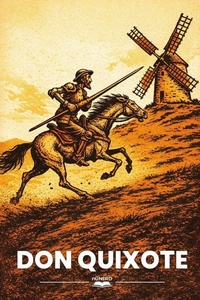
Don Quixote
Description
The most famous novel in the world. The man who wrote it was broke, aging, and had spent five years as a prisoner of war. The character he created has outlasted every empire since.
Around the year 1600, Miguel de Cervantes sat down to write a story. Before Don Quixote, heroes in stories were purely good and villains were purely evil. Cervantes wrote the first character who was both foolish and brave, wrong about everything and right about the thing that matters most. He invented a new kind of story, one where the comedy and the sadness live in the same sentence, and the reader has to decide for themselves what it all means.
This retelling gives young readers the complete novel. Not just the famous windmill scene, but everything most children's versions leave out. Don Quixote frees a group of prisoners who go on to hurt more people. A Duke and Duchess invite him to their castle specifically to humiliate him for entertainment. A man from Don Quixote's own village disguises himself as a knight and defeats him on a beach, forcing him home.
Sancho holds his hand until the end. "You were real," Sancho tells him. "You were good. You helped people." And then Sancho goes home to his farm, his wife, his same old fields. He stands outside at night and looks at the stars, and he is not the same man who left.
The afterword asks the same question university students wrestle with: is it better to see the world as it is, or as it should be? Cervantes didn't answer it. Neither does this book. Your child gets to sit with it, the same way readers have been sitting with it for four centuries.
Includes a foreword on Cervantes' life, pronunciation guides for every Spanish name, and 17 original illustrations. The novel is retold in full. No episodes skipped, no endings softened, no complexity removed.
What this version does: This is where the novel becomes a conversation. Your child doesn't just follow the funny episodes. They see the consequences. They watch Sancho change from a farmer chasing an island into someone who would fight strangers to defend his friend's honor. They feel the cruelty of the Duke and Duchess. They face the ending. And they encounter the question that has kept this novel alive for four hundred years: what do you do with someone who is both a fool and a hero, and you can't have one without the other? Your child gets there years early.
An early chapter book at roughly 7,000 words. Longer than an early reader, shorter than a typical chapter book, with enough depth to reward rereading and enough clarity to read solo.
Ages 6-10 - 96 pages - 7,000 words - Flesch-Kincaid 3.1 - Black-and-white illustrations - Independent and guided reading
Content note: Contains slapstick violence (windmill crash, blanket-tossing, a charge into a flock of sheep), sustained emotional cruelty from the Duke and Duchess, a duel on a beach, and a death scene. Don Quixote's death is handled with tenderness. Sancho holds his hand, and the narrative does not flinch. Themes of friendship, belief, disillusionment, and what it costs to be kind in an unkind world. Appropriate for independent readers who are ready for stories where the ending is sad and the questions don't have easy answers.
Part of the nüNERD Learning System. At 6-8, they're reading with growing independence. You're still there for the hard words and big concepts, but the book is becoming theirs. At 8-10, they're fully solo. The topics you introduced years ago click into place, not just remembered, but understood. nüNERD topics come in three age-appropriate versions, each built for how children actually think at that stage. This is where it takes root.
Also available for Ages 0-4 and Ages 3-7.