

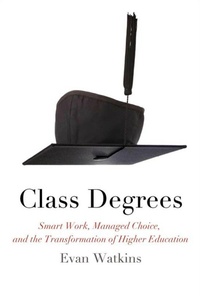
Class Degrees
Smart Work, Managed Choice, and the Transformation of Higher Education
Will be published approx. on 15. September 2008
Book
Paperback/Softback
128 pages
978-0-8232-2983-3 (ISBN)
Description
A current truism holds that the undergraduate degree today is equivalent to the high-school diploma of yesterday. But undergraduates at a research university would probably not recognize themselves in the historical mirror of high-school vocational education. Students in a vast range of institutions are encouraged to look up the educational social scale, whereas earlier vocational education was designed to "cool out" expectations of social advancement by training a working class prepared for massive industrialization.
In Class Degrees, Evan Watkins argues that reforms in vocational education in the 1980s and 1990s can explain a great deal about the changing directions of class formation in the United States, as well as how postsecondary educational institutions are changing.
Responding to a demand for flexibility in job skills and reflecting a consequent aspiration to choice and perpetual job mobility, those reforms aimed to eliminate the separate academic status of vocational education. They transformed it from a "cooling out" to a "heating up" of class expectations. The result has been a culture of hyperindividualism.
The hyperindividual lives in a world permeated with against-all-odds plots, from "beat the odds" of long supermarket checkout lines by using self-checkout and buying FasTrak transponders to beat the odds of traffic jams, to the endless superheroes on film and TV who daily save various sorts of planets and things against all odds.
Of course, a few people can beat the odds only if most other people do not. As choice begins to replace the selling of individual labor at the core of contemporary class formation, the result is a sort of waste labor left behind by the competitive process. Provocatively, Watkins argues that, in the twenty-first century, academic work in the humanities is assuming the management function of reclaiming this waste labor as a motor force for the future.
In Class Degrees, Evan Watkins argues that reforms in vocational education in the 1980s and 1990s can explain a great deal about the changing directions of class formation in the United States, as well as how postsecondary educational institutions are changing.
Responding to a demand for flexibility in job skills and reflecting a consequent aspiration to choice and perpetual job mobility, those reforms aimed to eliminate the separate academic status of vocational education. They transformed it from a "cooling out" to a "heating up" of class expectations. The result has been a culture of hyperindividualism.
The hyperindividual lives in a world permeated with against-all-odds plots, from "beat the odds" of long supermarket checkout lines by using self-checkout and buying FasTrak transponders to beat the odds of traffic jams, to the endless superheroes on film and TV who daily save various sorts of planets and things against all odds.
Of course, a few people can beat the odds only if most other people do not. As choice begins to replace the selling of individual labor at the core of contemporary class formation, the result is a sort of waste labor left behind by the competitive process. Provocatively, Watkins argues that, in the twenty-first century, academic work in the humanities is assuming the management function of reclaiming this waste labor as a motor force for the future.
Reviews / Votes
"No, classes haven't disappeared in the United States. But they certainly don't operate the way they did 150 or even 50 years ago. In this original and timely book, noted scholar and teacher Evan Watkins uses vocational education as a lens to focus on the dramatic changes that are currently taking place in the areas of work, choice, and higher education, which have led to new processes of class formation. He also shows how, if we challenge the assumptions about the magic of the economy, those of us who work in postsecondary education--including, and perhaps especially, the humanities--have a unique opportunity to "use where we are" to bring into being a social world without exploitation." -- -David F. Ruccio University of Notre Dame "A crucial new work from one of our leading theorists." -- -Jeffrey Nealon Pennsylvania State University "One of America's foremost scholars of work, class, and education at the top of his game." -- -Catherine Prendergast University of Illinois, Champaign/UrbanaMore details
Language
English
Place of publication
New York
United States
Target group
Professional and scholarly
Product notice
Paperback (trade)
Dimensions
Height: 221 mm
Width: 150 mm
Thickness: 10 mm
Weight
159 gr
ISBN-13
978-0-8232-2983-3 (9780823229833)
Copyright in bibliographic data and cover images is held by Nielsen Book Services Limited or by the publishers or by their respective licensors: all rights reserved.
Schweitzer Classification
Other editions
Additional editions
E-Book
08/2009
Fordham University Press
€30.49
Available for download
E-Book
08/2009
1st Edition
Fordham University Press
€32.99
Available for download
Person
Evan Watkins is Professor of English at the University of California, Davis. He is the author of Class Degrees: Smart Work, Managed Choice, and the Transformation of Higher Education (Fordham); Everyday Exchanges: Marketwork and Capitalist Common Sense; Throwaways: Work Culture and Consumer Education; and Work Time: English Departments and the Circulation of Cultural Value.