

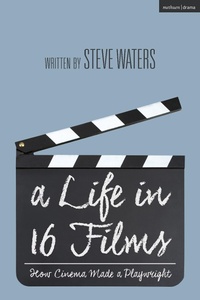
A Life in 16 Films
How Cinema Made a Playwright
Published on 1. July 2021
Book
Paperback/Softback
144 pages
978-1-350-20523-9 (ISBN)
Description
Steve Waters examines how the very idea of film has defined him as a playwright and a person in this book. Through the the lens of cinema, it provides a cultural and political snapshot of life in Britain from the 2nd part of the 20th century up to the present day.
The films spanning almost a century, starting with The White Hell of Pitz Palu (1929) and moving most recently to Dark Waters (2019), each chapter examines aspects of Waters's journey from his working-class Midlands upbringing to working in professional theatre to living through the Covid epidemic, through the prism of a particular film.
From The Wizard of Oz to Code Unknown, from sci-fi to documentary, from queer cinema to world cinema, this honest, comic book offers a view of film as a way of thinking about how we live. In doing so, it illuminates culture and politics in the UK over half a century and provides an intimate insight into drama and writing.
The films spanning almost a century, starting with The White Hell of Pitz Palu (1929) and moving most recently to Dark Waters (2019), each chapter examines aspects of Waters's journey from his working-class Midlands upbringing to working in professional theatre to living through the Covid epidemic, through the prism of a particular film.
From The Wizard of Oz to Code Unknown, from sci-fi to documentary, from queer cinema to world cinema, this honest, comic book offers a view of film as a way of thinking about how we live. In doing so, it illuminates culture and politics in the UK over half a century and provides an intimate insight into drama and writing.
Reviews / Votes
Playwright Steve Waters has come up with a brilliantly simple and original idea: a memoir built round the movies that have shaped his life. The result is partly autobiography, partly social history and partly a hymn of praise to the medium that made him. A jewel of a book: informative, moving, witty and compelling. -- David EdgarMore details
Language
English
Place of publication
London
United Kingdom
Publishing group
Bloomsbury Publishing PLC
Target group
College/higher education
Dimensions
Height: 235 mm
Width: 156 mm
Thickness: 15 mm
Weight
248 gr
ISBN-13
978-1-350-20523-9 (9781350205239)
Copyright in bibliographic data and cover images is held by Nielsen Book Services Limited or by the publishers or by their respective licensors: all rights reserved.
Schweitzer Classification
Other editions
Additional editions
E-Book
06/2021
1st Edition
Methuen Drama
€26.49
Available for download
E-Book
06/2021
1st Edition
Methuen Drama
€26.49
Available for download
Person
Steve Waters's stage plays include The Contingency Plan (2009), Temple (2015), Limehouse (2017) and his radio plays include Miriam and Youssef (2020) for BBC World Service. He has taught at the University of Cambridge and University of Birmingham, where he ran the Playwriting MPhil and currently is Professor of Scriptwriting at the University of East Anglia. He is the author of The Secret Life of Plays (2010), has edited the Contemporary Theatre Review (2013) and written a blog for the Guardian.
Content
Introduction - Dark Waters (2019, Todd Haynes)
Watching film in an age of Covid
The Wizard of Oz (1939, Victor Fleming)
Working-class cinema-going in the Midlands; children and adult film; the Western; film as an embodiment of maleness
Logan's Run (1976, Michael Anderson)
Rural England and the appeal of horror and sci-fi; rural v city; class conflict
Nosferatu The Vampyre (1979, Werner Herzog)
Grammar school in the 80s; uncinematic nature of provincial Britain; discovery of art and European film
Solaris (1972, Andrei Tarkovsky)
Coming of age during Thatcher and punk; film and cycling; the rise of Channel 4 as a vector for film; second cold war; Solaris v Apocalypse Now
Shoah (1985, Claude Lanzmann)
Kibbutz Dalia, Israel; Film and internationalism; film and the Holocaust; travels in the Middle East; confirmation bias
Vagabond (1985, Agnes Varda)
Film and intellectualism at Oxford University; feminist and queer film; making film
Comrades (1986, Bill Douglas)
Film, work and radical politics; Communist and the city of Bristol; theatre and radical film-making; John Akomfrah and Julian Isaac
The White Hell of Pitz Palu (1929, Arnold Fanck and GW Pabst)
Becoming a teacher; film history and education; falling in love through film
Reservoir Dogs (1992, Quentin Tarantino)
Studying with playwrights Sarah Kane and David Edgar; Reservoir Dogs and Blasted; caught between film and theatre; influence of David Mamet, Quentin Tarantino and Sarah Kane
Winter Light (1963, Ingmar Bergman)
Film, marriage and faith; Bergman and Bresson; film as ritual; becoming a theatre director; becoming a playwright
Code Unknown (2001, Michael Haneke)
Film and London; residential playwright at Hampstead Theatre; writing and multi-culturalism; Haneke's pessimism versus 'Cool Britannia'
The Wind Will Carry Us (2000, Abbas Kiarostami)
After 9/11; film and the War on Terror; film and having children; writing World music; influence of Iranian film
An Inconvenient Truth (2006, Davis Guggenheim)
Film and ecology; climate change activism and writing The Contingency Plan; adapting theatre to film
Hell or High Water (2016, David Mackenzie)
Film and precarity; parents' death; illness; end of cinema; growth of populism
Afterword - Girlhood (2019, Celine Sciamma)
Watching films with my daughter
Index
Watching film in an age of Covid
The Wizard of Oz (1939, Victor Fleming)
Working-class cinema-going in the Midlands; children and adult film; the Western; film as an embodiment of maleness
Logan's Run (1976, Michael Anderson)
Rural England and the appeal of horror and sci-fi; rural v city; class conflict
Nosferatu The Vampyre (1979, Werner Herzog)
Grammar school in the 80s; uncinematic nature of provincial Britain; discovery of art and European film
Solaris (1972, Andrei Tarkovsky)
Coming of age during Thatcher and punk; film and cycling; the rise of Channel 4 as a vector for film; second cold war; Solaris v Apocalypse Now
Shoah (1985, Claude Lanzmann)
Kibbutz Dalia, Israel; Film and internationalism; film and the Holocaust; travels in the Middle East; confirmation bias
Vagabond (1985, Agnes Varda)
Film and intellectualism at Oxford University; feminist and queer film; making film
Comrades (1986, Bill Douglas)
Film, work and radical politics; Communist and the city of Bristol; theatre and radical film-making; John Akomfrah and Julian Isaac
The White Hell of Pitz Palu (1929, Arnold Fanck and GW Pabst)
Becoming a teacher; film history and education; falling in love through film
Reservoir Dogs (1992, Quentin Tarantino)
Studying with playwrights Sarah Kane and David Edgar; Reservoir Dogs and Blasted; caught between film and theatre; influence of David Mamet, Quentin Tarantino and Sarah Kane
Winter Light (1963, Ingmar Bergman)
Film, marriage and faith; Bergman and Bresson; film as ritual; becoming a theatre director; becoming a playwright
Code Unknown (2001, Michael Haneke)
Film and London; residential playwright at Hampstead Theatre; writing and multi-culturalism; Haneke's pessimism versus 'Cool Britannia'
The Wind Will Carry Us (2000, Abbas Kiarostami)
After 9/11; film and the War on Terror; film and having children; writing World music; influence of Iranian film
An Inconvenient Truth (2006, Davis Guggenheim)
Film and ecology; climate change activism and writing The Contingency Plan; adapting theatre to film
Hell or High Water (2016, David Mackenzie)
Film and precarity; parents' death; illness; end of cinema; growth of populism
Afterword - Girlhood (2019, Celine Sciamma)
Watching films with my daughter
Index