

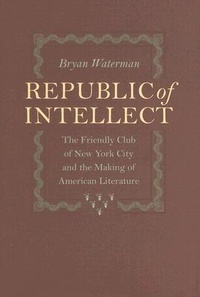
Republic of Intellect
The Friendly Club of New York City and the Making of American Literature
Published on 10. July 2007
Book
Hardback
344 pages
978-0-8018-8566-2 (ISBN)
Description
In the 1790s, a single conversational circle-the Friendly Club-united New York City's most ambitious young writers, and in Republic of Intellect, Bryan Waterman uses an innovative blend of literary criticism and historical narrative to re-create the club's intellectual culture. The story of the Friendly Club reveals the mutually informing conditions of authorship, literary association, print culture, and production of knowledge in a specific time and place-the tumultuous, tenuous world of post-revolutionary New York City. More than any similar group in the early American republic, the Friendly Club occupied a crossroads-geographical, professional, and otherwise-of American literary and intellectual culture. Waterman argues that the relationships among club members' novels, plays, poetry, diaries, legal writing, and medical essays lead to important first examples of a distinctively American literature and also illuminate the local, national, and transatlantic circuits of influence and information that club members called "the republic of intellect."
He addresses topics ranging from political conspiracy in the gothic novels of Charles Brockden Brown to the opening of William Dunlap's Park Theatre, from early American debates on gendered conversation to the publication of the first American medical journal. Voluntary association and print culture helped these young New Yorkers, Waterman concludes, to produce a broader and more diverse post-revolutionary public sphere than scholars have yet recognized.
He addresses topics ranging from political conspiracy in the gothic novels of Charles Brockden Brown to the opening of William Dunlap's Park Theatre, from early American debates on gendered conversation to the publication of the first American medical journal. Voluntary association and print culture helped these young New Yorkers, Waterman concludes, to produce a broader and more diverse post-revolutionary public sphere than scholars have yet recognized.
Reviews / Votes
This book is excellent... Highly recommended for anyone interested in early American print culture, the late Enlightenment, or literary networks. -- Jeremy B. Dibbell philobiblos.blogspot.com 2007 Over the course of Waterman's narrative, the reader is treated to charming and informative vignettes that feature many leading early American intellectuals... His affection for the Friendly Club's endeavor makes Waterman's book charming, vibrant, even persuasive. -- Mark Garrett Longaker American Historical Review 2008 Remarkable study... The book has so much to offer and produces such a fascinating account of late eighteenth-century American cultural life. -- Edward Larkin Modern Intellectual History 2008 Meticulously researched, elegantly written... will be of lasting value to students of eighteenth-century fiction... The depth and quality of research is obvious on every page of Republic of Intellect, as is the author's love of his topic. -- Thomas Allen Eighteenth-Century Fiction 2008 Subtle, convincing book. -- William Howell Register of the Kentucky Historical Society 2007 The perhaps unexpected contribution of this book... is that it also has sly relevance for writing, religion, and politics in the twenty-first century... Republic of Intellect should also make its way among colleagues in our professional circles of literary criticism and history. -- Russ Castronovo Early American Literature 2008 I see Waterman's book as one of genuine quality and rarity, because it truly understands the vital and contradictory spaces that are generated when young men really think about the world they are to inherit. -- Michael J. Collins Journal of American Studies 2008 Groundbreaking history of the Friendly Club, the first comprehensive monograph on that organization... Waterman's discriminating readings and his insightful contextualization of texts in wider issues make Republic of Intellect a necessary study in understanding the development of early national culture. -- Jeffrey H. Richards Eighteenth-Century Studies 2009 A truly enlightening case study of the synergy between literary and intellectual culture... Readers interested in the way literary production responds to public discourse will find this book a lucid,well-researched, and rewarding case study. -- Robert D. Habich Journal of American History 2009 Republic of Intellect provides us with a deeply compelling picture of one remarkable group of early national intellectuals in action. Along the way, he enriches our understanding of the relations between national and international politics, between religion and skepticism, between private conversation and public prints. And that, surely, is enough to secure Republic of Intellect a place at the top of the 'must-read' lists of American historians and literary scholars. -- Catherine E. Kelly William and Mary Quarterly 2009More details
Series
Language
English
Place of publication
Baltimore, MD
United States
Target group
Professional and scholarly
Edition type
Annotated edition
Product notice
sewn/stitched
Cloth over boards
With dust jacket
Illustrations
8 s/w Photographien bzw. Rasterbilder
8 Halftones, black and white
Dimensions
Height: 230 mm
Width: 164 mm
Thickness: 27 mm
Weight
603 gr
ISBN-13
978-0-8018-8566-2 (9780801885662)
DOI
10.1353/book.3512
Copyright in bibliographic data and cover images is held by Nielsen Book Services Limited or by the publishers or by their respective licensors: all rights reserved.
Schweitzer Classification
Other editions
Additional editions
Bryan Waterman
Republic of Intellect
The Friendly Club of New York City and the Making of American Literature
E-Book
07/2007
Johns Hopkins University Press
€45.49
Available for download
Person
Bryan Waterman is an assistant professor of English at New York University.
Content
Acknowledgments
Introduction: "There exists in this city, a small association of men"
Part I: Association
Prelude: Pictures at an Exhibition
1. "The Town is the only place for rational beings": Sociability, Science, and the Literature of Intimate Inquiry
2. Dangerous Associations: The Illuminati Conspiracy Scare as a Crisis of Public Intellectual Authority
3. Unrestrained Conversation and the "Understanding of Woman": Radicalism, Feminism, and the Challenge of Polite Society
Part II: Industries of Knowledge
Prelude: James Kent, Legal Knowledge, and the Politics of Print
4. The Public Is in the House: William Dunlap's Park Theatre and the Making of American Audiences
5. "Here was fresh matter for discourse": Yellow Fever, the Medical Repository, and Arthur Mervyn
Coda: The End of the American Enlightenment: Samuel Miller's A Brief Retrospect of the Eighteenth Century
Appendix: Friendly Club Membership and Nineteenth-Century New York City Historiography
Abbreviations
Notes
Index
Introduction: "There exists in this city, a small association of men"
Part I: Association
Prelude: Pictures at an Exhibition
1. "The Town is the only place for rational beings": Sociability, Science, and the Literature of Intimate Inquiry
2. Dangerous Associations: The Illuminati Conspiracy Scare as a Crisis of Public Intellectual Authority
3. Unrestrained Conversation and the "Understanding of Woman": Radicalism, Feminism, and the Challenge of Polite Society
Part II: Industries of Knowledge
Prelude: James Kent, Legal Knowledge, and the Politics of Print
4. The Public Is in the House: William Dunlap's Park Theatre and the Making of American Audiences
5. "Here was fresh matter for discourse": Yellow Fever, the Medical Repository, and Arthur Mervyn
Coda: The End of the American Enlightenment: Samuel Miller's A Brief Retrospect of the Eighteenth Century
Appendix: Friendly Club Membership and Nineteenth-Century New York City Historiography
Abbreviations
Notes
Index