

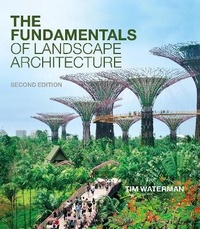
The Fundamentals of Landscape Architecture
2nd Edition
Published on 26. February 2015
Book
Paperback/Softback
192 pages
978-1-4725-3144-5 (ISBN)
Description
From climate change to sustainable communities, landscape architecture is at the forefront of today's most crucial issues and this book provides an introduction to the key elements of this broad field.
The Fundamentals of Landscape Architecture explains the process of designing for sites, calling upon historical precedent and evolving philosophies to discuss how a project moves from concept to realization. It serves as a guide to the many specializations within landscape architecture, such as landscape strategy and urban design.
The second edition features new international and US-based case studies including a study of Peter Schaudt of Hoerr Schaudt Landscape Architects based in Chicago, US, which features the Historic Landscape Preservation Plan, at The University of North Carolina, Chapel Hill. The work of Dr Kongjian Yu of Turenscape is explored and features Houtan Park, Shanghai, China and Greg Grabasch's project Januburu Six Seasons, Broome, Western Australia is discussed. Examined in depth is the work of Ten Eyck Landscape Architects at The Arizona State University Polytechnic Campus, US.
For the second edition the author, Tim Waterman, has interviewed the following leading landscape architects: Phil Askew of the London Legacy Development Corporation, UK, discusses the continuing legacy of the Olympics in London. The work of New York-based Thomas Balsley is explored through his project at Hunter's Point South Waterfront Park, New York, USA. The ethos of Raymond Jungles is examined with reference to his project at 1111 Lincoln Road, Miami, Florida, USA. And the role of the landscape architect is discussed with Thierry Kandjee of Taktyk in Brussels, Belgium. These interviews and case studies should inspire landscape architect students the world over to create innovative and creative designs.
The Fundamentals of Landscape Architecture explains the process of designing for sites, calling upon historical precedent and evolving philosophies to discuss how a project moves from concept to realization. It serves as a guide to the many specializations within landscape architecture, such as landscape strategy and urban design.
The second edition features new international and US-based case studies including a study of Peter Schaudt of Hoerr Schaudt Landscape Architects based in Chicago, US, which features the Historic Landscape Preservation Plan, at The University of North Carolina, Chapel Hill. The work of Dr Kongjian Yu of Turenscape is explored and features Houtan Park, Shanghai, China and Greg Grabasch's project Januburu Six Seasons, Broome, Western Australia is discussed. Examined in depth is the work of Ten Eyck Landscape Architects at The Arizona State University Polytechnic Campus, US.
For the second edition the author, Tim Waterman, has interviewed the following leading landscape architects: Phil Askew of the London Legacy Development Corporation, UK, discusses the continuing legacy of the Olympics in London. The work of New York-based Thomas Balsley is explored through his project at Hunter's Point South Waterfront Park, New York, USA. The ethos of Raymond Jungles is examined with reference to his project at 1111 Lincoln Road, Miami, Florida, USA. And the role of the landscape architect is discussed with Thierry Kandjee of Taktyk in Brussels, Belgium. These interviews and case studies should inspire landscape architect students the world over to create innovative and creative designs.
Reviews / Votes
This book is a handy reference and easy to use especially for students ... The timeline especially is very good. * Deepika Shetty, Manipal School of Architecture and Planning, India * ...quality content and focus on what the profession is about - augmented with concise text, explanation of terms, and great graphic content. It's a superb book. * Landscape + Urbanism blog, 2010 * This might be the perfect gift for those people that continually fail to understand what it is a landscape architect really does. * Andrew Spiering, Land8Lounge *More details
Series
Edition
2nd Revised edition
Language
English
Place of publication
London
United Kingdom
Publishing group
Bloomsbury Publishing PLC
Target group
College/higher education
Professional and scholarly
Edition type
Revised edition
Illustrations
200 colour illus
Dimensions
Height: 230 mm
Width: 200 mm
Weight
697 gr
ISBN-13
978-1-4725-3144-5 (9781472531445)
DOI
CBID182264
Copyright in bibliographic data and cover images is held by Nielsen Book Services Limited or by the publishers or by their respective licensors: all rights reserved.
Schweitzer Classification
Other editions
Previous edition

Tim Waterman
The Fundamentals of Landscape Architecture
Book
05/2009
AVA Publishing SA
€44.79
Article exhausted; check for reprint
Person
Tim Waterman is a senior lecturer in landscape architecture at the Writtle School of Design in the UK. He is a tutor at The Bartlett School of Architecture, University College London, UK and Honorary Editor, of Landscape: The Journal of the Landscape Institute.
Content
Contents
Introduction
Chapter 1 History and Ideas
Yesterday and Today
Before The Ancient World
The Ancient World
The Middle Ages
The Renaissance and Baroque
The Nineteenth Century
The Twentieth Century
Millennial Landscapes
Case Study: Hoerr Schaudt/ Historic Landscape Preservation Plan, The University Of North Carolina, US
Chapter 2 Site and Context
Landscape: Site and Context
Climate
Land
Water
Plants
Topography
Landscape Character
Case Study: Kongjian Yu/ Houtan Park, Shanghai, China
Chapter 3 Inhabiting the Landscape
Site Planning and Development
The View of the Landscape
Landscape Planting
Flow: Circulation and Access
Structures and Habitation
Community Planning
Case Study: Greg Grasbach/ Australia
Chapter 4 Representation
The Sketch
Orthographic Projection
Perspective
3D Images
Models
Computer-Aided Design (CAD)
Storyboards
The Moving Image
Presentation
The Portfolio
Chapter 5: The Anatomy of a Project
The Arizona State University Polytechnic Campus
The Project Timeline
The Brief
Contributors and Their Roles
Analysis
Synthesis and Design
Detail Development
Construction
The Project as it Matures
Chapter 6: Professional Profiles
Careers
Interview: Phil Askew, CMLI, London Legacy Development Corporation
Interview: Thomas Balsley, FASLA, Thomas Balsley Associates
Interview: Raymond Jungles, FASLA, Raymond Jungles, Inc.
Interview: Thierry Kandjee, Paysagiste, TaktykConclusion
Conclusion
Glossary
Bibliography
Contacts and Resources
Index
Acknowledgements and credits
Introduction
Chapter 1 History and Ideas
Yesterday and Today
Before The Ancient World
The Ancient World
The Middle Ages
The Renaissance and Baroque
The Nineteenth Century
The Twentieth Century
Millennial Landscapes
Case Study: Hoerr Schaudt/ Historic Landscape Preservation Plan, The University Of North Carolina, US
Chapter 2 Site and Context
Landscape: Site and Context
Climate
Land
Water
Plants
Topography
Landscape Character
Case Study: Kongjian Yu/ Houtan Park, Shanghai, China
Chapter 3 Inhabiting the Landscape
Site Planning and Development
The View of the Landscape
Landscape Planting
Flow: Circulation and Access
Structures and Habitation
Community Planning
Case Study: Greg Grasbach/ Australia
Chapter 4 Representation
The Sketch
Orthographic Projection
Perspective
3D Images
Models
Computer-Aided Design (CAD)
Storyboards
The Moving Image
Presentation
The Portfolio
Chapter 5: The Anatomy of a Project
The Arizona State University Polytechnic Campus
The Project Timeline
The Brief
Contributors and Their Roles
Analysis
Synthesis and Design
Detail Development
Construction
The Project as it Matures
Chapter 6: Professional Profiles
Careers
Interview: Phil Askew, CMLI, London Legacy Development Corporation
Interview: Thomas Balsley, FASLA, Thomas Balsley Associates
Interview: Raymond Jungles, FASLA, Raymond Jungles, Inc.
Interview: Thierry Kandjee, Paysagiste, TaktykConclusion
Conclusion
Glossary
Bibliography
Contacts and Resources
Index
Acknowledgements and credits