

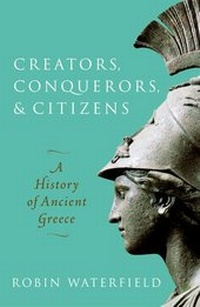
Creators, Conquerors, and Citizens
A History of Ancient Greece
Published on 19. April 2018
Book
Hardback
544 pages
978-0-19-872788-0 (ISBN)
Description
"We Greeks are one in blood and one in language; we have temples to the gods and religious rites in common, and a common way of life." Herodotus
Throughout the course of ancient Greek civilization, there always existed a sense of shared culture among the many Greek communities scattered throughout the Mediterranean. During the Classical (479-338) and Hellenistic (338-30) periods, the countless individual poleis of the Archaic period gradually came together in leagues and alliances, and finally were more or less united when they fell under the Roman empire.
But what is fascinating about this process is how much resistance there was to it. The Greeks found it impossible to unify when faced with common enemies. Even under Roman rule the Greek cities still bickered. Acts of union - going back to the legendary Trojan War - were widely celebrated, but made little practical difference. If the Greeks knew that they were kin, why is Greek history so often the history of their internecine wars and other forms of competition with one another? This is the
question acclaimed historian Robin Waterfield sets out to explore in Creators, Conquerors, and Citizens.
This extraordinary contradiction - the recognition that they were all Greeks, but the deep-seated reluctance to unify - is at the heart of this ambitious new history. The culmination of a lifetime of research, Waterfield gives a comprehensive account of seven hundred years, from the emergence of the Greeks around 750 BCE to the downfall of the last of the Greco-Macedonian kingdoms in 30 BCE, looking at political, military, social, and cultural history.
Throughout the course of ancient Greek civilization, there always existed a sense of shared culture among the many Greek communities scattered throughout the Mediterranean. During the Classical (479-338) and Hellenistic (338-30) periods, the countless individual poleis of the Archaic period gradually came together in leagues and alliances, and finally were more or less united when they fell under the Roman empire.
But what is fascinating about this process is how much resistance there was to it. The Greeks found it impossible to unify when faced with common enemies. Even under Roman rule the Greek cities still bickered. Acts of union - going back to the legendary Trojan War - were widely celebrated, but made little practical difference. If the Greeks knew that they were kin, why is Greek history so often the history of their internecine wars and other forms of competition with one another? This is the
question acclaimed historian Robin Waterfield sets out to explore in Creators, Conquerors, and Citizens.
This extraordinary contradiction - the recognition that they were all Greeks, but the deep-seated reluctance to unify - is at the heart of this ambitious new history. The culmination of a lifetime of research, Waterfield gives a comprehensive account of seven hundred years, from the emergence of the Greeks around 750 BCE to the downfall of the last of the Greco-Macedonian kingdoms in 30 BCE, looking at political, military, social, and cultural history.
Reviews / Votes
Drawing on contemporary literature and inscriptions, informed by the most up-to-date archaeology, illustrated throughout with half-tone photographs and containing an excellent timeline (from 1200 to 27 BC), lists of rulers (of Ptolemaic Egypt, Macedon from the fourth century, Pergamum, Persia, Syracuse and Seleucid Syria), fifteen maps and a glossary, this book provides an invaluable resource for anyone wishing a comprehensive account of Greek history and culture,while reading lists point the way for those who wish to find out more. W's masterly review of how tensions between cultural unity and political disunity unfolded over eight hundred years is to be thoroughly recommended. * David Stuttard, Classics for All * Waterfield's tone is suitably authoritative and measured... his book is enlivened by its detail. * Daisy Dunn, Sunday Times * Engaging but rigorously researched narrative history. All you ever needed to know about the Greeks. * The Lady * The scholarship is thorough, deep, and well-explained ... Readers looking for an authoritative account of almost any aspect of ancient Greek history should be thoroughly gratified. * Kirkus * As one might expect, the scholarship is impeccable. Waterfield touches on a staggering array of topics, succinctly reviewing the evidence and summarizing the most recent scholarly work. * Andrew T. Alwine, College of Charleston *
More details
Language
English
Place of publication
Oxford
United Kingdom
Illustrations
Approx. 30 halftones and 10 line drawings
Dimensions
Height: 238 mm
Width: 161 mm
Thickness: 46 mm
Weight
832 gr
ISBN-13
978-0-19-872788-0 (9780198727880)
Copyright in bibliographic data and cover images is held by Nielsen Book Services Limited or by the publishers or by their respective licensors: all rights reserved.
Schweitzer Classification
Other editions
Additional editions
Book
07/2020
Oxford University Press
€18.00
Available immediately
E-Book
04/2018
1st Edition
OUP eBook
€13.49
Available for download
E-Book
04/2018
1st Edition
OUP eBook
€13.49
Available for download
Person
Robin Waterfield is an independent scholar, living in southern Greece. In addition to more than twenty-five translations of works of Greek literature, he is the author of numerous books, most recently Taken at the Flood: The Roman Conquest of Greece (OUP, 2014).
Content
Preface and Acknowledgements
List of Illustrations
List of Maps
Chronology and King Lists
Introduction I: Historical Background
Introduction II: Environmental Background
ACT I: The Archaic Period (c. 750-480): The Formation of States
1: The Emergence of the Greeks in the Mediterranean
2: Aristocracy and the Archaic State
3: The Archaic Greek World
4: Athens in the Seventh and Sixth Centuries
5: The Athenian Democratic Revolution
6: Sparta
7: Greek Religion
8: The Persian Wars
9: The Greeks at War
ACT II: The Classical Period (479-323): A Tale, Mainly, of Two Cities
10: The Delian League
11: The Economy of Greece
12: Periclean Athens
13: Women, Sexuality, and Family Life
14: The Peloponnesian War
15: Socrates and the Thirty Tyrants
16: The Futility of War
17: Athens and Macedon
18: Alexander the Great
19: The Instability of Syracuse
ACT III: The Hellenistic Period (323-30): Greeks, Macedonians, and Romans
20: The Successor Kingdoms
21: Greeks and Macedonians in the Third Century
22: The Greek Cities in the New World
23: Life and Culture in the Hellenistic World
24: The Roman Conquest
25: A Feat of Imagination
Glossary
Recommended Reading
Index
List of Illustrations
List of Maps
Chronology and King Lists
Introduction I: Historical Background
Introduction II: Environmental Background
ACT I: The Archaic Period (c. 750-480): The Formation of States
1: The Emergence of the Greeks in the Mediterranean
2: Aristocracy and the Archaic State
3: The Archaic Greek World
4: Athens in the Seventh and Sixth Centuries
5: The Athenian Democratic Revolution
6: Sparta
7: Greek Religion
8: The Persian Wars
9: The Greeks at War
ACT II: The Classical Period (479-323): A Tale, Mainly, of Two Cities
10: The Delian League
11: The Economy of Greece
12: Periclean Athens
13: Women, Sexuality, and Family Life
14: The Peloponnesian War
15: Socrates and the Thirty Tyrants
16: The Futility of War
17: Athens and Macedon
18: Alexander the Great
19: The Instability of Syracuse
ACT III: The Hellenistic Period (323-30): Greeks, Macedonians, and Romans
20: The Successor Kingdoms
21: Greeks and Macedonians in the Third Century
22: The Greek Cities in the New World
23: Life and Culture in the Hellenistic World
24: The Roman Conquest
25: A Feat of Imagination
Glossary
Recommended Reading
Index