

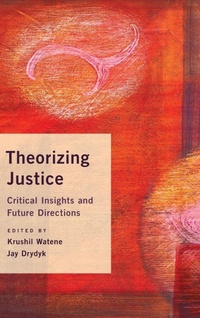
Theorizing Justice
Critical Insights and Future Directions
Published on 14. July 2016
Book
Hardback
210 pages
978-1-78348-404-1 (ISBN)
Description
One of the most important contributions to contemporary political philosophy, Rawls's A Theory of Justice, re-ignited political philosophy and revolutionized how we theorize about justice. Rawls's approach to justice advanced political philosophy in important and valuable ways - most significantly in the way that it showed that political philosophy remained relevant for our lives and our world.
Unsurprisingly, over forty years later, social and global realities present theories of justice with new challenges. This volume examines what these new challenges are, and whether contemporary theories are in a position to respond to them. The collection brings together essays that push the boundaries of justice theorizing in new directions, and that begin to construct a new paradigm. The collection contributes to the creation of a platform from which new ideas and new conversations, about the challenges and opportunities for justice in our world, can be further explored and developed.
Unsurprisingly, over forty years later, social and global realities present theories of justice with new challenges. This volume examines what these new challenges are, and whether contemporary theories are in a position to respond to them. The collection brings together essays that push the boundaries of justice theorizing in new directions, and that begin to construct a new paradigm. The collection contributes to the creation of a platform from which new ideas and new conversations, about the challenges and opportunities for justice in our world, can be further explored and developed.
Reviews / Votes
If we want to address cases of injustice, we need to rethink our theories of justice. That requires a critical analysis of the assumptions in liberal theories of justice as well as the development of alternatives. Theorizing Justice makes important contributions to this project, and should be required reading for anyone interested in justice for the world as it is. -- Ingrid Robeyns, Professor of Ethics, Utrecht University This collection stimulatingly explores a great variety of questions that arise under the umbrella of justice-from Rawls's question about the basic structure of society to questions about minimal, fundamental, and transitional justice; justice for indigenous peoples; justice in circumstances with more than moderate scarcity; and more-here appropriately addressed by a strikingly diverse set of distinctive authorial voices. -- Henry S. Richardson, Professor of Philosophy, Georgetown UniversityMore details
Language
English
Place of publication
United Kingdom
Publishing group
Bloomsbury Publishing PLC
Target group
College/higher education
US School Grade: From College Junior to College Graduate Student
Illustrations
1 table
Dimensions
Height: 235 mm
Width: 157 mm
Thickness: 17 mm
Weight
499 gr
ISBN-13
978-1-78348-404-1 (9781783484041)
Copyright in bibliographic data and cover images is held by Nielsen Book Services Limited or by the publishers or by their respective licensors: all rights reserved.
Schweitzer Classification
Other editions
Additional editions
E-Book
07/2016
1st Edition
Rowman & Littlefield Publishers
€47.49
Available for download
E-Book
07/2016
1st Edition
Rowman & Littlefield Publishers
€47.49
Available for download
Persons
Krushil Watene is Lecturer in Philosophy at Massey University, New Zealand. She is of Ngati Manu, Te Hikutu, Ngati Whatua Orakei, and Tongan descent.
Jay Drydyk is Professor of Philosophy at Carleton University, a former President of the International Development Ethics Association, and a Fellow of the Human Development and Capability Association. He is the co-author of Displacement by Development.
Contributors:
Tim Mulgan, Professor of Philosophy, University of Auckland, New Zealand, and University of St Andrews, UK; Colleen Murphy, Associate Professor of Philosophy, University of Illinois at Urbana-Champaign, USA; Amartya Sen, Thomas W. Lamont University Professor, and Professor of Economics and Philosophy, Harvard University, USA; Mozaffar Qizilbash, Professor of Economics and Philosophy, University of York, UK; Jay Drydyk, Professor of Philosophy, Carleton University, Canada; Thom Brooks, Professor of Law and Government, University of Durham, UK; Krushil Watene, Lecturer in Philosophy, Massey University, New Zealand; Rutger Claassen, Associate Professor of Ethics and Political Philosophy, University of Utrecht, Netherlands; Stacy J. Kosko Assistant Director MIDCM, University of Maryland, USA
Jay Drydyk is Professor of Philosophy at Carleton University, a former President of the International Development Ethics Association, and a Fellow of the Human Development and Capability Association. He is the co-author of Displacement by Development.
Contributors:
Tim Mulgan, Professor of Philosophy, University of Auckland, New Zealand, and University of St Andrews, UK; Colleen Murphy, Associate Professor of Philosophy, University of Illinois at Urbana-Champaign, USA; Amartya Sen, Thomas W. Lamont University Professor, and Professor of Economics and Philosophy, Harvard University, USA; Mozaffar Qizilbash, Professor of Economics and Philosophy, University of York, UK; Jay Drydyk, Professor of Philosophy, Carleton University, Canada; Thom Brooks, Professor of Law and Government, University of Durham, UK; Krushil Watene, Lecturer in Philosophy, Massey University, New Zealand; Rutger Claassen, Associate Professor of Ethics and Political Philosophy, University of Utrecht, Netherlands; Stacy J. Kosko Assistant Director MIDCM, University of Maryland, USA
Content
Acknowledgements / Preface, Jay Drydyk / Introduction, Krushil Watene / Part I: Critical Insights / 1. Theorizing about Justice for a Broken World, Tim Mulgan / 2. Transitional Justice: A Conceptual Map, Colleen Murphy / 3. What do we want from a Theory of Justice?, Amartya Sen / 4. Utilitarianism and Some of Its Critics: On Some Alternative 'Incomplete' Theories of, and Approaches to, Morality and Justice, Mozaffar Qizilbash / Part II: Future Directions / 5. Justice as a Virtue: What can we Expect of our Allies?, Jay Drydyk / 6. Justice as Stakeholding, Thom Brooks / 7. Indigenous Peoples and Justice, Krushil Watene / 8. Justice in Regulation: Towards a Liberal Account, Rutger Claassen / 9. The Recognition Gap: Why Labels Matter in Human Rights Protection, Stacy Kosko / Notes on Contributors / Index