

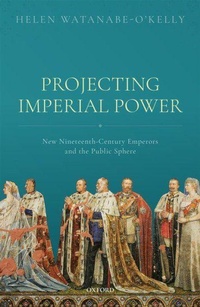
Projecting Imperial Power
New Nineteenth Century Emperors and the Public Sphere
Published on 9. July 2021
Book
Hardback
360 pages
978-0-19-880247-1 (ISBN)
Description
The nineteenth century is notable for its newly proclaimed emperors, from Franz I of Austria and Napoleon I in 1804, through Agustin of Mexico, Pedro I of Brazil, Napoleon III of France, Maximilian of Mexico, and Wilhelm I of Germany, to Victoria, empress of India, in 1876. These monarchs projected an imperial aura through coronations, courts, medals, costumes, portraits, monuments, international exhibitions, festivals, religion, architecture, and town planning. They relied on ancient history for legitimacy while partially espousing modernity. Projecting Imperial Power is the first book to consider together these newly proclaimed emperors in six territories on three continents across the whole of the long nineteenth century.
The first emperors' successors-Pedro II of Brazil, Franz Joseph of Austria, and Wilhelm II of Germany-expanded their panoply of power, until Pedro was forced to abdicate in 1889 and the First World War brought the Austrian and German empires to an end. Britain invented an imperial myth for its Indian empire in the twentieth century, but George VI still had to relinquish the title of emperor in 1947.
Using a wide range of sources, Projecting Imperial Power explains the imperial ambition behind the cities of Berlin, Paris, Vienna, and New Delhi. It discusses the contested place of the emperors and their empires in national cultural memory by examining how the statues that were erected in huge numbers in the second part of the period are treated today.
The first emperors' successors-Pedro II of Brazil, Franz Joseph of Austria, and Wilhelm II of Germany-expanded their panoply of power, until Pedro was forced to abdicate in 1889 and the First World War brought the Austrian and German empires to an end. Britain invented an imperial myth for its Indian empire in the twentieth century, but George VI still had to relinquish the title of emperor in 1947.
Using a wide range of sources, Projecting Imperial Power explains the imperial ambition behind the cities of Berlin, Paris, Vienna, and New Delhi. It discusses the contested place of the emperors and their empires in national cultural memory by examining how the statues that were erected in huge numbers in the second part of the period are treated today.
Reviews / Votes
This ground-breaking study is the first, as the book's blurb states, "to consider together these newly proclaimed emperors in six territories on three continents across the whole of the long nineteenth-century." The author draws upon a wealth of written sources and offers a multifaceted approach, exploring how these monarchs projected an imperial aura through courts, honours, coronations, city planning, and much more. This absorbing book brings new perspectives to key themes in the history of emperorship. * Aidan Jones, King's College London, Royal Studies Journal * The narrative strength of the book lies in its presentation of the visual power of imperial ceremonies such as emperors' coronations, their portraits, narratives, architectures, and acts of commemoration in Europe, South America, and India. * Jana Osterkamp, Ludwig Maximilian University, Munich, Germany *More details
Language
English
Place of publication
Oxford
United Kingdom
Target group
Professional and scholarly
Product notice
sewn/stitched
Cloth over boards
Dimensions
Height: 236 mm
Width: 159 mm
Thickness: 27 mm
Weight
698 gr
ISBN-13
978-0-19-880247-1 (9780198802471)
Copyright in bibliographic data and cover images is held by Nielsen Book Services Limited or by the publishers or by their respective licensors: all rights reserved.
Schweitzer Classification
Other editions
Additional editions
Helen Watanabe-O'Kelly
Projecting Imperial Power
New Nineteenth Century Emperors and the Public Sphere
E-Book
07/2021
1st Edition
OUP eBook
€21.99
Available for download
Helen Watanabe-O'Kelly
Projecting Imperial Power
New Nineteenth Century Emperors and the Public Sphere
E-Book
07/2021
1st Edition
OUP eBook
€21.99
Available for download
Person
Helen Watanabe-O'Kelly is a Professor of German Literature at the University of Oxford and an Emeritus Fellow at Exeter College. She is the editor of The Cambridge History of German Literature (Cambridge University Press, 1997) and Queens Consort, Cultural Transfer and European Politics, c. 1500-1800 (Routledge, 2016), and author of Beauty or Beast? The Woman Warrior in the German Imagination from the Renaissance to the Present (Oxford University Press, 2010).
Content
Introduction
1: Creating Myth, Asserting Dynasty
2: Adopting the Imperial Idea Outside Europe
3: Performing Emperorship
4: Being an Imperial Consort
5: Seeing the Emperor
6: Harnessing Religion to the Imperial Cause
7: Creating the Imperial City
8: Showcasing the Empire - International Exhibitions
9: Inventing Empire in India and Britain
10: Staging Empire as History and Allegory in Germany and Austria
11: Ending an Remembering
1: Creating Myth, Asserting Dynasty
2: Adopting the Imperial Idea Outside Europe
3: Performing Emperorship
4: Being an Imperial Consort
5: Seeing the Emperor
6: Harnessing Religion to the Imperial Cause
7: Creating the Imperial City
8: Showcasing the Empire - International Exhibitions
9: Inventing Empire in India and Britain
10: Staging Empire as History and Allegory in Germany and Austria
11: Ending an Remembering