

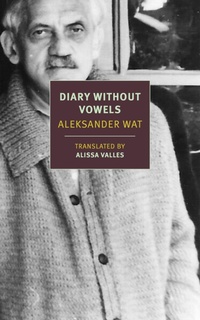
Diary Without Vowels
Will be published approx. on 10. November 2026
Book
Paperback/Softback
272 pages
979-8-89623-079-3 (ISBN)
Description
An intellectual and spiritual self-portrait by one of the most important Polish writers of the twentieth century, this companion to Aleksander Wat's memoir My Century is a moving testimony on pain and suffering and their relationship to thought and wisdom.
Aleksander Wat’s Diary Without Vowels is an enigmatic text found among the poet’s papers after his death, typed on loose leaf sheets, partly in code, and deciphered by his widow, Ola. Written in Paris and Berkeley, California, from October 1963 to May 1965—a period partially overlapping with the conversations with Czeslaw Milosz that led to Wat’s renowned memoir My Century—the diary charts Wat’s struggle with the pain and illness which plagued him in the post-war years, with the joys and difficulties of life in emigration. Lit by flashes of comedy and lyricism, it renders Wat’s stubborn fight to recover a sense of self from the storm of history and give a true shape to his fate as a poet and a man.
An indispensable companion to My Century, Diary Without Vowels is hailed by Wat’s biographer Tomas Venclova as “one of the most refined and intriguing examples of self-analysis in world literature.”
Aleksander Wat’s Diary Without Vowels is an enigmatic text found among the poet’s papers after his death, typed on loose leaf sheets, partly in code, and deciphered by his widow, Ola. Written in Paris and Berkeley, California, from October 1963 to May 1965—a period partially overlapping with the conversations with Czeslaw Milosz that led to Wat’s renowned memoir My Century—the diary charts Wat’s struggle with the pain and illness which plagued him in the post-war years, with the joys and difficulties of life in emigration. Lit by flashes of comedy and lyricism, it renders Wat’s stubborn fight to recover a sense of self from the storm of history and give a true shape to his fate as a poet and a man.
An indispensable companion to My Century, Diary Without Vowels is hailed by Wat’s biographer Tomas Venclova as “one of the most refined and intriguing examples of self-analysis in world literature.”
More details
Persons
Aleksander Wat (1900-1967), the nom de plume of Aleksander Chwat, was born in Warsaw. He attended Warsaw University, where he studied philosophy, psychology, and logic, and formed strong ties with the literary avant-garde, publishing a first book of poems, Me from One Side and Me from the Other Side of My Pug Iron Stove, in 1920 and, some years later, a collection of stories entitled Lucifer Unemployed. Wat edited a variety of influential journals and was connected to the futurist literary movement in Poland. He fled the east in 1939 and confined his writing to journalism during World War II. In 1963, he left his native country for France. Wat was invited in 1964 to the University of California, Berkeley, where he taped a series of conversations about his life and times with his countryman the poet Czeslaw Milosz. Edited by Milosz, these were published posthumously as My Century.
Alissa Valles is an author and translator. She has been a recipient of the Poetry Magazine Ruth Lilly Poetry Fellowship and the Bess Hokin Prize. For NYRB, she has translated Ryszard Krynicki’s Our Life Grows and Józef Czapski’s Memories of Starobielsk. She lives in Boston and the Bay Area.
Alissa Valles is an author and translator. She has been a recipient of the Poetry Magazine Ruth Lilly Poetry Fellowship and the Bess Hokin Prize. For NYRB, she has translated Ryszard Krynicki’s Our Life Grows and Józef Czapski’s Memories of Starobielsk. She lives in Boston and the Bay Area.