

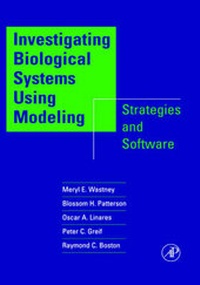
Investigating Biological Systems Using Modeling
Strategies and Software
Published on 3. November 1998
Book
Hardback
382 pages
978-0-12-736740-8 (ISBN)
Description
Investigating Biological Systems Using Modeling describes how to apply software to analyze and interpret data from biological systems. It is written for students and investigators in lay person's terms, and will be a useful reference book and textbook on mathematical modeling in the design and interpretation of kinetic studies of biological systems. It describes the mathematical techniques of modeling and kinetic theory, and focuses on practical examples of analyzing data. The book also uses examples from the fields of physiology, biochemistry, nutrition, agriculture, pharmacology, and medicine.
More details
Language
English
Place of publication
San Diego
United States
Publishing group
Elsevier Science Publishing Co Inc
Target group
Professional and scholarly
AUDIENCE: Graduate students and professionals in the fields of medicine, physiology, biochemistry, biomathematics, pharmacology, agricultural systems, nutrition, and animal science.
Dimensions
Height: 229 mm
Width: 152 mm
Weight
900 gr
ISBN-13
978-0-12-736740-8 (9780127367408)
Copyright in bibliographic data and cover images is held by Nielsen Book Services Limited or by the publishers or by their respective licensors: all rights reserved.
Schweitzer Classification
Other editions
Additional editions
Meryl E. Wastney | Blossom H. Patterson | Oscar A. Linares
Investigating Biological Systems Using Modeling
Strategies and Software
E-Book
12/2012
Academic Press
€93.95
Available for download
Persons
Meryl Wastney is an Associate Professor in the Department of Pediatrics and the Department of Biomathematics and Biostatistics at the Georgetown University Medical Center in Washington D.C. She received her Ph.D. in biochemistry from Lincoln College at the University of Canterbury in New Zealand. She was a Fogarty Fellow in the Laboratory of Mathematical Biology, NCI, NIH, Bethesda, Maryland for three years and joined the Department of Pediatrics at Georgetown University in 1983. She is the author of 30 articles and has presented over 40 invited lectures and workshops on modeling biological systems.
Author
Georgetown University Medical Center, Washington, D.C.
National Cancer Institute, Bethesda, Maryland, U.S.A.
Biomodeling Unit, Oakwood Healthcare System Southgate Center, Southgate, Michigan, U.S.A.
National Cancer Institute, National Institutes of Health, Bethesda, Maryland, U.S.A.
School of Veterinary Medicine, Clinical Studies, Kennett Square, PA
Content
Introduction:
What is Modeling?
The Steps in Building a Model.
The Difference Between Building a Model and Using a Model.
Why Model Biological Systems?
Modeling Software:
Review of Software.
WinSAAM.
Concepts and Tools of Modeling:
Building Models in Sections.
Techniques and Tools to Facilitate Model Development.
Strategies for Modeling Biological Systems:
Experimental Design and Data Collection.
Starting Modeling and Developing a Model.
Rejecting Hypotheses and Accepting a Model.
Model Summarization.
Multiple Studies Analysis.
Information in the Model.
Errors in Compartmental Modeling.
Testing Robustness: Sensitivity, Identifiability, and Stability.
Evaluating and Using Published Models:
Why Use a Published Model?
Reviewing and Summarizing Published Models.
The Model Translation Process.
Verification and Validation.
Using the Model.
A Library of Models.
Subject Index.
Appendices.
What is Modeling?
The Steps in Building a Model.
The Difference Between Building a Model and Using a Model.
Why Model Biological Systems?
Modeling Software:
Review of Software.
WinSAAM.
Concepts and Tools of Modeling:
Building Models in Sections.
Techniques and Tools to Facilitate Model Development.
Strategies for Modeling Biological Systems:
Experimental Design and Data Collection.
Starting Modeling and Developing a Model.
Rejecting Hypotheses and Accepting a Model.
Model Summarization.
Multiple Studies Analysis.
Information in the Model.
Errors in Compartmental Modeling.
Testing Robustness: Sensitivity, Identifiability, and Stability.
Evaluating and Using Published Models:
Why Use a Published Model?
Reviewing and Summarizing Published Models.
The Model Translation Process.
Verification and Validation.
Using the Model.
A Library of Models.
Subject Index.
Appendices.