

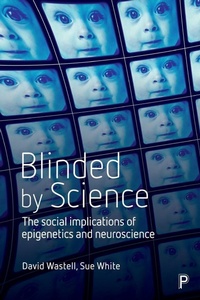
Blinded by Science
The Social Implications of Epigenetics and Neuroscience
1st Edition
Published on 15. March 2017
Book
Paperback/Softback
304 pages
978-1-4473-2234-4 (ISBN)
Description
In recent years, new areas of biology, especially epigenetics and neuroscience, have enthralled the public imagination. They have been used as powerful arguments for developing social policy in a particular direction, from early intervention in the lives of disadvantaged children to seeking 'biomarkers' as identifiers of criminality.
This timely book, written by leading commentators, critically examines the capabilities and limitations of these biotechnologies, exploring their implications for policy and practice.
The book will enable social scientists, policy makers, practitioners and interested general readers to understand how the new biologies of epigenetics and neuroscience have increasingly influenced the fields of family policy, mental health, child development and criminal justice.
The book will facilitate much needed debate about what makes a good society and how best to build one. It also draws attention to the ways that the uncertainties of the original science are lost in their translation into the everyday world of practice and policy.
This timely book, written by leading commentators, critically examines the capabilities and limitations of these biotechnologies, exploring their implications for policy and practice.
The book will enable social scientists, policy makers, practitioners and interested general readers to understand how the new biologies of epigenetics and neuroscience have increasingly influenced the fields of family policy, mental health, child development and criminal justice.
The book will facilitate much needed debate about what makes a good society and how best to build one. It also draws attention to the ways that the uncertainties of the original science are lost in their translation into the everyday world of practice and policy.
Reviews / Votes
"this book provides a wealth of information and helpful analysis...I would strongly recommend that readers buy this book and share with colleagues." Aotearoa New Zealand Social Work "The information and challenges this book presents should be viewed as a timely warning to those who wish to rush to judgement about findings from science that few have examined as carefully and critically as these authors. We are in debt to them." Children Australia "Part of the appeal of the book is the unique constellation of expertise and interests that the authors bring to their topic-it is not often you get a neuroscientist and a sociologistworking together on a detailed synthesis of their respective fields." The British Journal of Social Work "Well-written, highly informative and amply referenced, this is an important book to read and return to, for teachers, students and practitioners." Professional Social Work Magazine. "Too often early childhood policy is founded on dogmatic interpretations of over-simplified science. Skepticism is the antidote, which this remarkable piece of scholarship provides, bringing ethical concerns to the fore." John Bruer, President Emeritus, James S. McDonnell Foundation "Forensically detailed, compelling and at points unsettling, this book is a very welcome antidote to simplistic policy appropriations of biology. It deserves to be widely read." Val Gillies, Professor of Social Policy and Criminology, University of Westminster
More details
Edition
First Edition
Language
English
Place of publication
Bristol
United Kingdom
Publishing group
Bristol University Press
Target group
Professional and scholarly
Illustrations
8 s/w Tabellen, 8 s/w Photographien bzw. Rasterbilder
8 Halftones, black and white; 8 Tables, black and white
Dimensions
Height: 234 mm
Width: 156 mm
Thickness: 16 mm
Weight
465 gr
ISBN-13
978-1-4473-2234-4 (9781447322344)
Copyright in bibliographic data and cover images is held by Nielsen Book Services Limited or by the publishers or by their respective licensors: all rights reserved.
Schweitzer Classification
Other editions
Additional editions
David Wastell | Susan White
Blinded by Science
The Social Implications of Epigenetics and Neuroscience
Book
03/2017
1st Edition
Policy Press
€103.20
Shipment within 15-20 days
David Wastell | Susan White
Blinded by Science
The Social Implications of Epigenetics and Neuroscience
E-Book
03/2017
1st Edition
Policy Press
€51.99
Available for download
David Wastell | Susan White
Blinded by Science
The Social Implications of Epigenetics and Neuroscience
E-Book
03/2017
1st Edition
Policy Press
€231.99
Available for download
Persons
David Wastell began his career as a cognitive neuroscientist at Durham University before moving to the Medical School at Manchester, where his interests in technology led him to specialize in Information Systems. He is now Emeritus Professor of Information Systems at Nottingham University.
Sue White is Professor of Social Work at the University of Sheffield. She is a registered social worker with an academic background in sociology and has spent the last two decades researching how professionals use knowledge in their everyday reasoning.
Sue White is Professor of Social Work at the University of Sheffield. She is a registered social worker with an academic background in sociology and has spent the last two decades researching how professionals use knowledge in their everyday reasoning.
Content
Neuro-bio-social policy;
PART I: GETTING TO GRIPS WITH THE THOUGHT STYLES;
Biology and the drive for social improvement;
Understanding how brain science is created and interpreted;
Blaming the Brain;
PART II: FIXING REAL PEOPLE;
The Cat is Out of the Bag - From early intervention to child protection;
Perfecting People: The Inexorable Rise of Prevention Science;
Epigenetics - from rat mum to my mum?;
Human Epigenetics Prematurely Born(e)?;
Are We Broken? Fixing People (or Society) in the 21st Century.
PART I: GETTING TO GRIPS WITH THE THOUGHT STYLES;
Biology and the drive for social improvement;
Understanding how brain science is created and interpreted;
Blaming the Brain;
PART II: FIXING REAL PEOPLE;
The Cat is Out of the Bag - From early intervention to child protection;
Perfecting People: The Inexorable Rise of Prevention Science;
Epigenetics - from rat mum to my mum?;
Human Epigenetics Prematurely Born(e)?;
Are We Broken? Fixing People (or Society) in the 21st Century.