

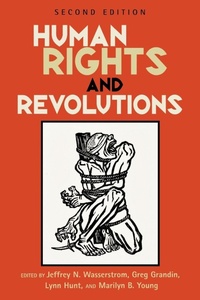
Human Rights and Revolutions
2nd Edition
Published on 15. May 2007
Book
Paperback/Softback
244 pages
978-0-7425-5514-3 (ISBN)
Description
Now in a revised and updated edition with added original chapters, this acclaimed book provides an interdisciplinary perspective on the complex links between revolutionary struggles and human rights discourses and practices. Covering events as far removed from one another in time and space as the English Civil War, the Parisian upheavals of 1789, Latin American independence struggles, and protests in late twentieth-century China, the contributors explore the paradoxes of revolutionary and human rights projects.
The book convincingly shows the ways in which revolutions have both helped spur new advances in thinking about human rights and produced regimes that commit a range of abuses. Providing an unusually balanced analysis of the changes over time in conceptions of human rights in Western and non-Western contexts, this work offers a unique window into the history of the world during modern times and a fresh context for understanding today's pressing issues.
Contributions by: Florence Bernault, Mark Philip Bradley, Sumit Ganguly, Greg Grandin, James N. Green, Lynn Hunt, Yanni Kotsonis, Timothy McDaniel, Kristin Ross, Jeffrey N. Wasserstrom, Alexander Woodside, Marilyn B. Young, David Zaret, and Michael Zuckert
The book convincingly shows the ways in which revolutions have both helped spur new advances in thinking about human rights and produced regimes that commit a range of abuses. Providing an unusually balanced analysis of the changes over time in conceptions of human rights in Western and non-Western contexts, this work offers a unique window into the history of the world during modern times and a fresh context for understanding today's pressing issues.
Contributions by: Florence Bernault, Mark Philip Bradley, Sumit Ganguly, Greg Grandin, James N. Green, Lynn Hunt, Yanni Kotsonis, Timothy McDaniel, Kristin Ross, Jeffrey N. Wasserstrom, Alexander Woodside, Marilyn B. Young, David Zaret, and Michael Zuckert
Reviews / Votes
This book is a necessary addition to a research collection, because it provides a comprehensive framework and well chosen set of cases to illustrate the state of the art of the major debates in the human rights field. * H-Net: Humanities and Social Science Reviews Online * The authors argue convincingly that without revolutions human rights would never have become a political reality, even though countries that never have had a revolution have done a better job of preserving freedom. Many of the essays are interrelated in that they illustrate one or another or both of these themes. On the whole, this is an interesting, worthwhile, and thought-provoking book. Social and political philosophers might gain a great deal from understanding the history of the concepts that they use and argue about. -- Robert van Wyk * Human Rights Revolution * A noteworthy contribution to our understanding of the complexities involved in the human rights discourse. * International Relations * This is an excellent collection on an important topic. The contributions cover an admirably diverse set of times and places. * American Historical Review * Altogether, we have here an exemplary set of thoughtful, erudite, and often provocative essays that provides readers with a rich and profound understanding of immensely important and complex issues. * Contemporary Sociology * There are some astute insights in this volume. * American Journal of Islamic Social Studies * This is a fine collection of thirteen essays on human rights, each of which can stand on its own, and each author displays impeccable credentials. Together, they have much to offer. * Journal of World History * The rise to prominence of human rights discourse carries much promise, as well as grave threats, in the context of structures of power and dominance. These searching, thoughtful, and highly informative essays inquire into the nature and origin of human rights from varied perspectives, unraveling intricate and often conflicting strands of history, practice, and doctrine. The collection is an impressive contribution to understanding and should be a valuable guide to constructive action as well. -- Noam Chomsky, Laureate Professor, University of Arizona This elegant, wide-ranging collection of essays thoughtfully explores the origins, evolution, and contemporary significance of human rights and provides a much-needed, deeply analytical guide to understanding how to interpret today's debates. Everyone who cares should read it; everyone will learn something new. -- Daniel Chirot, University of Washington This is an exemplary collection of essays by a wonderfully diverse-both in their disciplines and their opinions-group of scholars and intellectuals. They demonstrate, above all, that strenuous historical analysis can light up the contemporary political world. -- Michael Walzer, Institute for Advanced Study, Princeton UniversityMore details
Edition
2nd edition
Language
English
Place of publication
United States
Publishing group
Bloomsbury Publishing Plc
Target group
College/higher education
US School Grade: From College Freshman to College Graduate Student
Dimensions
Height: 229 mm
Width: 152 mm
Thickness: 15 mm
Weight
402 gr
ISBN-13
978-0-7425-5514-3 (9780742555143)
Copyright in bibliographic data and cover images is held by Nielsen Book Services Limited or by the publishers or by their respective licensors: all rights reserved.
Schweitzer Classification
Other editions
Additional editions
Jeffrey N. Wasserstrom | Greg Grandin | Lynn Hunt
Human Rights and Revolutions
E-Book
05/2007
2nd Edition
Rowman & Littlefield Publishers
€43.99
Available for download
Persons
Jeffrey N. Wasserstrom is professor of history at the University of California, Irvine. Greg Grandin is professor of history at New York University. Lynn Hunt is Eugen Weber Professor of French History at the University of California, Los Angeles. Marilyn B. Young is professor of history at New York University.
Content
Introduction: Human Rights and Revolutions
Part I: Two Opening Perspectives
Chapter 1: The Paradoxical Origins of Human Rights
Chapter 2: The Chinese Revolution and Contemporary Paradoxes
Part II: The English, American, and Russian Revolutions
Chapter 3: Tradition, Human Rights, and the English Revolution
Chapter 4: Natural Rights in the American Revolution: The American Amalgam
Chapter 5: A European Experience: Human Rights and Citizenship in Revolutionary Russia
Part III: Asian and African Case Studies
Chapter 6: An Enlightenment of Outcasts: Some Vietnamese Stories
Chapter 7: India, Human Rights, and Asian Values
Chapter 8: What Absence Is Made Of: Human Rights in Africa
Part IV: A Human Rights Revolution?
Chapter 9: (Homo)sexuality, Human Rights, and Revolution in Latin America
Chapter 10: Ethics and the Rearmament of Imperialism: The French Case
Chapter 11: The Strange Career of Radical Islam
Part V: A Concluding Perspective
Chapter 12: Human Rights and Empire's Embrace: A Latin American Counterpoint
Part I: Two Opening Perspectives
Chapter 1: The Paradoxical Origins of Human Rights
Chapter 2: The Chinese Revolution and Contemporary Paradoxes
Part II: The English, American, and Russian Revolutions
Chapter 3: Tradition, Human Rights, and the English Revolution
Chapter 4: Natural Rights in the American Revolution: The American Amalgam
Chapter 5: A European Experience: Human Rights and Citizenship in Revolutionary Russia
Part III: Asian and African Case Studies
Chapter 6: An Enlightenment of Outcasts: Some Vietnamese Stories
Chapter 7: India, Human Rights, and Asian Values
Chapter 8: What Absence Is Made Of: Human Rights in Africa
Part IV: A Human Rights Revolution?
Chapter 9: (Homo)sexuality, Human Rights, and Revolution in Latin America
Chapter 10: Ethics and the Rearmament of Imperialism: The French Case
Chapter 11: The Strange Career of Radical Islam
Part V: A Concluding Perspective
Chapter 12: Human Rights and Empire's Embrace: A Latin American Counterpoint