

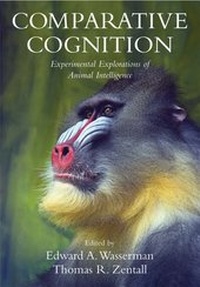
Comparative Cognition
Experimental Explorations of Animal Intelligence
Published on 20. April 2006
Book
Hardback
704 pages
978-0-19-516765-8 (ISBN)
Description
In 1978, Hulse, Fowler and Honig published "Cognitive Processes in Animal Behavior", an edited volume that was a landmark in the scientific study of animal intelligence. It liberated interest in complex learning and cognition from the grasp of the rigid theoretical strictures of behaviorism that had prevailed during the previous four decades, and as a result, the field of comparative cognition was born. At long last, the study of the cognitive capacities of animals other than humans emerged as a worthwhile scientific enterprise. No less rigourous than purely behavioristic investigations, studies of animal intelligence spanned such wide-ranging topics as perception, spatial learning and memory, timing and numerical competence, categorisation and conceptualisation, problem solving, rule learning and creativity. During the ensuing 25 years, the field of comparative cognition has thrived and grown, and public interest in it has risen to unprecedented levels. In their quest to understand the nature and mechanisms of intelligence, researchers have studied animals from bees to chimpanzees.
Sessions on comparative cognition have become common at meetings of the major societies for psychology and neuroscience, and in fact research in comparative cognition has increased so much that a separate society, the Comparative Cognition Society, has been formed to bring it together. This volume celebrates comparative cognition's first quarter century, with a state-of-the-art collection of chapters, covering the broad realm of the scientific study of animal intelligence.
Sessions on comparative cognition have become common at meetings of the major societies for psychology and neuroscience, and in fact research in comparative cognition has increased so much that a separate society, the Comparative Cognition Society, has been formed to bring it together. This volume celebrates comparative cognition's first quarter century, with a state-of-the-art collection of chapters, covering the broad realm of the scientific study of animal intelligence.
Reviews / Votes
"Those who study comparative cognition find themselves in a particularly prosperous time . . . A diversity of available species to study, opportunities for increased national and international collaboration, and technological advances offer us a greater opportunity for data collection and dissemination than at any time in history. The present book attests to how these opportunities can produce compelling research programs that serve as excellent models for thefuture of comparative cognition." --Michael J. Beran in PsycCRITIQUES
"This book is an outstanding collection of chapters by an exceptional group of researchers. A unique aspect of this collection is the strong reliance on experimental science in each of the research programs. One chapter after another provides a critical analysis of the state of knowledge about a fascinating cognitive ability. How do animals perceive, order, and categorize the world? Do animals remember their own past? Do species differ in their sense of time
and space? How flexible are animals in the use of tools and in their problem solving? Are there unique social cognitive processes? Each of these well-written chapters contains enough detail to provide
the reader with the information necessary to reach their own conclusions about the validity of an argument. Everyone interested in the cognitive and intellectual capacities of animals should read this book." --Peter Balsam, Samuel R Milbank Professor of Psychology, Barnard College and Columbia University
"This book is a gem. It brings together a large, readable, and rich set of chapters by an international group of experts on many of the most important topics in the study of cognitive processes in animals. It will be a 'must read' for students and scientists who are curious about the state of the art of the modern science of comparative cognition." --Mark E. Bouton, Professor of Psychology, University of Vermont
"This impressive compendium shows the remarkable breadth and depth of current experimental research in comparative cognition. It is sure to become a major landmark in long history of this continually evolving field." --Michael Domjan, Professor of Psychology, University of Texas
"Comparative Cognition will be an invaluable resource for all working or being interested in the wide field of comparative psychology and neuroscience."--European Journal of Neurology
"Excellent book...Highly recommended."--Choice
"Those who study comparative cognition find themselves in a particularly prosperous time . . . A diversity of available species to study, opportunities for increased national and international collaboration, and technological advances offer us a greater opportunity for data collection and dissemination than at any time in history. The present book attests to how these opportunities can produce compelling research programs that serve as excellent models for the
future of comparative cognition." --Michael J. Beran in PsycCRITIQUES
"This book is an outstanding collection of chapters by an exceptional group of researchers. A unique aspect of this collection is the strong reliance on experimental science in each of the research programs. One chapter after another provides a critical analysis of the state of knowledge about a fascinating cognitive ability. How do animals perceive, order, and categorize the world? Do animals remember their own past? Do species differ in their sense of time
and space? How flexible are animals in the use of tools and in their problem solving? Are there unique social cognitive processes? Each of these well-written chapters contains enough detail to provide
the reader with the information necessary to reach their own conclusions about the validity of an argument. Everyone interested in the cognitive and intellectual capacities of animals should read this book." --Peter Balsam, Samuel R Milbank Professor of Psychology, Barnard College and Columbia University
"This book is a gem. It brings together a large, readable, and rich set of chapters by an international group of experts on many of the most important topics in the study of cognitive processes in animals. It will be a 'must read' for students and scientists who are curious about the state of the art of the modern science of comparative cognition." --Mark E. Bouton, Professor of Psychology, University of Vermont
"This impressive compendium shows the remarkable breadth and depth of current experimental research in comparative cognition. It is sure to become a major landmark in long history of this continually evolving field."--Michael Domjan, Professor of Psychology, University of Texas
"Comparative Cognition will be an invaluable resource for all working or being interested in the wide field of comparative psychology and neuroscience."--European Journal of Neurology
"Excellent book...Highly recommended."--Choice
More details
Language
English
Place of publication
New York
United States
Target group
Professional and scholarly
Illustrations
52 Fotos bzw. Rasterbilder, 261 Abbildungen
52 halftones, 261 line illustrations
Dimensions
Height: 254 mm
Width: 178 mm
Weight
1446 gr
ISBN-13
978-0-19-516765-8 (9780195167658)
Copyright in bibliographic data and cover images is held by Nielsen Book Services Limited or by the publishers or by their respective licensors: all rights reserved.
Schweitzer Classification
Other editions
Additional editions
Edward A. Wasserman | Thomas R. Zentall
Comparative Cognition
Experimental Explorations of Animal Intelligence
E-Book
04/2009
1st Edition
OUP eBook
€65.99
Available for download
Content
1. Perception and Illusion; 2. Attention and Search; 3. Memory Processes; 4. Spatial Cognition; 5. Timing and Counting; 6. Conceptualization and Categorization; 7. Pattern Learning; 8. Tool Fabrication and Use; 9. Problem Solving and Behavioral Flexibility; 10. Social Cognition Processes