

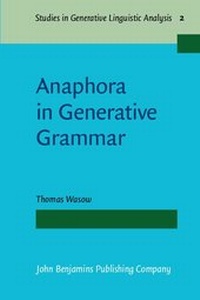
Anaphora in Generative Grammar
Published on 1. January 1979
Book
Paperback/Softback
181 pages
978-90-6439-162-0 (ISBN)
Description
Intuitively, it is clear why languages have anaphoric relations: anaphora reduces redundancy, thereby shortening (and hence simplifying) sentences. In order for this simplification to be possible, however, it is necessary that the speaker of a language be able to identify correctly the elements participating in an anaphoric relation and to determine correctly the meaning of the anaphor on the basis of meaning of the antecedent. If a grammar is to reflect the linguistic competence of a native speaker of a language, it must include mechanisms of associating anaphor and antecedent. In this volume the following questions will be considered: What sorts of mechanisms are best suited for representing anaphora in a grammar? What are the conditions on the rule(s) associating anaphors with antecedents? Do the various cases of anaphora form a linguistically significant class of phenomena, and, if so, how can the grammar capture this fact? And what do these answers entail for linguistic theory?
More details
Series
Language
English
Place of publication
Amsterdam
Netherlands
Target group
Professional and scholarly
Weight
350 gr
ISBN-13
978-90-6439-162-0 (9789064391620)
Copyright in bibliographic data and cover images is held by Nielsen Book Services Limited or by the publishers or by their respective licensors: all rights reserved.
Schweitzer Classification
Other editions
Additional editions
Thomas Wasow
Anaphora in Generative Grammar
E-Book
01/1979
1st Edition
John Benjamins Publishing Company
€84.49
Available for download
Person
Content
1. Acknowledgements; 2. Preface; 3. Chapter One : Background; 4. PART I : Pronominal Anaphora; 5. Chapter Two : The Pronominalization and Reflexivization Transformations; 6. Chapter Three : Alternatives to Pronominalization; 7. Chapter Four : The Pronominal Anaphora Rule; 8. PART II : Other Anaphoric Relations; 9. Chapter Five : The Essential Unity of Anaphora; 10. Chapter Six : An Alternative to Deletion; 11. Chapter Seven : The Status of Equi; 12. Chapter Eight : Conclusions; 13. Appendix I : The Bach-Peters Paradox and Karttunen's Argument; 14. Appendix II : Postal's WH-Constraint; 15. Bibliography