

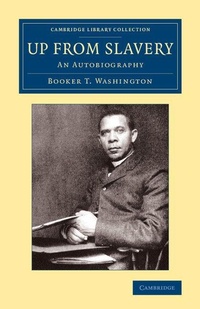
Up from Slavery
An Autobiography
Published on 4. December 2014
Book
Paperback/Softback
346 pages
978-1-108-07940-2 (ISBN)
Description
Born into slavery on a Virginia plantation, Booker T. Washington (1856-1915) educated himself tirelessly in the years after the American Civil War. In 1881, he was appointed head of the Tuskegee Institute, a teacher-training college for African Americans. As a writer, orator and fundraiser, he became one of the leading figures of the black community. Washington argued that the best way of bettering the social position of African Americans was through vocational education, which would make them indispensable and productive members of society. In this 1901 autobiography, he uses his life as an example to illustrate these principles, covering particularly the work of the Tuskegee Institute and his fundraising on behalf of black education. The book also contains the full text of his 1895 Atlanta Exposition speech, which created the model for Southern race relations until Washington's death and the emergence of more overtly assertive African-American civil rights leaders.
More details
Series
Language
English
Place of publication
Cambridge
United Kingdom
Target group
Professional and scholarly
Product notice
Paperback (trade)
Illustrations
1 Plates, black and white
Dimensions
Height: 216 mm
Width: 140 mm
Thickness: 20 mm
Weight
489 gr
ISBN-13
978-1-108-07940-2 (9781108079402)
Copyright in bibliographic data and cover images is held by Nielsen Book Services Limited or by the publishers or by their respective licensors: all rights reserved.
Schweitzer Classification
Person
Booker Taliaferro Washington (April 18, 1856 - November 14, 1915) was an American educator, author, orator, and adviser to multiple presidents of the United States. Between 1890 and 1915, Washington was the dominant leader in the African American community and of the contemporary black elite.[1] Washington was from the last generation of black American leaders born into slavery and became the leading voice of the former slaves and their descendants. They were newly oppressed in the South by disenfranchisement and the Jim Crow discriminatory laws enacted in the post-Reconstruction Southern states in the late 19th and early 20th centuries.
Washington was a key proponent of African-American businesses and one of the founders of the National Negro Business League. His base was the Tuskegee Institute, a historically black college in Tuskegee, Alabama. As lynchings in the South reached a peak in 1895, Washington gave a speech, known as the "Atlanta compromise", which brought him national fame. He called for black progress through education and entrepreneurship, rather than trying to challenge directly the Jim Crow segregation and the disenfranchisement of black voters in the South.
Washington mobilized a nationwide coalition of middle-class blacks, church leaders, and white philanthropists and politicians, with a long-term goal of building the community's economic strength and pride by a focus on self-help and schooling. With his own contributions to the black community, Washington was a supporter of Racial uplift. But, secretly, he also supported court challenges to segregation and restrictions on voter registration.[2]
Black activists in the North, led by W. E. B. Du Bois, at first supported the Atlanta compromise, but later disagreed and opted to set up the National Association for the Advancement of Colored People (NAACP) to work for political change. They tried with limited success to challenge Washington's political machine for leadership in the black community, but built wider networks among white allies in the North.[3] Decades after Washington's death in 1915, the civil rights movement of the 1950s took a more active and progressive approach, which was also based on new grassroots organizations based in the South, such as Congress of Racial Equality (CORE), the Student Nonviolent Coordinating Committee (SNCC) and Southern Christian Leadership Conference
Washington was a key proponent of African-American businesses and one of the founders of the National Negro Business League. His base was the Tuskegee Institute, a historically black college in Tuskegee, Alabama. As lynchings in the South reached a peak in 1895, Washington gave a speech, known as the "Atlanta compromise", which brought him national fame. He called for black progress through education and entrepreneurship, rather than trying to challenge directly the Jim Crow segregation and the disenfranchisement of black voters in the South.
Washington mobilized a nationwide coalition of middle-class blacks, church leaders, and white philanthropists and politicians, with a long-term goal of building the community's economic strength and pride by a focus on self-help and schooling. With his own contributions to the black community, Washington was a supporter of Racial uplift. But, secretly, he also supported court challenges to segregation and restrictions on voter registration.[2]
Black activists in the North, led by W. E. B. Du Bois, at first supported the Atlanta compromise, but later disagreed and opted to set up the National Association for the Advancement of Colored People (NAACP) to work for political change. They tried with limited success to challenge Washington's political machine for leadership in the black community, but built wider networks among white allies in the North.[3] Decades after Washington's death in 1915, the civil rights movement of the 1950s took a more active and progressive approach, which was also based on new grassroots organizations based in the South, such as Congress of Racial Equality (CORE), the Student Nonviolent Coordinating Committee (SNCC) and Southern Christian Leadership Conference
Content
Preface; 1. A slave among slaves; 2. Boyhood days; 3. The struggle for an education; 4. Helping others; 5. The reconstruction; 6. Black race and red race; 7. Early days at Tuskegee; 8. Teaching school in a stable and a hen-house; 9. Anxious days and sleepless nights; 10. A harder task than making bricks without straw; 11. Making their beds before they could lie on them; 12. Raising money; 13. Two thousand miles for a five minute speech; 14. The Atlanta Exposition address; 15. The secret of success in public speaking; 16. Europe; 17. Last words; Index.