

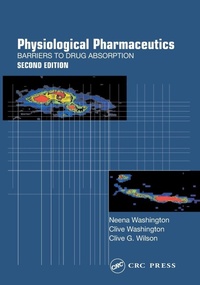
Physiological Pharmaceutics
Barriers to Drug Absorption
1st Edition
Published on 21. December 2000
Book
Paperback/Softback
328 pages
978-0-7484-0610-4 (ISBN)
Description
In recent years, the emphasis in drug development has been the design of new delivery systems rather than new drugs. It is the aim of innovative pharmaceutical scientists to design the new dosage forms to overcome the body's barrier mechanisms which have specifically evolved to exclude foreign material.
This book provides an integrated approach to the study of drug formulation in the body with the emphasis on the formulation variables rather than the drugs. The link between physiology and pharmaceutics is presented to give an essential background of biological principles for the pharmacy student, pharmaceutical formulator and healthcare professional. Complex mathematical aspects of physical chemistry have been avoided to facilitate understanding, enabling the reader to concentrate on how the biological environment affects the performance of the drugs and dosage forms. As the majority of drugs are administered via the oral route a large proportion of the book is devoted to the gastrointestinal tract and the variation in the capacity for drug absorption which occurs along its length. Transdermal, ocular, pulmonary and nasal drug delivery are discussed in detail. New chapters in the book include 'Vaginal drug delivery', the 'Blood brain barrier' and 'Parenteral drug delivery'.
This book provides an integrated approach to the study of drug formulation in the body with the emphasis on the formulation variables rather than the drugs. The link between physiology and pharmaceutics is presented to give an essential background of biological principles for the pharmacy student, pharmaceutical formulator and healthcare professional. Complex mathematical aspects of physical chemistry have been avoided to facilitate understanding, enabling the reader to concentrate on how the biological environment affects the performance of the drugs and dosage forms. As the majority of drugs are administered via the oral route a large proportion of the book is devoted to the gastrointestinal tract and the variation in the capacity for drug absorption which occurs along its length. Transdermal, ocular, pulmonary and nasal drug delivery are discussed in detail. New chapters in the book include 'Vaginal drug delivery', the 'Blood brain barrier' and 'Parenteral drug delivery'.
Reviews / Votes
'Provides essential information...There is no equivalent source work.' '...a worthwhile and valuable contribution to this area.'More details
Edition
2nd edition
Language
English
Place of publication
London
United Kingdom
Target group
College/higher education
Professional and scholarly
Edition type
New edition
Dimensions
Height: 254 mm
Width: 178 mm
Thickness: 18 mm
Weight
623 gr
ISBN-13
978-0-7484-0610-4 (9780748406104)
Copyright in bibliographic data and cover images is held by Nielsen Book Services Limited or by the publishers or by their respective licensors: all rights reserved.
Schweitzer Classification
Other editions
Additional editions
Neena Washington | Clive Washington | Clive Wilson
Physiological Pharmaceutics
Barriers to Drug Absorption
E-Book
12/2000
1st Edition
CRC Press
€100.99
Available for download
Neena Washington | Clive Washington | Clive Wilson
Physiological Pharmaceutics
Barriers to Drug Absorption
E-Book
12/2000
1st Edition
CRC Press
€100.99
Available for download
Neena Washington | Clive Washington | Clive Wilson
Physiological Pharmaceutics
Barriers to Drug Absorption
Book
12/2000
1st Edition
Taylor & Francis
€165.60
Shipment within 15-20 days
Persons
Neena Washington, Clive Washington and Clive G. Wilson
Content
1. Cell Membranes, Epithelial Barriers and Drug Absorption 2. Parenteral Drug Delivery 3. Drug Delivery to the Oral Cavity or Mouth 4. Oesophageal Transit 5. The Stomach 6. Drug Absorption from the Small Intestine 7. Drug Delivery to the Large Intestine and Rectum 8. Transdermal Drug Delivery 9. Nasal Drug Delivery 10. Pulmonary Drug Delivery 11. Ocular Drug Delivery 12. Vaginal and Intrauterine Drug Delivery.