


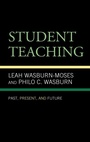
Student Teaching
Past, Present, and Future
Published on 17. November 2020
Book
Hardback
120 pages
978-1-7936-0232-9 (ISBN)
Description
Student teaching is considered to be the single most powerful learning experience in teacher preparation. Although much has been made of its importance, surprisingly little research has been conducted specifically on student teaching, which some claim has remained unchanged for a century. Because student teaching is nearly universal in a field with wide-ranging practices even within a single institution of higher education, the possibility of modification in student teaching to lead reform in teacher preparation is quite strong. The authors present a history of student teaching, theory, practice, and policy; review the research literature, past and present; and present practical guidelines for reform that align with evidence.
Reviews / Votes
This book makes a highly significant contribution to the field of clinical experiences, student teaching, and teacher education. Since Johnson (1968) there has not been a book that has analysed student teaching with this level of detail and analysis. In particular, the insights in the latter half of the book capture many of the recent trends in field experiences and student teaching. -- Alexander Cuenca, Indiana University This is a needed and timely volume for teacher education in the 21st century. As Wasburn-Moses and Wasburn contend, "one of the least explored but most promising opportunities in teacher preparation is the transition from student teaching to the first year of teaching" (p. 99). They seek to address this lacuna by exploring student teaching from its historical origins through the evolution of professional teaching over 10 chapters, supported by references and an index that is practical and educational. Student teaching is contextualized in relation to teacher preparation, past practices, and innovation in clinical placement, areas that are essential for change in both K-12 and higher education. The authors outline four principles for educational partners to strengthen student teaching: common philosophy, research-grounded matchmaking, triad role clarity, and mutual professional development. They caution readers to be careful in their approach to change and to select only the principle they believe their institutions and partners are ready to consider and implement. In closing, this is a text that will help practitioners in both K-12 and higher education settings, and students' plans for the future in teacher-education programs. Recommended. * Choice Reviews *More details
Language
English
Place of publication
United States
Publishing group
Bloomsbury Publishing Plc
Target group
Professional and scholarly
Dimensions
Height: 235 mm
Width: 157 mm
Thickness: 11 mm
Weight
336 gr
ISBN-13
978-1-7936-0232-9 (9781793602329)
Copyright in bibliographic data and cover images is held by Nielsen Book Services Limited or by the publishers or by their respective licensors: all rights reserved.
Schweitzer Classification
Other editions
Additional editions
E-Book
11/2020
1st Edition
Lexington Books
€35.49
Available for download
Persons
Leah Wasburn-Moses is professor of educational psychology at Miami University.
Philo C. Wasburn was professor emeritus of sociology at Purdue University.
Philo C. Wasburn was professor emeritus of sociology at Purdue University.
Content
Chapter 1: Origins of Student Teaching
Chapter 2: Evolution of Student Teaching
Chapter 3: Student Teaching in the Post-Sputnik Era
Chapter 4: Current Context in Teacher Preparation
Chapter 5: Current Context in Student Teaching
Chapter 6: Comparison to Past Practice
Chapter 7: Innovation in Clinical Placement
Chapter 8: Principles for Practice
Chapter 9: First Steps
Chapter 10: Planning for Innovation
Chapter 2: Evolution of Student Teaching
Chapter 3: Student Teaching in the Post-Sputnik Era
Chapter 4: Current Context in Teacher Preparation
Chapter 5: Current Context in Student Teaching
Chapter 6: Comparison to Past Practice
Chapter 7: Innovation in Clinical Placement
Chapter 8: Principles for Practice
Chapter 9: First Steps
Chapter 10: Planning for Innovation